
Checking catalyst
- Make
- SEAT
- Model
- Alhambra
- Year
- 1996–2010
- Section
- 5-cyl. injection engine, (4-valve), Mechanics · AZX › Checking catalyst
Checking catalyst
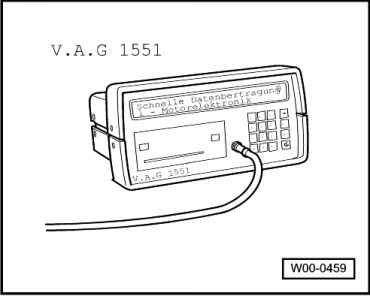
V.A.G 1551 Fault reader
The vehicle system tester V.A.G 1552 can be used instead of the fault reader V.A.G 1551, however a print-out is not possible.
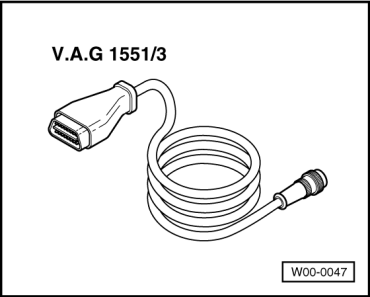
V.A.G 1551/3 Cable
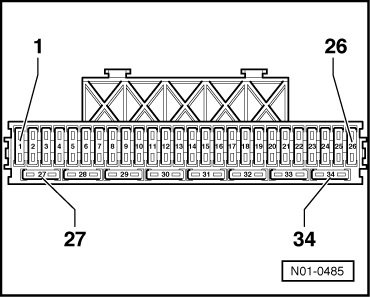
→ The fuses must be OK.
The battery voltage must be at least 11.5 V.
Exhaust system between catalyst and cylinder head must be free of leaks
No faults must be stored in fault memory
=> Repair group 01; Fault memory; Interrogating and erasing fault memory of engine control unit 5-cyl. injection engine, (4-valve), Mechanics Fault memory Interrogating and erasing fault memory of engine control unit
Coolant temperature must be at least 80 °C, =>display group 01, display zone 2.
Catalyst temperature must be at least 350 °C, =>Display group 205, display zone 2
Connect fault reader V.A.G 1551 (V.A.G 1552). Start engine and select the engine control unit with the "Address word" 01. Connecting fault reader and selecting engine control unit:
=> Repair group 01; Self-diagnosis general: Connecting fault reader V.A.G 1551 and selecting engine electronics control unit.5-cyl. injection engine, (4-valve), Mechanics Self-diagnosis general: Connecting fault reader V.A.G 1551 and selecting engine electronics control unit.
Rapid data transfer HELP
Select function XXX→ Indicated on display:
Press keys 0 and 4 for the function "Introduction of basic setting" and confirm entry with Q key.
Basic setting
Input display group number XXX→ Indicated on display:
During some tests it may happen that a subsequent test has already been performed successfully in the background. In this case, continue with the next test.
Press keys 2, 0 and 5 for "Display group number 205" and confirm entry with Q key.
Read measured value block 205 ⇒
1 2 3 4 → Indicated on display:
(1...4 = Display zones)
Only continue with the test when
Catalyst temperature exceeds 350 °C
-display zone 2-Depress brake pedal and hold.
Press accelerator pedal to wide-open position.
The engine speed is increased by the control unit to
approx. 2 300 rpm.Allow engine to run at increased speed until
Specification: x x x x x 1 0 0
appears in display zone 4.
If the display does not indicate as described:
Press ⇒key.
Interrogate fault memory:
=> Repair group 01; Fault memory; Interrogating and erasing fault memory of engine control unit 5-cyl. injection engine, (4-valve), Mechanics Fault memory Interrogating and erasing fault memory of engine control unit
Read out the readiness code:
=> Repair group 01; Readiness code; Reading out readiness code 5-cyl. injection engine, (4-valve), Mechanics Readiness code Reading out readiness code
If the fault memory has been erased or the engine control unit separated from the permanent positive, the readiness code must be generated again.
=> Repair group 01; Readiness code; Generating readiness code 5-cyl. injection engine, (4-valve), Mechanics Readiness code Generating readiness code
If the display indicates as described:
Check Lambda probe ageing before catalyst (probe dynamics) => Page 26-13.
Change to display group 212 as follows:
Press C key.
Basic setting
Input display group number XXX→ Indicated on display:
Press keys 2, 1 and 2 for "Display group number 212" and confirm entry with Q key.
Read measured value block 212 ⇒
1 2 3 4 → Indicated on display:
(1...4 = Display zones)
Depress brake pedal and hold.
Press accelerator pedal to wide-open position.
The engine speed is increased by the control unit to
approx. 2 300 rpm.Allow engine to run at increased speed until
Specification: x x x x x 1 0 0
appears in display zone 4 after about 80 seconds.
If the display does not indicate as described:
Press ⇒key.
Interrogate fault memory:
=> Repair group 01; Fault memory; Interrogating and erasing fault memory of engine control unit 5-cyl. injection engine, (4-valve), Mechanics Fault memory Interrogating and erasing fault memory of engine control unit
Read out the readiness code:
=> Repair group 01; Readiness code; Reading out readiness code 5-cyl. injection engine, (4-valve), Mechanics Readiness code Reading out readiness code
If the fault memory has been erased or the engine control unit separated from the permanent positive, the readiness code must be generated again.
=> Repair group 01; Readiness code; Generating readiness code 5-cyl. injection engine, (4-valve), Mechanics Readiness code Generating readiness code
If the display indicates as described:
Check fuel supply system at partial load => Page 26-14.
Change to display group 216 as follows:
Press C key.
Basic setting
Input display group number XXX→ Indicated on display:
Press keys 2, 1 and 6 for the "Display group number 216" and confirm entry with Q key.
Read measured value block 216 ⇒
1 2 3 4 → Indicated on display:
(1...4 = Display zones)
Depress brake pedal and hold.
Press accelerator pedal to wide-open position.
The engine speed is increased by the control unit to
approx. 2 300 rpm.Allow engine to run at increased speed until
Specification: x x x x x 1 0 0
appears in display zone 4 after about 75 seconds.
If the display does not indicate as described:
Press ⇒key.
Interrogate fault memory:
=> Repair group 01; Fault memory; Interrogating and erasing fault memory of engine control unit 5-cyl. injection engine, (4-valve), Mechanics Fault memory Interrogating and erasing fault memory of engine control unit
Read out the readiness code:
=> Repair group 01; Readiness code; Reading out readiness code 5-cyl. injection engine, (4-valve), Mechanics Readiness code Reading out readiness code
If the fault memory has been erased or the engine control unit separated from the permanent positive, the readiness code must be generated again.
=> Repair group 01; Readiness code; Generating readiness code 5-cyl. injection engine, (4-valve), Mechanics Readiness code Generating readiness code
If the display indicates as described:
Check Lambda probe heating after catalyst => Page 26-16.
Change to display group 220 as follows:
Press C key.
Basic setting
Input display group number XXX→ Indicated on display:
Press keys 2, 2 and 0 for "Display group number 220" and confirm entry with Q key.
Read measured value block 220 ⇒
1 2 3 4 → Indicated on display:
(1...4 = Display zones)
Depress brake pedal and hold.
Depress accelerator pedal to wide-open position
The engine speed is increased by the control unit to
approx. 2 300 rpm.Allow engine to run at increased speed until
Specification: x x x x x 1 0 0
appears in display zone 4.
If the display does not indicate as described:
Press ⇒key.
Interrogate fault memory:
=> Repair group 01; Fault memory; Interrogating and erasing fault memory of engine control unit 5-cyl. injection engine, (4-valve), Mechanics Fault memory Interrogating and erasing fault memory of engine control unit
Read out the readiness code:
=> Repair group 01; Readiness code; Reading out readiness code 5-cyl. injection engine, (4-valve), Mechanics Readiness code Reading out readiness code
If the fault memory has been erased or the engine control unit separated from the permanent positive, the readiness code must be generated again.
=> Repair group 01; Readiness code; Generating readiness code 5-cyl. injection engine, (4-valve), Mechanics Readiness code Generating readiness code
If the display indicates as described:
Check Lambda probe after catalyst
=> Page 26-17.
Change to display group 222 as follows:
Press C key.
Basic setting
Input display group number XXX→ Indicated on display:
Press keys 2, 2 and 2 for "Display group number 222" and confirm entry with Q key.
Read measured value block 222 ⇒
1 2 3 4 → Indicated on display:
(1...4 = Display zones)
Depress brake pedal and hold.
Depress accelerator pedal to wide-open position
The engine speed is increased by the control unit to
approx. 2 300 rpm.Allow engine to run at increased speed until
Specification: x x x x x 1 0 0
appears in display zone 4 after about 30 seconds.
If the display does not indicate as described:
Press ⇒key.
Interrogate fault memory:
=> Repair group 01; Fault memory; Interrogating and erasing fault memory of engine control unit 5-cyl. injection engine, (4-valve), Mechanics Fault memory Interrogating and erasing fault memory of engine control unit
Read out the readiness code:
=> Repair group 01; Readiness code; Reading out readiness code 5-cyl. injection engine, (4-valve), Mechanics Readiness code Reading out readiness code
If the fault memory has been erased or the engine control unit separated from the permanent positive, the readiness code must be generated again.
=> Repair group 01; Readiness code; Generating readiness code 5-cyl. injection engine, (4-valve), Mechanics Readiness code Generating readiness code
If the display indicates as described:
Check Lambda probe ageing after catalyst (probe dynamics) => Page 26-19.
Change to display group 225 as follows:
Press C key.
Basic setting
Input display group number XXX→ Indicated on display:
Press keys 2, 2 and 5 for "Display group number 225" and confirm entry with Q key.
Read measured value block 225 ⇒
1 2 3 4 → Indicated on display:
(1...4 = Display zones)
Depress brake pedal and hold.
Depress accelerator pedal to wide-open position
The engine speed is increased by the control unit to
approx. 2 300 rpm.Allow engine to run at increased speed until
Specification: x x x x x 1 0 0
appears in display zone 4 after about 15 seconds.
If the display does not indicate as described:
Press ⇒key.
Interrogate fault memory:
=> Repair group 01; Fault memory; Interrogating and erasing fault memory of engine control unit 5-cyl. injection engine, (4-valve), Mechanics Fault memory Interrogating and erasing fault memory of engine control unit
Read out the readiness code:
=> Repair group 01; Readiness code; Reading out readiness code 5-cyl. injection engine, (4-valve), Mechanics Readiness code Reading out readiness code
If the fault memory has been erased or the engine control unit separated from the permanent positive, the readiness code must be generated again.
=> Repair group 01; Readiness code; Generating readiness code 5-cyl. injection engine, (4-valve), Mechanics Readiness code Generating readiness code
If the display indicates as described:
Check catalyst => Page 26-20.
Change to display group 227 as follows:
Press C key.
Basic setting
Input display group number XXX→ Indicated on display:
Press keys 2, 2 and 7 for "Display group number 227" and confirm entry with Q key.
System in basic setting 227 ⇒
1 2 3 4 → Indicated on display:
(1...4 = Display zones)
Depress brake pedal and hold.
Depress accelerator pedal to wide-open position
The engine speed is increased by the control unit to
approx. 2 300 rpm.Allow engine to run at increased speed until
Specification: x x x x x 1 0 0
appears in display zone 4 after about 60 seconds.Press ⇒key.
Press keys 0 and 6 for the function "End output" and confirm entry with the Q key.
Switch off ignition.
If the display does not change as described:
Renew catalyst
=> Page 26-4, item 11.
Parts & tools for this job For 1996 SEAT Alhambra
- PARTEngine gasket setSearch: SEAT Alhambra 1996 engine gasket set
- TOOLTorque wrenchSearch: 3/8 inch torque wrench
- TOOLFeeler gauge setSearch: feeler gauge set
As an Amazon Associate we earn from qualifying purchases.