
Checking seat belts
- Make
- SEAT
- Model
- Ibiza / Córdoba / Vario
- Year
- 6K, 1993–2002
- Section
- Bodywork, Interior fitting work › Checking seat belts
Checking seat belts
Warning
After an accident of any type, the safety belt system should be systematically checked. If any damage is observed during the checkpoints, the customer should be advised of the need to change the safety belts.
- Check belt webbing
- Check inertia reel device (locking effect)
- Visual check of belt buckle
- Visual check of belt buckle operation
- Check pillar loops and tongue connector
- Check components and anchorage points
- Check inertia reel device of lap belt
Note
- If the customer refuses to change the damaged safety belts, the customer's decision should be noted.
Completely remove the belt webbing from the inertia reel or the adjustment tongue from the lap belt.
Check the belt webbing for dirt; if necessary clean with a weak soapy solution, see also the Operating Instructions
If any of the damage described below (1 and 2) is observed in a vehicle which has been involved in an accident, replace the complete safety belt with the belt buckle
If any of the damage described below (1,2 and 3) is observed in a vehicle which has not been involved in an accident, it is sufficient to replace the worn safety belt
1- Belt fabric with cuts, tears, ripped or ragged
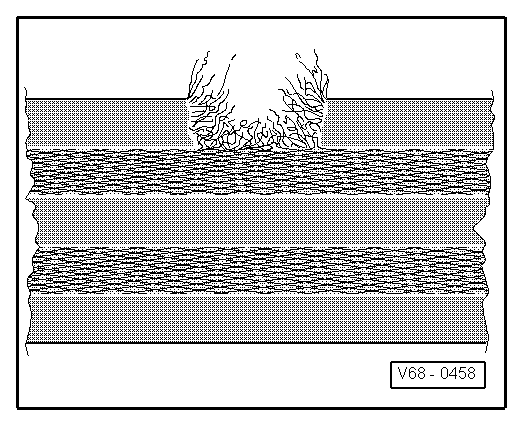
2- Edge fibres broken
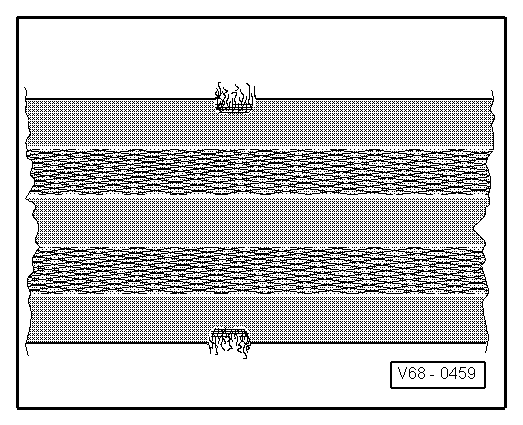
3- Cigarette burn marks or similar
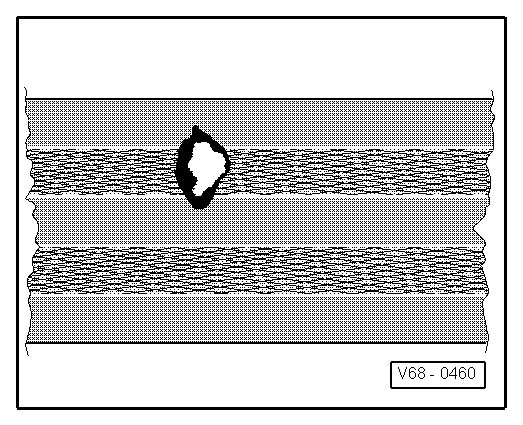
The automatic belt device has two locking functions
The first locking function takes place when the belt is pulled sharply from the inertia reel device (acceleration of belt extraction)
Pull belt webbing hard out of the inertia reel device.
If it does not block, replace the complete safety belt with the buckle
If the belt has problems on extraction or retraction, then check whether the position of the inertia reel has been altered.
The second blocking function takes place when the development of the vehicle movement is modified (blocking function dependent on vehicle)
Fasten seat belts
Accelerate vehicle to 20 km/h and then brake sharply with foot brake.
If the belt does not block during braking, the complete belt including the buckle must be replaced
Warning
For safety reasons, the test should be carried out in a traffic-free area to avoid endangering other users of the road.
Check the belt buckle for cracks and wear
In the event of damage, replace the complete safety belt with the buckle
Checking seat belt buckle:
Insert the tongue connector in the buckle until it is heard to click into place. Pull hard on the belt to check that the locking mechanism is engaged.
If in a minimum of 5 tests, the tongue connector comes out once or more, the complete safety belt and buckle should be replaced
Check the unlocking:
Release the safety belt by pressing the buckle button with the finger.
When the webbing is slack, the tongue connector should come out of the buckle.
Repeat the test at least 5 times. If in a minimum of 5 tests, the tongue connector does not come out once or more, the complete safety belt and buckle should be replaced
Warning
Never use lubricants to remove noise or stiffness in the buckle buttons of the belts.
The support fittings covered in plastic have slight parallel grooves after the belts have been subjected to load (accident with the belt fastened), while only flat wear without lines can be seen as a result of wear from frequent use
Check for dents, cracks or damage to the plastic.
In the event of grooves and/or damage, replace the complete safety belt with the buckle
- Misshapen tongue connector (stretched)
- Height control does not work
- Anchorage points (seats, struts, vehicle floor) damaged or damaged threads
If the parts are observed to be damaged, replace the complete safety belt with the buckle
Replace the anchorage points.
Note
- In the case of damage not produced by an accident, e.g. wear, only the corresponding piece need be replaced.
Parts & tools for this job For 1993 SEAT Ibiza
- TOOLOBD2 scanner with SRSSearch: OBD2 scanner ABS SRS
- TOOLTrim removal tool kitSearch: trim removal tool kit
As an Amazon Associate we earn from qualifying purchases.