
Filling
- Make
- SEAT
- Model
- Inca
- Year
- 1995–2003
- Section
- 4 cyl. diesel engine (1,9 ltr.), Mechanics · 1Y › Filling
Engine coolingFilling
Filling
Note!
- VW 774 F. Identification: purple colour.
- VW 774 F standard) can be mixed with the additive G 12 which was being used before.
- If the fluid in expansion tank is brown, G 12 has been mixed with other anti-freeze additives. In this case the coolant must be changed.
- VW 774 F” avoid damage due to corrosion, freezing or lime sedimentation. They also increase the boiling temperature of the liquid coolant. For this reason the system must be filled all year round with anti-freeze and corrosion protection additives.
- Because of its high boiling point, the coolant improves engine reliability under heavy workloads, particularly in countries with tropical climates.
- The anti-freeze protection should be guaranteed to approx. -25 °C (for countries with an artic climate approx -35 °C).
- Coolant concentration must not be reduced by adding water, even in warmer seasons or in warmer countries. The percentage of antifreeze should be about 40 %.
- If, for climatic reasons, a better antifreeze protection is required, the percentage of G 12 can be increased but only up to 60 % (antifreeze protection up to -40 °C). With a greater concentration engine cooling and anti-freeze properties are diminished.
- If radiator, heat exchanger, cylinder head or cylinder head gasket has been replaced, do not reuse old coolant.
| Frost protection to | Anti-freeze amount. | G 12 Note “Cooling liquid: evacuation and charging” | Water Note “Cooling liquid: evacuation and charging” |
|---|---|---|---|
| -25 °C -35 °C | 40 % 50 % | 2.6 litre 3.25 litre | 3.9 litre 3.25 litre |
Note
Slowly fill the cooling system with cooling liquid up until the Max. mark on the expansion tank.
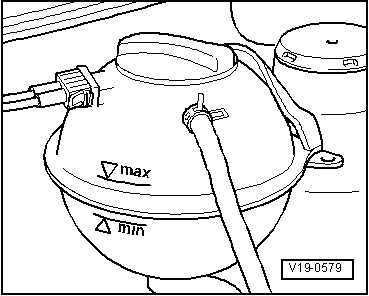
Start the engine and run it for about 2 minutes at 1500 RPM and fill with cooling liquid until the overflow hole in the expansion tank.
Close the tank and run the engine until the ventilator starts.
Check the coolant level and, if necessary add more liquid when the pressure has reduced.
With the engine hot, the level of liquid should be at the Max. mark and when the engine is cool the level should be between the Min. and Max. levels.
Parts & tools for this job For 1995 SEAT Inca
- PARTGlow plugsSearch: SEAT Inca 1995 glow plugs
- TOOLGlow plug socketSearch: glow plug socket
- TOOLDiesel compression testerSearch: diesel compression tester
As an Amazon Associate we earn from qualifying purchases.