
Filling
- Make
- SEAT
- Model
- Toledo
- Year
- 5P, 2004–2009
- Section
- 4 cylinder Injection engine (Autogas) · CHGA › Filling
Filling
Note
- The water used for the mixture has a significant influence on the affectivity of the cooling agent. With respect to the contents that may vary from country to country, or even region to region, Volkswagen has made the decision to define the quality of the water that is used for the cooling system. Purified water fulfils all requirements. For this reason, we recommend that purified water is used for mixing the cooling agent when filling the cooling system or when topping up with cooling agent. This also applies for older models. Purified water has to be used for newer models (construction year 2010 ►).
Warning
Purified water may only be used for mixing G12 plus-plus. An optimum protection against corrosion is achieved when using purified water.
Note
- Only use coolant additive G 12 plusplus in accordance with TL VW 774 G
- You may only use distilled water for the mixture.
- prevent prevent the formation of lime sediment as well as damage caused by frost and corrosion. These also raise the boiling temperature. For this reason, the cooling system must be filled with coolant additive all year round.
- Thanks to this rise in the boiling point, the coolant guarantees good running, even when the engine undergoes heavy strain, especially in countries with tropical climates.
- The antifreeze protection must be guaranteed to approx. - 25 ºC (down to approx. -35 ℃ in countries with arctic climate).
- The concentration of the coolant must not be reduced by adding water in summer or in countries with hot climates. The amount of anti-freeze in the coolant must be at least 40 %.
- If the climate requires a stronger anti-freeze, the anti-freeze agent can be increased, but only up to 60% (anti-freeze protection down to approx. -40ºC). If the proportion is greater, the cooling and anti-freeze protection capacity is reduced.
- T10007 is recommended for determining the current anti-freeze density.
- If radiator, heat exchanger, cylinder head or cylinder head gasket has been replaced, do not reuse old coolant.
Recommended mixture ratios:
| Anti-freeze protection up to | Anti-freeze proportion | G 12 plus 1) G 12 plus-plus 1) | Water 1) |
|---|---|---|---|
| -25 ℃ -35 ℃ | 40 % 50 % | 3.2 l 4.0 l | 4.8 l 4.0 l |
1) The quantity of coolant can vary depending upon the vehicle specifications.
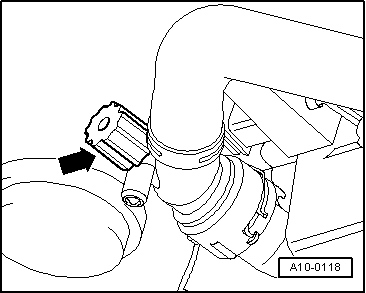
Close drain screw (arrow).
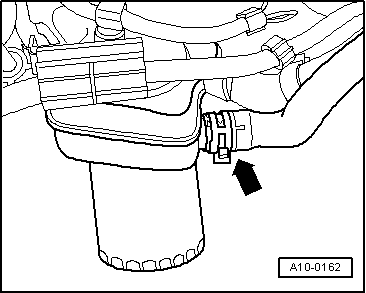
Connect coolant hose to the oil cooler (arrow).
Fit the soundproofing elements Bodywork, front part, soundproofing
Screw adapter for cooling system tester V.A.G 1274/8 onto expansion tank.
Fill the coolant circuit using the equipment VAS 6096 Instruction manual for cooling system filling equipment VAS 6096.
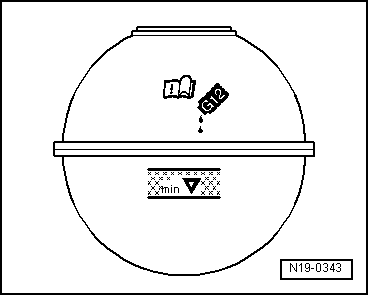
Slowly fill coolant to upper marking of shaded field on expansion tank.
Close expansion tank.
Start the engine and keep the engine speed at approx. 2000 / min for approx. 3 minutes.
Allow engine to run until fan starts up.
Warning
Steam may be released when opening the expansion tank. Wear safety goggles and appropriate clothing to avoid injury to eyes and burns. Cover the cap with a cloth and open carefully.
Check coolant level and top up any missing coolant, if necessary. At normal operating temperature, the coolant level must be at the top mark, and when the engine is cold, it must be in the middle of the hatched area.
Parts & tools for this job For 2004 SEAT Toledo
- PARTEngine gasket setSearch: SEAT Toledo 2004 engine gasket set
- TOOLTorque wrenchSearch: 3/8 inch torque wrench
- TOOLFeeler gauge setSearch: feeler gauge set
As an Amazon Associate we earn from qualifying purchases.