EngineRepairing Valve Gear
| Special tools and workshop equipment required |
| t
| Valve seat machining device (NAC milling cutter) |

Note | t
| When carrying out repairs on engines with leaking valves, it is not sufficient to machine or replace the valve seats and valves. It is also necessary to inspect the valve guides for wear, particularly on engines with a high mileage. |
| t
| Rework valve seats only sufficiently in order to obtain a proper contact pattern. Calculate the maximum permissible reworking dimension before commencing. If the reworking dimension is exceeded, proper operation of the hydraulic valve clearance compensation is no longer assured and the cylinder head should be replaced. |
| The maximum permissible reworking dimension can be calculated as follows: |
| –
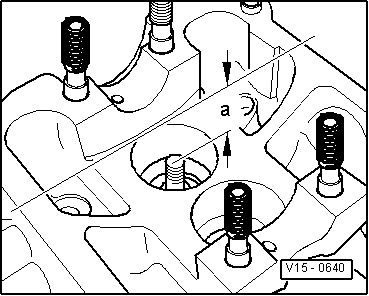
| Insert valve and press firmly against the valve seat. |
Note | If the valve is replaced when carrying out repair work, use a new valve for the measurement. |
|
|
|
| –
| Measure distance -a- between the end of the valve stem and the upper face of the cylinder head. |
| –
| Calculate max. permissible reworking dimension from the distance -a- measured and the minimum dimension. |
| Minimum dimension: Inlet valve 33.8 mm; Outlet valve 34.1 mm |
| Distance measured -a- minus minimum dimension = max. permissible reworking dimension. |
|
|
|
| | Distance measured -a- | 35,1 | mm |
| - | Minimum dimension | 34,1 | mm |
| = | max. permissible reworking dimension → Note | 1,0 | mm |
| 1)
| The max. permissible reworking dimension is shown in the figures for reworking the valve seats as dimension “b”. |
|
|
|
01 Engine