
Checking seat belts
- Make
- Volkswagen
- Model
- Caddy Mk3
- Year
- 2004–2015
- Section
- Safety information › Checking seat belts
Checking seat belts
Warning The seat belt system must be inspected systematically after every accident! If damage is determined at any of the points to be checked, customer must be informed regarding necessity of changing belts.
- Check belt webbing
- Check inertia reel (locking mechanism)
- Visually check belt buckle
- Check operation of belt buckle
- Check belt guide fittings and latch plate
- Check securing elements and anchorage points
Pull belt completely out of inertia reel or lap belt adjustment plate.
Check belt webbing for soiling, and if necessary wash with a mild soapy solution Owner's Manual.
If either of the following illustrated damage examples (1 and 2) are found on accident vehicle - renew seat belt complete with belt buckle and belt height adjustment.If damage as illustrated under points 1, 2, 3 and/or 4 is determined on a vehicle which has not been involved in an accident, it is sufficient to renew damaged belt only.Belt webbing cut, torn or chafed.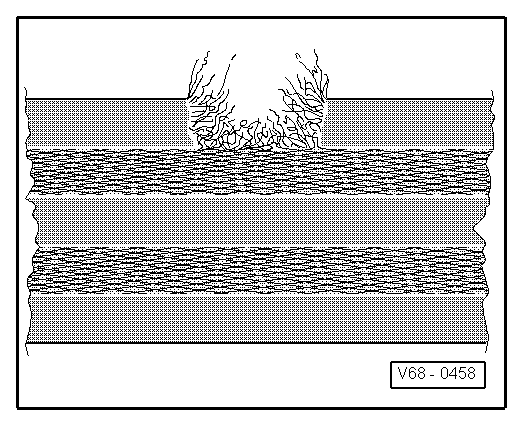
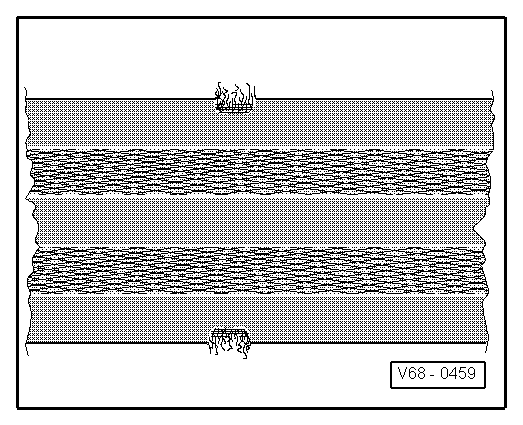
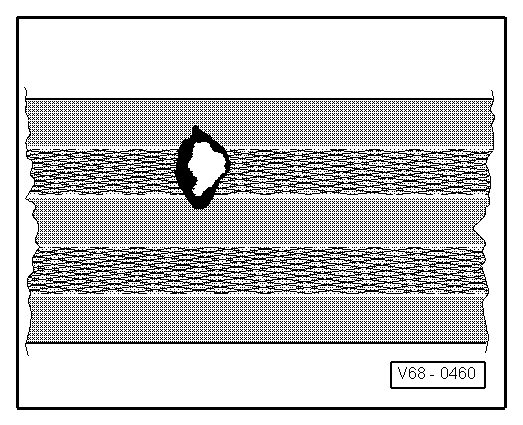
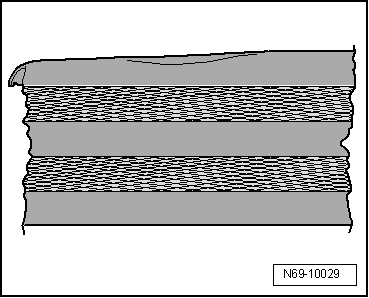
The inertia reel has two locking functions.
- The first locking function is triggered by the belt being jerked out of the belt inertia reel (belt extraction acceleration).
Pull belt out of inertia reel with firm jerk.
Will not lock - renew seat belt complete with buckle.If difficulties are experienced when belt is extended or retracted, first check whether position of inertia reel has been altered.The second locking function is triggered by a change in vehicle speed (vehicle-dependent locking function). Vehicle must be moved over a flat level surface for this.Put on seat belt.
Accelerate vehicle to 20 km/h and then carry out emergency braking with foot brake.
If seat belt is not locked by locking mechanism during braking procedure, renew seat belt complete with buckle.Warning For safety reasons, the road test should be carried out on a traffic-free stretch to ensure that other road users are not endangered.
Inspect belt buckle for cracks and chips.
If damaged, seat belt and belt buckle must be renewed.Checking belt buckle:
Push latch plate into belt buckle until it engages audibly. Check whether locking mechanism is properly engaged by pulling firmly on belt webbing.
If latch plate fails even once to engage properly in belt buckle during at least 5 tests, renew seat belt and belt buckle.Checking release mechanism:
Release seat belt by pressing button on belt buckle with finger pressure.
When belt is slack, latch plate must spring out of belt buckle on its own.
Carry out test at least 5 times. If latch plate fails even once to spring out of buckle, renew seat belt complete with belt buckle.Warning Under no circumstances whatsoever may lubricant be used to eliminate noise or stiffness in belt buckle buttons.
Plastic-coated fittings show fine, parallel scoring after stress on belt system (when belt was fastened during accident). (On the other hand, wear caused by frequent belt use can be recognized by smooth wear, free of lines).
Inspect for deformation, fracturing and cracks in plastic.
If scoring and/or damage is determined, renew seat belt complete with belt latch.- Latch plate deformed (stretched)
- Height adjustment does not function
- Anchorage points (seat, pillars, underbody) distorted or thread damaged
Note
- In case of damage resulting not from an accident, but for example, from wear, only the part which is actually damaged need be renewed.
Parts & tools for this job For 2004 Volkswagen Caddy
- TOOLOBD2 scanner with SRSSearch: OBD2 scanner ABS SRS
- TOOLTrim removal tool kitSearch: trim removal tool kit
As an Amazon Associate we earn from qualifying purchases.