
Checking fuel delivery rate
- Make
- Volkswagen
- Model
- CC Passat CC and CC
- Year
- 2008–2016
- Section
- Fuel pump › Checking fuel delivery rate
Checking fuel delivery rate
Note
- When driving characteristic problems occur when the fuel tank is a approx. 1/4 filled, then check fuel delivery rates with approx. 1/4 filled tank or less.
- When fitting the push-fit connectors, they must »audibly« click into place.
- Take note of colour assignment when connecting push-fit connectors Anchor.
- Ensure push-fit connector is secured properly by pulling it.
- Separating push-fit connectors → Chapter.
Remove bench seat General body repairs, interiorRep. gr.72Rear seat; Removing and installing bench seat / individual seats.
Guide carpet out and fold upwards, if fitted.
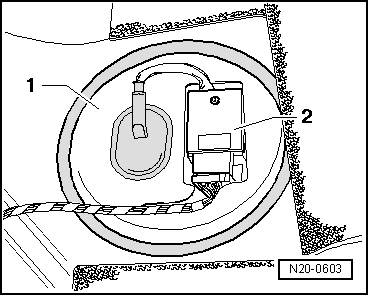
Remove right cover with fuel pump control unit J538(2) from assembly opening above fuel delivery unit.
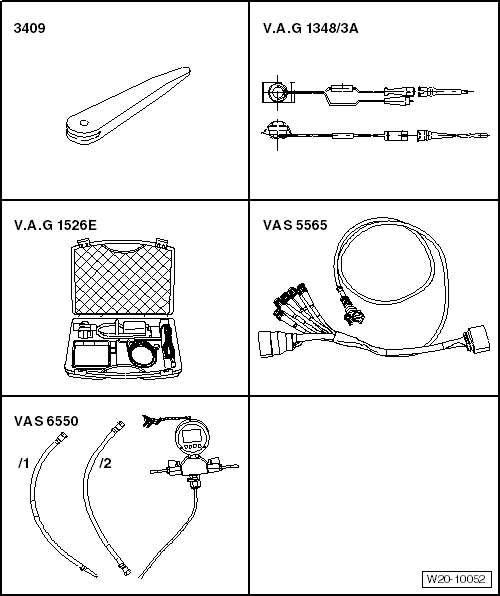
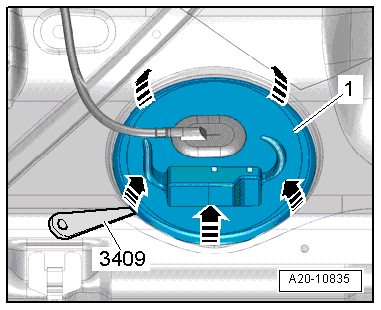
To do this, unclip right cover (1) at retaining tabs (arrows), using removal wedge 3409.
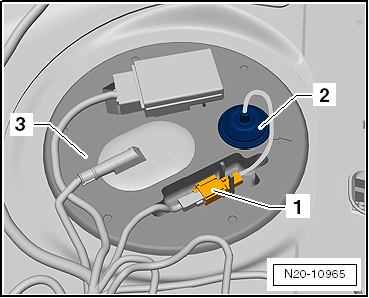
Remove connection (1) from cover (3).
Release connector (1) and pull off.
Unclip sealing grommet (2) downwards out of cover (3) and guide wiring harness out downwards.
Release and pull fuel delivery line (2) from flange (1). Separating push-fit connectors → Chapter.
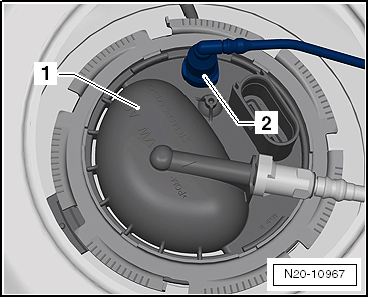
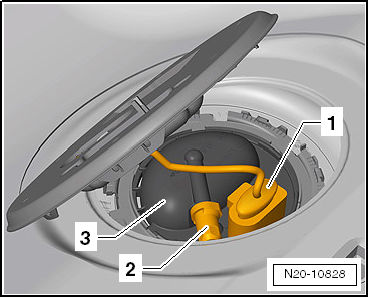
Pull connector (1) off flange (3).
Check contacts on plug and on fuel delivery unit for damage.
Connect test instrument adapter/DSO (5-pin) VAS 5565 to connector and fuel delivery unit.
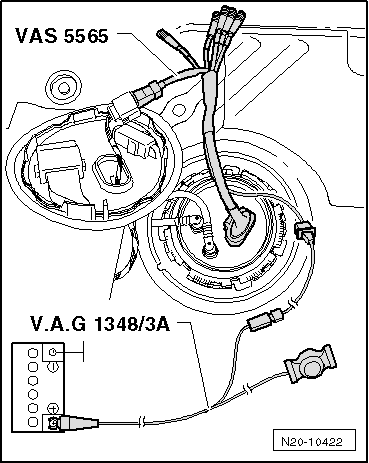
Connect remote control V.A.G 1348/3A to adapter VAS 5565 and to battery positive terminal in engine compartment.
Note
- This step serves only to have the fuel pump running when the engine is stopped.
Warning The fuel line is under pressure.
Risk of injury to eyes and skin from fuel.
Wear eye protection and protective clothing to avoid eye injuries and skin contact. Before loosening hose connections, wrap a cloth around the connection. Then release pressure by carefully opening the connection point.
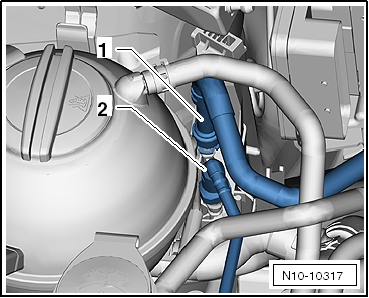
Pull off supply line (metal coupling) (arrow) and catch escaping fuel with a cloth. Separating push-fit connectors → Chapter.
Connect pressure tester VAS 6550 to fuel supply line with adapter VAS 6550/2. Hold adapter VAS 6550/1 in a measuring container.
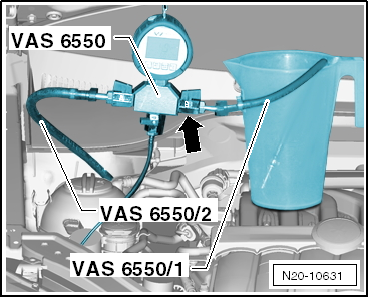
Make sure that drain tap is closed and cut-off taps are open.
Warning Danger of spraying! Wear eye protection and protective clothing to avoid eye injuries and skin contact. Hold container in front of the free connection on the pressure tester VAS 6550.
Operate remote control V.A.G 1348/3A. Then slowly close shut-off tap (arrow) until a pressure of 4 bar is displayed on pressure gauge. From this point on do not move position of shut-off tap.
Drain measuring container.
The quantity of fuel delivered by the fuel pump is dependant on the battery voltage. The multimeter V.A.G 1715 must therefore be connected to contacts (1) and (5) of 5-pin test instrument/DSO adapter VAS 5565 as well.
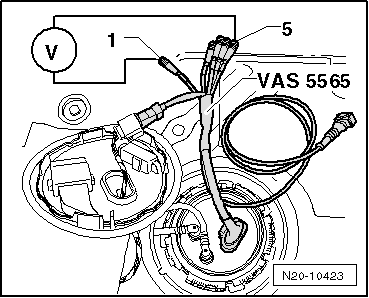
Operate remote control for 60 seconds, whilst measuring voltage at fuel pump.
Compare delivered quantity of fuel with specification.
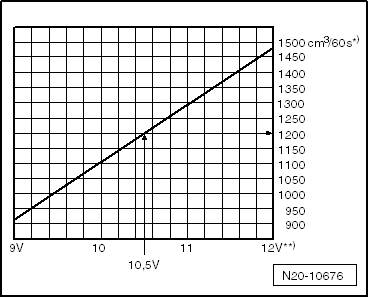
*) Minimum delivery rate cm3/60 s
**) Voltage at fuel pump with engine not running and pump running.
Example:
During the test a voltage of 10.5 volts is measured. This equates to a minimum delivery rate of approx. 1200 cm3/60 s.
Check fuel lines for possible restrictions (kinks) or blockages.
If no fault is found:
Remove cap from fuel filler neck and repeat check. If fuel delivery rate is now reached, check fuel tank breather → Chapter.
Remove fuel delivery unit and check filter strainer for dirt.
If no fault is detected:
Check current draw of fuel pump → Chapter.
If no fault is detected:
Renew fuel delivery unit → Chapter.
If fuel delivery rate has been attained, but nevertheless you suspect a fuel supply system fault (e.g. intermittent failure of fuel supply system):
Check current draw of fuel pump → Chapter.
Parts & tools for this job For 2008 Volkswagen CC
- PARTFuel filterSearch: Volkswagen CC 2008 fuel filter
- TOOLFuel pressure test kitSearch: fuel pressure test kit
- TOOLFuel line disconnect toolSearch: fuel line disconnect tool
As an Amazon Associate we earn from qualifying purchases.