
Replenishing
- Make
- Volkswagen
- Model
- Gol G6 with Voyage and Saveiro, Brazil
- Year
- 2012–2016
- Section
- Cooling system components › Replenishing
Replenishing
Note
- One of the elements that most affect coolant efficiency is the water used in its preparation. The quality of the water to be used is based on multiple substances, which may present different specifications depending on the country or even in different regions. Fresh water meets all requirements. Therefore, the coolant must be prepared with fresh and drinkable water, either when preparing new filling procedures or coolants used to top off the coolant tank.
- Only the antifreeze additive may be used. Correspondence: Electronic Parts Catalogue“ETKA”. It is identified by the pink colour.
- Do not mix antifreeze additive with other types of antifreeze additives from other suppliers under any circumstance.
- A brown colour in the coolant reservoir indicates that the antifreeze additive has been mixed with other antifreeze additives. In this case, replace all of the coolant.
- The antifreeze additive prevents damages caused due to corrosion, freezing, or slob sedimentation, further increasing the coolant's boiling temperature. Therefore, the cooling system must always have the recommended mixture of antifreeze and anti-corrosion products.
- Due to the high boiling temperatures it provides, antifreeze is especially helpful in tropical countries, ensuring safe operation when the engine is submitted to heavy-duty work.
- Antifreeze protection must be assured to approximately -25 °C (in countries with arctic climates, to approximately -35 °C).
- Coolant concentration must not be diluted by adding fresh and drinkable water during hot seasons, or in countries with hot climates. The percentage of antifreeze should be at least 40 %.
- If the climate requires greater antifreeze protection, the antifreeze additive percentage may be increased, but to a maximum of 60 % (antifreeze protection up to -40 °C). The higher proportion lowers cooling capacity and antifreeze protection.
- Use the Refractometer T10007A to determine the antifreeze protection and the corresponding antifreeze protection percentage.
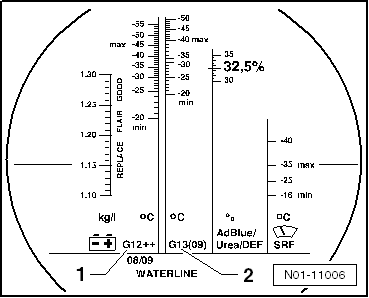
- Do not reuse used coolants, including in situations in which drainage is required.
- Use only clean drinkable water to prepare the coolant.
| Antifreeze protection up to | Antifreeze proportion | Coolant additiveRemark | WaterRemark |
|---|---|---|---|
| -25 ℃ | 40 % | 2.25 l | 3.35 l |
| -35 ℃ | 50 % | 2.8 l | 2.8 l |
Note
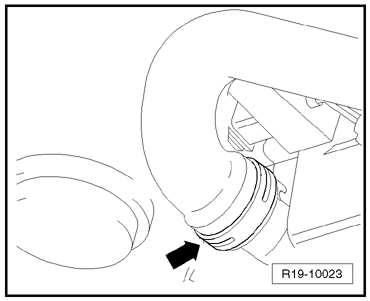
Install the lower hose on the radiator (left side) (arrow).
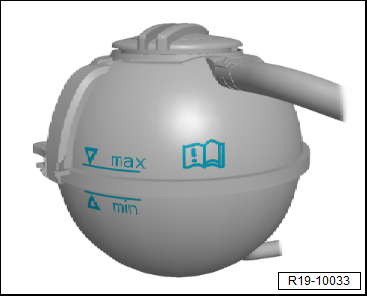
Remove coolant expansion tank lid.
Install the Adaptor for VAG 1274 VAG 1274/8 on the coolant tank.
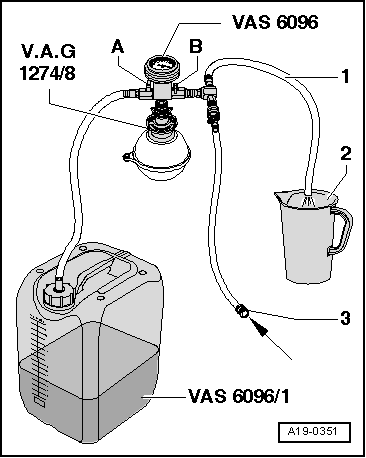
Install the Cooling system supply unit VAS 6096.
Note
- A small quantity of coolant is removed along with the air discharge, which must be collected.
Close the valves (A) and (B), allowing levers to seat transversely to the passage direction.
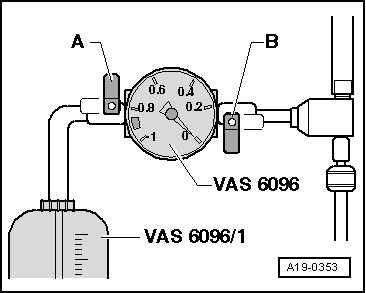
Connect the hose (3 ) to the compressed air system.
The compressed air pressure must be 6 to 10 bar.
Open the valve (B) placing the lever in the passage direction.
The aspiration jet pump generates vacuum in the cooling system; the instrument gauge must move towards the green area.
Briefly open valve (A) placing the valve in the direction of the flow, in order to fill the Cooling system supply unit VAS 6096 coolant reservoir hose with coolant.
Close valve (A).
Leave valve (B) open for more than 2 minutes.
The aspiration jet pump continues to generate vacuum in the cooling system; the instrument gauge must stay in the green area.
Close valve (B).
The instrument gauge must remain still in the green area; the vacuum in the cooling system is sufficient to ensure proper supply.
Note
- If the gauge is below the green area, the operation must be repeated.
- If the vacuum reduces, check the cooling system for exhaust points.
Remove the compressed air hose.
Open the valve (A).
Due to the vacuum in the cooling system, the coolant is aspirated from the Cooling system supply unit VAS 6096 into the cooling system.
Remove the Cooling system supply unit VAS 6096 and the VAG 1274 adaptor VAG 1274/8 from the coolant tank.
Supply the coolant tank until the maximum mark.
Install the coolant tank cap.
Remove coolant expansion tank lid.
Supply the coolant tank until reaching the maximum mark.
Install the Adaptor for VAG 1274 VAG 1274/8 on the coolant tank.
Attach the Connection terminal V.A.G 1274 B/1 to the VAG 1274B adaptor VAG 1274/8.
Connect the Connection terminal V.A.G 1274 B/1 to the Engine cooling system analyzer VAG 1274 B through the flexible connection tube.
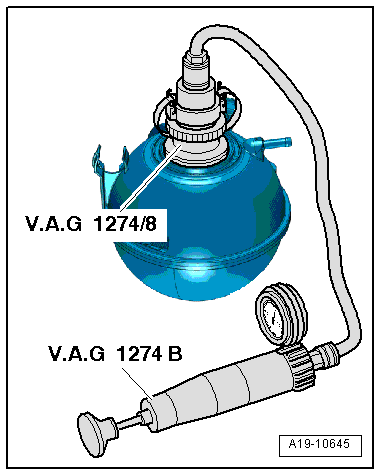
With the Engine cooling system analyzer VAG 1274B, generate a pressure of approx. 1.5 bar.
Warning DANGER!Risk of burns! Before removing the Engine cooling system analyzer VAG 1274B from the VAG 1274 adaptor VAG 1274/8 and the Connection terminal V.A.G 1274 B/1, eliminate all system pressure. Press the pressure relief valve in the Engine cooling system analyzer VAG 1274B, until the manometer reads »0«.
Supply the coolant tank until the upper edge.
Install the coolant tank cap.
Switch off the air conditioning, if applicable.
Turn off heating start device.
Start the engine and keep it idling until it is heated.
Maintain engine rotation at approx. 3800 rpm, until the Radiator fan V7 is activated.
After the Radiator fan V7 is activated, maintain engine rotation at approx. 3800 rpm for an additional 5 minutes.
Stop the engine.
Warning When opened, hot vapours may come from the coolant tank. Wear protection goggles and clothing to prevent eye injuries and burns. Place a cloth on the tank flap and open it carefully.
Check coolant level and top off if necessary.
With the engine under normal operating temperature, the coolant may be at the “max.” mark or above.With the cold engine, the coolant level must be between the “min. mark” and “max. mark”.Warning Hot vapours may escape when the coolant reservoir is opened; cover it with a cloth and open carefully.
Check coolant level and, if necessary, top it up. When the engine is hot, coolant level should be at the max. mark; when the engine is cold, it should be at the central mark, between the max. and min. marks.
Parts & tools for this job For 2012 Volkswagen Gol
- FLUIDCoolantSearch: Volkswagen coolant antifreeze
- PARTThermostatSearch: Volkswagen Gol 2012 thermostat
- TOOLCooling system pressure testerSearch: cooling system pressure tester
As an Amazon Associate we earn from qualifying purchases.