
Work instructions
- Make
- Volkswagen
- Model
- Golf Mk7 Estate
- Year
- 2013–2020
- Section
- Brake lines › Work instructions
Work instructions
Unbolt respective brake line from brake caliper or wheel brake cylinder.
Catch escaping brake fluid and dispose of it as per regulations.
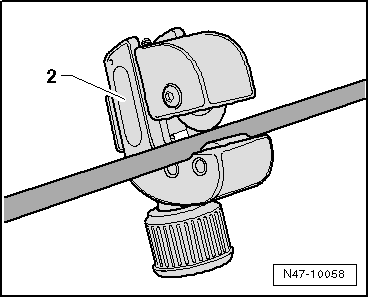
Cut through brake line at a suitable point (straight, freely accessible section) using pipe cutter (2).
Remove section to be renewed.
Degrease brake line surface.
Clamp brake line in set of grips (4) so that approx. 50 mm project from plastic jaws.
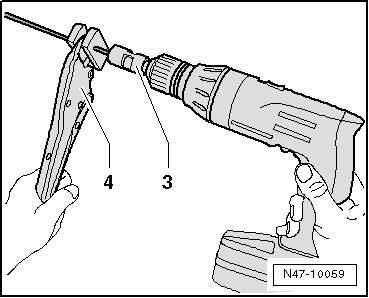
Clamp scraper (3) into a drill and place it onto brake line.
At slow drill speed and with gentle pressure on brake line, scrape coating off brake line.
Length of scraping is determined by stop in scraper.
Pull scraper off brake line and remove scrapings.
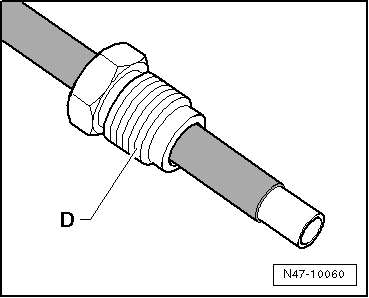
Remove grip wrench and slide flare nut (D) onto brake line.
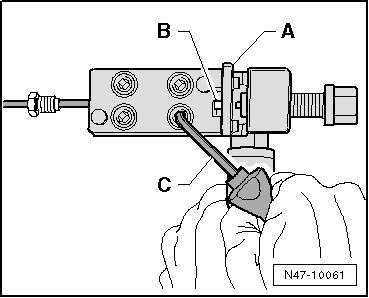
Slide brake line (B) up to stop (A) in flanging tool.
Note
- Brake line must be positioned against stop when the hexagon socket head bolts are tightened, or the flange will not be formed correctly.
Clamp brake line in flanging tool.
Push brake line towards front until it can no longer be moved.
Fold up stop (A).
Tighten hexagon socket head bolts diagonally using angle screw driver (C).
Turn spindle as far as stop in flanging tool.
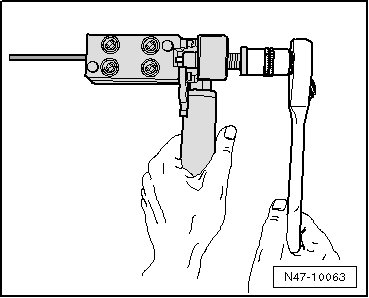
Turn spindle back again.
Unscrew hexagon socket head bolts in diagonal sequence.
Remove brake line from flanging tool, then clean and inspect brake line and flange.
Briefly flush the section of brake line remaining in the vehicle:
Connect brake filling and bleeding unit VAS 5234, connect bleeder bottle hose to brake line flange and allow brake filling and bleeding unit VAS 5234 to run briefly until a little brake fluid has run through.
Blow out new brake line to be inserted with compressed air.
Join brake lines using connector (E).
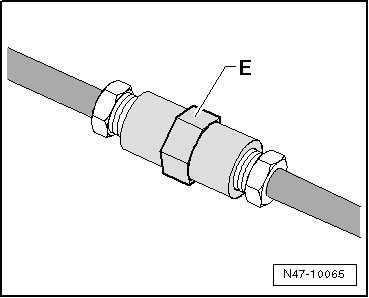
Install brake line.
Bleed brake system → Chapter.
Parts & tools for this job For 2013 Volkswagen Golf
- TOOLBrake bleeder kitSearch: one man brake bleeder kit
- FLUIDBrake fluidSearch: brake fluid
- TOOLBrake line flaring toolSearch: brake line flaring tool
As an Amazon Associate we earn from qualifying purchases.