
Workshop Manuals Factory service & repair Volkswagen
01 4-cylinder injection engine (1.4 l direct injection engine, turbocharger)02 4-cyl. direct injection engine (1.8 l and 2.0 l, 4 V, EA 888 gen III, turbocharger, chain drive)03 3-cylinder direct-injection engine (1.0 l engine, 4V, EA 211, turbocharger)04 4-cylinder direct-injection engine (1.2 l engine, 4V, EA 211, turbocharger)05 Engine: 4-Cyl. Common Rail (1.6 l and 2.0 l, 4V, Turbocharger, EA288)06 Fuel supply system - Petrol engines07 Fuel supply system - Diesel engines08 4-cylinder direct-injection engine (1.4 l, natural gas, EA 211, turbocharger)09 Fuel supply system - natural gas engines10 4-cyl. direct injection engine (2.0 l, 4 V, turbocharger, chain drive, generation III) Volkswagen R GmbH11 Fuel supply system – petrol engines, Volkswagen R GmbH12 4-cylinder injection engine (1.6 l engine)13 4-cyl. direct injection engine (1.8 l, 2.0 l, 4 V, turbocharger, chain drive, generation III)14 4-cyl. diesel engine (2.0 l engine, common rail)15 Propshaft and rear final drive16 6-speed manual gearbox 02Q, 0BB and 0FB17 6-speed manual gearbox 02S18 6-speed dual clutch gearbox 0D919 7-speed dual clutch gearbox 0CW20 6-speed manual gearbox 0AJ21 5-speed manual gearbox 0A422 5-speed manual gearbox 0AH23 5-speed manual gearbox 0AF24 6-speed dual clutch gearbox 0D9, Volkswagen R GmbH25 Propshaft and rear final drive Volkswagen R GmbH26 6-speed manual gearbox 0FB Volkswagen R GmbH27 6-speed manual gearbox 02Q28 6-speed automatic gearbox 09G29 Running gear, axles, steering30 Brake system31 Wheels and Tyres Guide32 Heating, air conditioning33 Heating and air conditioning: Auxiliary heater34 Electrical System, General Information35 Electrical system36 Electrical: Communication37 General body repairs, interior38 General body repairs, exterior39 Vehicle-specific paint information
Volkswagen Golf Mk7 Estate (2013-2020)29 · Running gear, axles, steering
29 · Steering & suspension

Leaks at shock absorbers (Running gear, axles, steering)

Make
Volkswagen
Model
Golf Mk7 Estate
Year
2013–2020
Section
Repair instructions › Leaks at shock absorbers
Running gear, axles, steeringLeaks at shock absorbers

Leaks at shock absorbers

Shock absorbers are often renewed because of externally visible leakage. Inspections on the test rig and in the vehicle have shown that in the majority of cases this renewal is not justified.

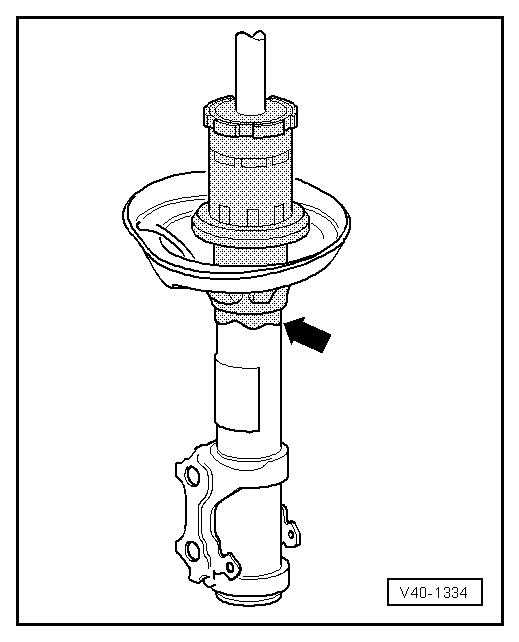
Slight loss of fluid (“sweating”) at the piston rod seal is not a reason for replacing a shock absorber. An oil sweating shock absorber is acceptable under the following conditions:

  • Fluid seepage (as shown in the shaded part of the illustration) is visible, but the fluid is dull and possibly dried by dust.
  • V40-1334
  • The fluid seepage extends only from the top shock absorber seal (piston rod oil seal) down to the bottom spring plate (arrow).
Parts & tools for this job For 2013 Volkswagen Golf

As an Amazon Associate we earn from qualifying purchases.