Caution | If large components (e.g. engine, radiator etc.) are to be removed/installed, it is absolutely essential to drain the cooling system. |
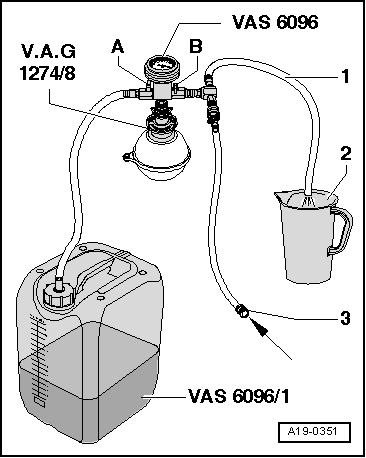
| If the coolant has been drained off, the cooling system must be filled using the cooling system charge unit -VAS 6096- → Anchor. |
|

Note | t
| A major factor for the effectiveness of a coolant is the water used for mixing. Due to varying substances in water, which may be specific to a country or even to a region, Volkswagen has decided to define the quality of the water for cooling systems. Distilled water will meet all requirements. |
| t
| Use only coolant additives in accordance with the → Electronic parts catalogue (ETKA). Other coolant additives may reduce corrosion protection substantially. The resulting damage could lead to loss of coolant and subsequent severe damage to the engine. |
| t
| The correct coolant solution ratio helps prevent damage from freezing and corrosion as well as scaling. Moreover, the boiling temperature is raised. Therefore, the cooling system must be filled all year round with coolant additive. |
| t
| Because of its higher boiling point, the coolant improves engine reliability under heavy loads, particularly in countries with tropical climates. |
| t
| Frost protection must be guaranteed down to about -25 °C (in countries with Arctic climates: down to about -35 °C). |
| t
| The coolant concentration must not be reduced by adding water even in warmer seasons and in warmer countries. The coolant additive concentration must be at least 40 %. |
| t
| If a stronger anti-freeze mixture is necessary due to harsher weather conditions, the coolant additive content can be increased. However, this is only permitted to 60% (antifreeze protection to about -40°C). Otherwise, the antifreeze protection will be reduced again and the cooling effect will be impaired. |
| t
| If radiator, heat exchanger, cylinder head or cylinder head gasket is renewed, do not reuse old coolant. |
| t
| The Refractometer -T10007A- is recommended for determining the current anti-freeze density. |
| Recommended mixture ratios: |
| l
| Coolant additive (40%) and distilled water (60%) for frost protection to -25°C |
| l
| Coolant additive (50%) and distilled water (50%) for frost protection to -35°C |
| l
| Coolant additive (60%) and distilled water (40%) for frost protection to -40°C |
| –
| Reconnect coolant hoses. |
| Using cooling system charge unit -VAS 6096-: |
| –
| Screw adapter for cooling system tester -V.A.G 1274/8- onto expansion tank. |
| –
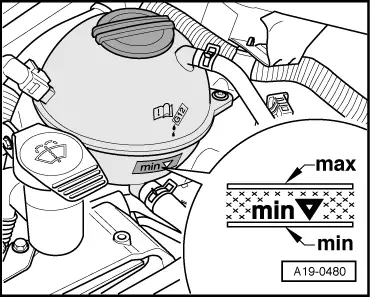
| Fill coolant circuit using cooling system charge unit -VAS 6096- |
| Operating instructions for cooling system charge unit -VAS 6096- are enclosed with unit. |
|
|
|