
Draining and filling coolant
- Make
- Volkswagen
- Model
- Golf Mk7
- Year
- 2013–2020
- Section
- Cooling system, coolant › Draining and filling coolant
Draining and filling coolant
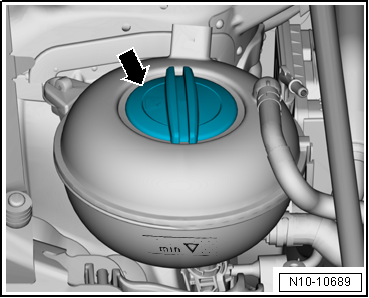
Open cap (arrow) on coolant expansion tank.
Remove noise insulation General body repairs, exteriorRep. gr.66Noise insulation; Removing and installing noise insulation.
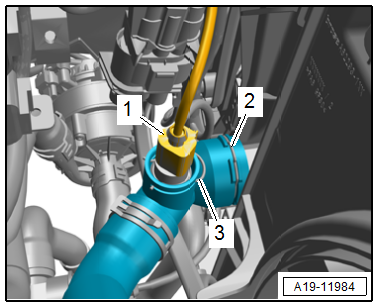
Disconnect electrical connector (1) on radiator outlet coolant temperature sender G83.
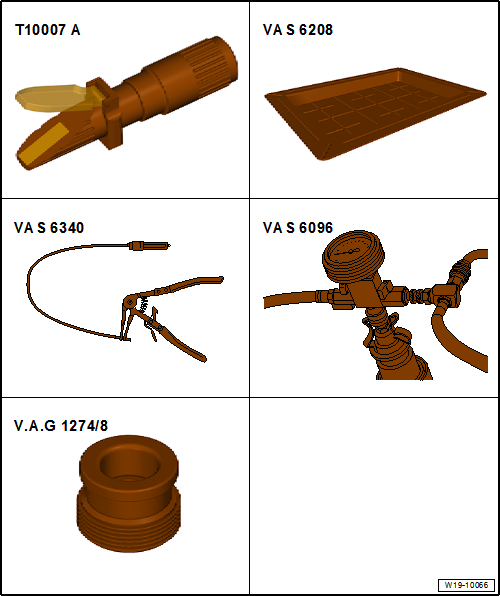
Set drip tray for workshop hoist VAS 6208 underneath.
Lift retaining clip (2), disconnect coolant hose from radiator (bottom left) and drain off coolant.
Note
- Disregard (item 3).
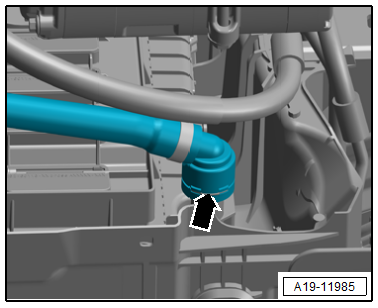
Lift retaining clip (arrow), disconnect coolant hose from water radiator (bottom right) for charge air cooling circuit and drain off coolant.
Risk of damage to the engine due to insufficiently filled/bled cooling system.
Always bleed cooling system with Vehicle diagnostic tester after it has been filled.The cooling system charge unit VAS 6096 must always be used to refill the cooling system.Note
- The water used in the coolant mixture has a great influence on its effectiveness. Because the water quality differs from country to country and even region to region, the quality of the water to be used has been defined. Distilled water fulfils all requirements. For this reason, we recommend using distilled water when mixing coolant for topping up or replacing coolant.
- Use only coolant additives which conform with the Electronic Parts Catalogue (ETKA). Other coolant additives may reduce corrosion protection substantially. The resulting damage could lead to loss of coolant and subsequent severe damage to the engine.
- The correct coolant solution ratio helps prevent damage from freezing and corrosion as well as scaling. Moreover, the boiling temperature is raised. Therefore, the cooling system must be filled all year round with coolant additive.
- Because of its higher boiling point, the coolant improves engine reliability under heavy loads, particularly in countries with tropical climates.
- ONLY refractometer T10007A may be used for determining current anti-freeze value.
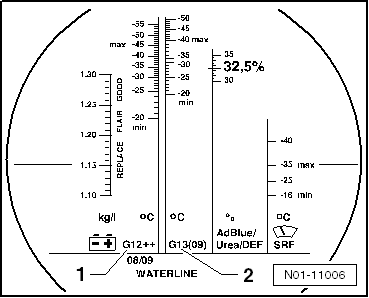
- The normal frost protection must be to at least -25°C, in countries with arctic conditions to -36°C. When climatic conditions require a stronger frost protection, only then may the frost protection be increased. It may only be increased, however, to a maximum of -48°C. Otherwise, the cooling effect of the coolant will be impaired.
- The coolant concentration must not be reduced by adding water even in warmer seasons and in warmer countries. Frost protection must be guaranteed to at least -25°C.
- Read off the frost protection value from the scale for the coolant additive being used.
- The temperature read off the refractometer T10007A equates to the »ice flocculation point«. Ice crystals can start forming in the coolant below this temperature.
- Do not reuse old coolant.
- Use only a water / coolant additive mixture as a slip agent for coolant hoses.
Connect lower left coolant hose (2) to radiator.
Connect coolant hose to water radiator for charge air cooling circuit (bottom right) (arrow).
Fill coolant reservoir of VAS 6096 with at least 10 litres of pre-mixed coolant in correct mixture ratio:
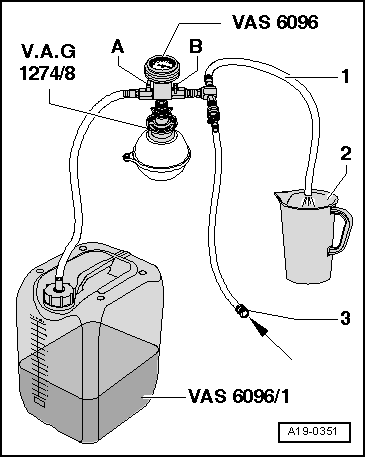
Screw adapter for cooling system tester V.A.G 1274/8 onto coolant expansion tank.
Mount cooling system charge unit VAS 6096 on adapter V.A.G 1274/8.
Feed vent hose (1) into a small container (2).
Note
- Exhaust air takes a slight quantity of coolant along with it; this should be collected.
Close valves (A) and (B) (turn lever transverse to direction of flow to do this).
Connect hose (3) to compressed air.
Pressure: 6 … 10 bar.Open valve (B); turn lever in direction of flow to do this.
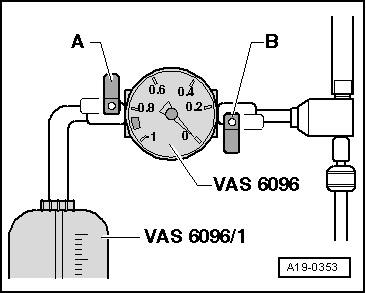
In addition, briefly open valve (A) (turn lever in direction of flow to do this) so that hose on VAS 6096 reservoir fills with coolant.
Close valve (A) again.
Leave valve (B) open for a further 2 minutes.
The suction-jet pump will continue generating a vacuum in the cooling system.The needle on the gauge must remain in the green zone.Close valve (B).
The needle on the gauge must stay in the green zone.The low pressure in the cooling system is then sufficient for subsequent filling.Note
- If the needle does not reach the green zone, repeat the process.
- If the vacuum drops, check the cooling system for leaks.
Pull off compressed air hose.
Open valve (A).
The partial vacuum in cooling system causes coolant to be extracted from VAS 6096 reservoir and coolant system to be filled.Remove cooling system charge unit VAS 6096 from coolant expansion tank.
Top up coolant to upper mark.
Install noise insulation General body repairs, exteriorRep. gr.66Noise insulation; Assembly overview - noise insulation.
On vehicles with auxiliary heater, switch on auxiliary heater for about 30 seconds.
Set temperature regulator to “HI”.
Switch off air conditioner compressor. To do this, press AC button.
LED in button should not light up.Connect vehicle diagnostic tester.
Switch on ignition and select the following menu options on vehicle diagnostic tester:
- 01 - Engine electronics
- Guided Functions
- 01 - Fill/bleed cooling system
Follow instructions shown on vehicle diagnostic tester.
Allow engine to cool down.
Check coolant level.
Fill more coolant if necessary.
Parts & tools for this job For 2013 Volkswagen Golf
- FLUIDCoolantSearch: Volkswagen coolant antifreeze
- PARTThermostatSearch: Volkswagen Golf 2013 thermostat
- TOOLCooling system pressure testerSearch: cooling system pressure tester
As an Amazon Associate we earn from qualifying purchases.