
Workshop Manuals Factory service & repair Volkswagen
01 4-cylinder injection engine (1.4 l direct injection engine, turbocharger)02 4-cyl. direct injection engine (1.8 l and 2.0 l, 4 V, EA 888 gen III, turbocharger, chain drive)03 4-cylinder injection engine (hybrid)04 Fuel supply system - petrol engines, hybrid vehicles05 3-cylinder direct-injection engine (1.0 l engine, 4V, EA 211, turbocharger)06 4-cylinder direct-injection engine (1.2 l engine, 4V, EA 211, turbocharger)07 Engine: 4-Cyl. Common Rail (1.6 l and 2.0 l, 4V, Turbocharger, EA288)08 Fuel supply system - Petrol engines09 Fuel supply system - Diesel engines10 4-cylinder direct-injection engine (1.4 l, natural gas, EA 211, turbocharger)11 Fuel supply system - natural gas engines12 4-cyl. direct injection engine (2.0 l, 4 V, turbocharger, chain drive, generation III) Volkswagen R GmbH13 Fuel supply system – petrol engines, Volkswagen R GmbH14 4-cylinder injection engine (1.6 l engine)15 4-cyl. direct injection engine (1.8 l, 2.0 l, 4 V, turbocharger, chain drive, generation III)16 4-cylinder injection engine (1.6 l engine, 4 valves, MPI)17 4-cyl. diesel engine (2.0 l engine, common rail)18 Propshaft and rear final drive19 6-speed manual gearbox 02Q, 0BB and 0FB20 6-speed manual gearbox 02S21 1-speed gearbox 0CZ22 6-speed dual clutch gearbox 0D923 7-speed dual clutch gearbox 0CW24 6-speed dual clutch gearbox 0DD, hybrid vehicles25 6-speed automatic gearbox 09G26 6-speed manual gearbox 0AJ27 5-speed manual gearbox 0A428 5-speed manual gearbox 0AH29 5-speed manual gearbox 0AF30 6-speed dual clutch gearbox 0D9, Volkswagen R GmbH31 Propshaft and rear final drive Volkswagen R GmbH32 6-speed manual gearbox 0FB Volkswagen R GmbH33 6-speed manual gearbox 02Q34 Wheels and Tyres Guide35 Running gear, axles, steering36 Brake system37 Brake system (hybrid)38 Heating, air conditioning39 Heating and air conditioning: Auxiliary heater40 Electrical System, General Information41 Electrical: Communication42 Electrical system43 Electrical: Electric drive44 General body repairs, interior45 General body repairs, exterior46 Vehicle-specific paint information
Volkswagen Golf Mk7 (2013-2020)36 · Brake system
36 · Brakes

Checking vacuum generation

Make
Volkswagen
Model
Golf Mk7
Year
2013–2020
Section
Vacuum system › Checking vacuum generation
Brake systemChecking vacuum generation

Checking vacuum generation

Note

  • The average air pressure of the earth's atmosphere at sea level is 1013 mbar and decreases steeply as the altitude increases (approx. 100 mbar/1,000 m altitude). Local and time fluctuations also influence vacuum generation.
  • A cold engine, a switched-on air-conditioning system as well as engine idling have an adverse influence on generation of a vacuum.

Before starting work, check all vacuum hoses for damage (e.g. cracks or marten bite) and to check that they are correctly and firmly attached

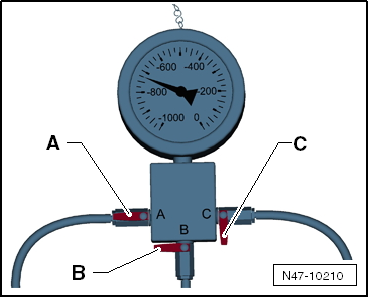
Connect brake servo vacuum gauge VAS 6721Chapter.

Open cut-off valve (A).

Close cut-off valves (B+C).
N47-10210

Start warm engine (>60°C), press accelerator briefly (engine speed above 2,000 rpm).

Read indicated measured value.

Normally (see notes), the vacuum that is generated should be between 600 and 950 mbar (depending on engine size).

If the measured value is not reached even through the preconditions (see notes) have been met, the vacuum system must first be checked for leaks.

For comparison purposes, generate the vacuum with the manual vacuum pump VAS 6213Chapter.

Open cut-off valve (B) to facilitate removal of hose connections and adapter.

Parts & tools for this job For 2013 Volkswagen Golf

As an Amazon Associate we earn from qualifying purchases.