
Removing and installing brake caliper
- Make
- Volkswagen
- Model
- Golf Mk7
- Year
- 2013–2020
- Section
- Rear brakes › Removing and installing brake caliper
Removing and installing brake caliper
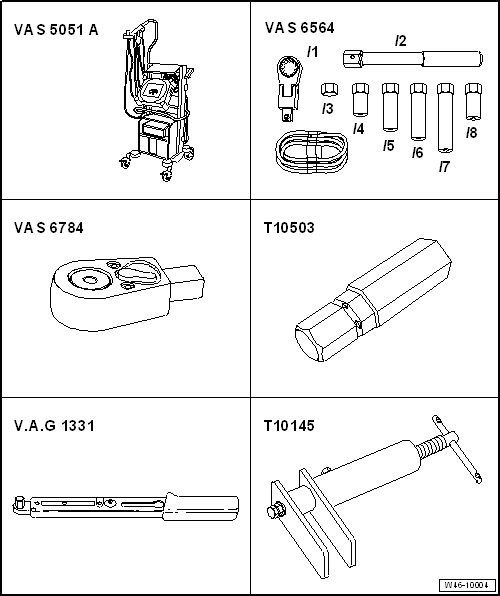
Note
- This procedure applies only to exchanging or the following repair work on the brake caliper.
Note
- Do not separate connectors of parking brake motors.
Remove wheels.
The electromechanical parking brake pistons must be moved back using Vehicle diagnostic tester.
Note
- Before resetting pistons, draw off brake fluid from brake fluid reservoir. Otherwise, particularly if reservoir has been topped up, fluid will overflow and cause damage.
Move back pistons using Vehicle diagnostic tester.
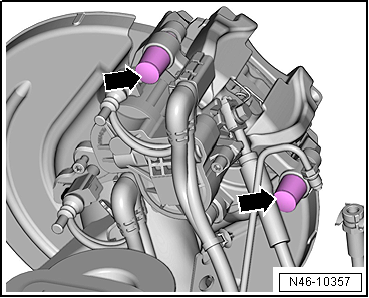
Unscrew bolts (arrows) for parking brake motor.
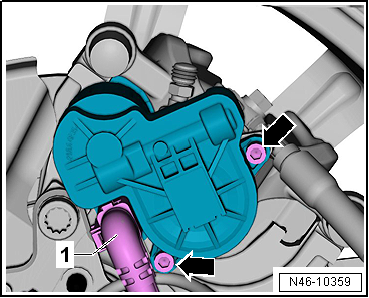
Pull off parking brake motor and place it to one side without disconnecting the connector.
Connect hose of bleed bottle (1) to bleed valve of brake caliper.
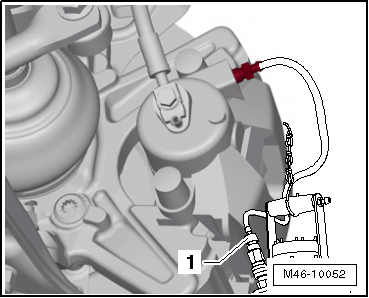
Open bleed valve.
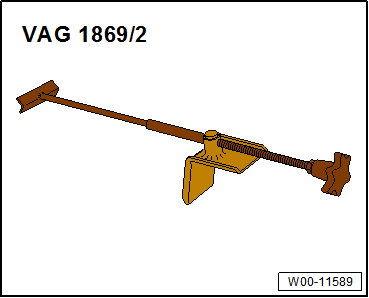
Apply brake pedal depressor V.A.G 1869/2.
Close bleed valve and remove bleed bottle.
Unscrew brake hose.
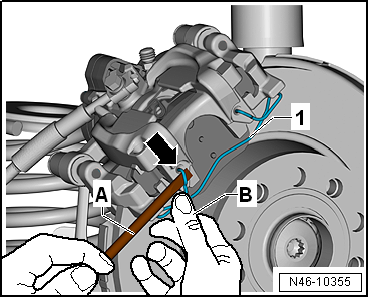
CAUTIONThe spring is under tension. Take care to avoid injury when removing.Use a screwdriver (A) to lever retaining spring (1) for brake pads out of brake caliper (arrow) while supporting retaining spring with the other hand.
Remove cover caps (arrows).
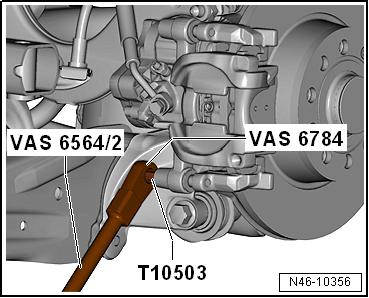
Unscrew both guide pins from brake caliper using 7 mm bit T10503 and insert tool with ratchet VAS 6784.
Pull brake caliper off brake carrier.
The brake pads are seated in the retaining springs on the brake carrier.Secure brake caliper to brake carrier with new self-locking bolts.
Note
- The annular groove and the contact surface of the parking brake motor must be clean.
Install new sealing ring.
Turn spindle back slightly using an E11 Torx socket until parking brake motor can be properly fitted.
Carefully fit parking brake motor, while ensuring that seal is correctly seated.
Turn parking brake motor until bolt hole and thread align.
Note
- Make sure that parking brake motor is flush with brake caliper. Never pull parking brake motor onto brake caliper using securing bolts.
Start new hexagon socket head bolts by hand and tighten them.
Attach brake hose to brake caliper.
Bleed brake system → Chapter.
After moving the pistons forwards using Vehicle diagnostic tester, carry out a basic setting of brake system.
Carry out basic setting of brake system using Vehicle diagnostic tester.
Fit wheels.
- Chapter“Assembly overview - rear brakes”
- Bleed valve Chapter“Assembly overview - rear brake caliper”
- Wheel bolts Running gear, axles, steeringRep. gr.44Wheels, tyres; Specified torque for wheel bolts.
Note
- Check brake fluid level.
Parts & tools for this job For 2013 Volkswagen Golf
- PARTRear brake padsSearch: Volkswagen Golf 2013 rear brake pads
- TOOLCaliper piston rewind toolSearch: brake caliper piston rewind tool
- FLUIDBrake fluidSearch: brake fluid
As an Amazon Associate we earn from qualifying purchases.