
Test prerequisites
- Make
- Volkswagen
- Model
- Golf Mk7
- Year
- 2013–2020
- Section
- Repair notes › Test prerequisites
Test prerequisites
Ambient temperature above 15°C.Radiator and condenser clean; clean if necessary.Poly V-belt for compressor drive OK and correctly tensioned, pulley actually driving air conditioner compressor (vehicles without high-voltage system).All air ducts, covers and seals are OK and properly installed.Seal between engine compartment, bonnet and plenum chamber is OK and properly fitted, checking General body repairs, exteriorRep. gr.50Plenum chamber bulkhead; (Assembly overview - plenum chamber cover).Air flow through dust and pollen filter not impeded by contamination; checking → Chapter.Air intake of heater and air conditioning unit (in fresh air and air recirculation mode) not impeded by contamination or retrofitted components.Vehicles without glove compartment cooling: connection for glove compartment cooling at air conditioning unit sealed off.Vehicles without glove compartment cooling: connection for glove compartment cooling at air conditioning unit installed according to specifications.The vehicle is not exposed to direct sunlight.Engine warm: coolant temperature above 80°C.Event memory of operating unit, air conditioning system control unit J301/Climatronic control unit J255 read and cleared, basic setting performed, and coding of J301/ J255 checked vehicle diagnostic tester in “Guided fault finding” mode.Adaption of J301/ J255 checked vehicle diagnostic tester in “Guided fault finding” mode.All dash panel vents and if applicable vents in rear centre console open.Air outlet from rear footwell vents (beneath front seats) not impeded by mats or other objects; check.Front lid closed.- The ignition is switched on and the vehicle's drive system is activated (note display in dash panel insert), the engine starts or is just running, if, for example, the high-voltage battery 1 AX2 is not charged sufficiently or the bonnet is released Owner's manual.
- When the ignition is switched on and the temperature preselection is set to “warm” on the operating unit of the air conditioning system, the Climatronic control unit J255 (“HI” displayed), the coolant flow through the heat exchanger of the heater and air conditioning unit is maintained via the coolant pump for high-temperature circuit V467Chapter“Incorporation of high-voltage heater (PTC) Z115 into coolant circuit” and Rep. gr.19Coolant pump, thermostat; Assembly overview - coolant pump.
Switch on ignition.
Shift selector lever to position "P".
Activate parking brake.
Switch off ignition.
Open bonnet.
Connect battery charger, e.g. battery charger VAS 5095A to jump start points of 12 V vehicle electrical system.
Switch on ignition.
Activate vehicle's drive system (engine must not start initially).
Start engine.
Engine is running (if necessary change setting on operating unit for J301 or J255 towards “heating”).
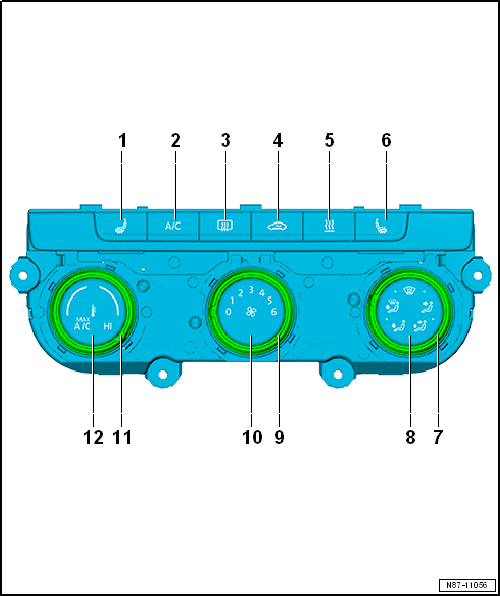
Set operating unit of air conditioning system control unit J301 as follows:
Set the rotary temperature control (11) to the “Cold” stop.Air conditioner compressor on: the indicator lamp in the A/C button (2) is on.Recirculation mode on: the indicator lamp in the air recirculation button (4) is on.Turn rotary air distribution knob (7) to “dash panel vent”.Set the rotary fresh air blower control (9) to maximum speed.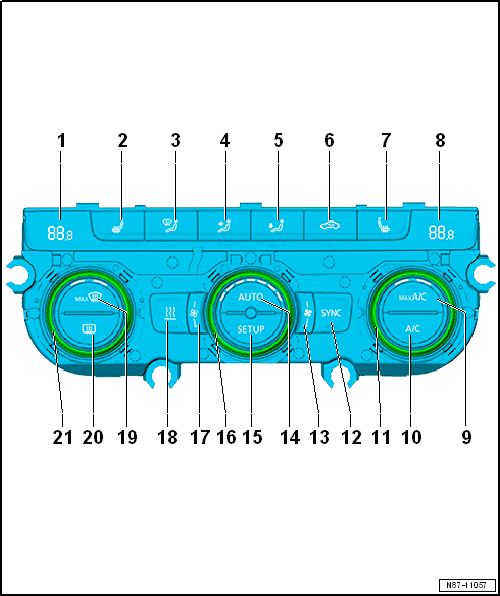
Set operating unit of Climatronic control unit J255 as follows:
“Auto” mode: the indicator lamp in the AUTO button (14) is on.Set the temperature preselection to “cold” via the rotary controls (21) and (11): “LO” displayed for driver side and front passenger side in display (1) and (8) of J255.Air conditioner compressor on: the indicator lamp in the A/C button (10) is on.Set the rotary fresh air blower control (16) to maximum speed.Note
- The AUTO button is switched off, if the fresh air blower speed is changed manually.
Note
- The max. possible fresh air blower speed depends on various conditions (vehicle voltage, etc.).
Functions with engine running (on vehicles without high-voltage system):
Functions with vehicle's drive system activated (on vehicles with high-voltage system):
Operation of radiator fan(s) V7/ V177. Activation and speed are governed by the pressure in the refrigerant circuit and the engine temperature.Note
- Depending on the version of the operating unit, J301/ J255, the radiator fan(s) V7/ V177 may only be switched in as of a certain pressure in the refrigerant circuit (currently as of a pressure of roughly 9 bar). The radiator fan activation is displayed in the “Read measured values” function vehicle diagnostic tester in “Guided fault finding” mode.
- Depending on the engine control unit, the actual speed of the radiator fans V7 and V177 may differ from the specification vehicle diagnostic tester in “Guided fault finding” mode.
Note
- The max. possible fresh air blower speed depends on various conditions (vehicle voltage, etc.).
If one of these prerequisites is not satisfied:
Read event memory, perform final control diagnosis, and read the corresponding measured values vehicle diagnostic tester in “Guided fault finding” mode.
Chapter“Checking cooling output on vehicles with manually controlled air conditioning system”
Chapter“Checking cooling output on vehicles with automatically controlled air conditioning system (without high-voltage system)”
Chapter“Checking cooling output on vehicles with automatically controlled air conditioning system (with high-voltage system)”
Parts & tools for this job For 2013 Volkswagen Golf
- TOOLA/C manifold gauge setSearch: AC manifold gauge set
- TOOLUV leak detection kitSearch: AC UV leak detection kit
- PARTCabin filterSearch: Volkswagen Golf 2013 cabin filter
As an Amazon Associate we earn from qualifying purchases.