
Calibrating Adaptive Cruise Control (ACC)
- Make
- Volkswagen
- Model
- Golf Mk7
- Year
- 2013–2020
- Section
- Adaptive cruise control › Calibrating Adaptive Cruise Control (ACC)
Calibrating Adaptive Cruise Control (ACC)
Note
- Re-adjustment is required:
- Rear axle toe setting has been adjusted.
- The adaptive cruise control unit J428 has been removed and reinstalled,
- The front bumper support has been removed and installed.
- The front bumper support has become loose or has been moved.
- The misalignment angle is greater than –0.8° to +0.8°.
- The vehicle has been brought into the service position.
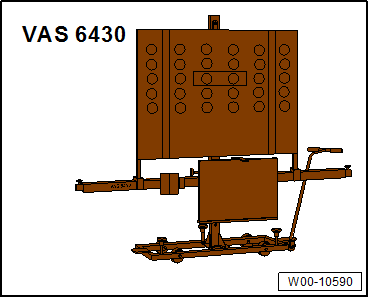
Note
- Before driving vehicle onto wheel alignment platform, make sure there is sufficient space between vehicle and setting device VAS 6430. The distance between setting device VAS 6430/3 and the sensor must be 120 cm ± 2.5 cm.
- If available space is not adequate, move vehicle backwards onto alignment platform as required to achieve space required.
- If position of ACC reflector mirror VAS 6430/3 on alignment beam is changed, setting of ACC setting device VAS 6430 must always be checked (e.g. spirit levels, individual toe values on adjusting beam, etc.).
Adjustment procedure described here is based on setting device VAS 6430.
Establish a distance of 120 cm ± 2.5 cm between the ACC reflective mirror VAS 6430/3 fitted in the middle and the sensor in the radiator grille.Install ACC reflector mirror VAS 6430/3 centred on alignment beam.Adjust adaptive cruise control unit J428.If wheel alignment has just been carried out, the steps described under “Setting without preceding wheel alignment” do not have to be carried out.
Press button to select ACC calibration in wheel alignment computer.
Note testing preconditions for wheel alignment → Chapter.
Drive car onto wheel alignment platform.
Connect battery charger Electrical system; General informationRep. gr.27Charging battery.
Connect Vehicle diagnostic tester. (Route diagnostic cable through open window.)
Note
- During the setting procedure, make sure that all the car doors remain closed and that the car's exterior lighting is switched off.
Move front wheels to straight-ahead position.
Mount quick-release clamps on rear wheels.
Mount measurement transducers on rear wheels.
Carry out wheel run-out compensation at rear wheels.
Remove trim (1).
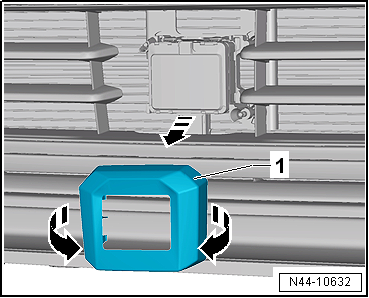
Remove trim (1).
Remove dirt, if there is any, from the sensor lens.
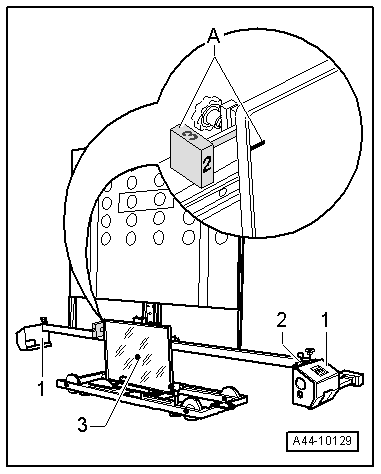
Position ACC setting device VAS 6430/3 centrally and parallel at a distance (a) from centrally fitted ACC reflector mirror VAS 6430/3 to adaptive cruise control unit J428.
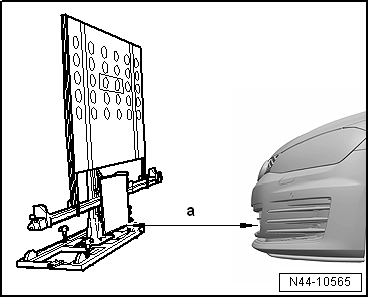
Note
- ACC setting device VAS 6430 is not allowed to be moved on alignment beam.
Mount measurement transducers (1) of front wheels on alignment beam.
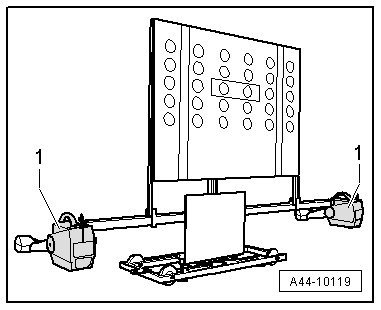
In the area (A), move position (2) on rotary knob so that it coincides with marking on mirror (the number 2 on the rotary knob must point towards the vehicle).
Use adjusting screws (1), (2) and (3) to bring spirit levels (A) and (B) to VAS 6430/3 horizontal.
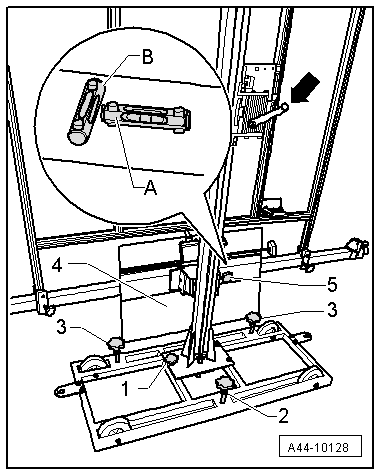
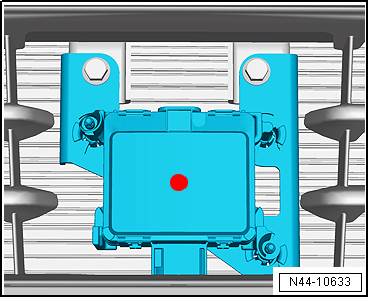
Adjust mirror (4) by means of crank handle (arrow) in such a way that the laser beam contacts the centre of the sensor lens.
Position the mirror on side of the alignment beam so that the laser beam contacts the centre of the sensor lens.
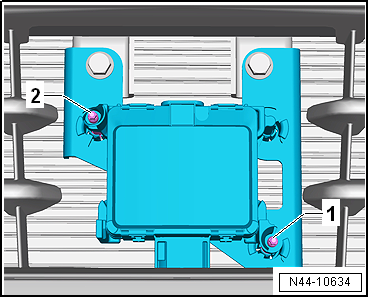
Use adjusting screw (1) to level spirit levels (2).
Turn fine adjuster screw (5) until display on wheel alignment computer is within tolerance.
Use adjusting screw (1) to level spirit levels (2).
Now, use laser beam (3) of VAS 6430/3 to check again whether spirit levels are horizontal and laser beam hits centre of sensor lens.
Note
- The alignment of VAS 6430/3 must be repeated if the laser beam does not coincide with the sensor lens.
Press Vehicle diagnostic testerGoTo button and select Select function/component function.
On the screen, click the following buttons one after the other:
- Running gear (Rep. Gr. 01; 40 - 49)
- 13 - Proximity control
- 01 - System capable of self-diagnosis
- 13 - Proximity control
- 13 - Proximity control, functions
- 13 - Calibration
Follow instructions on screen to set the control unit.
Warning The ACC setting is not accepted until “Final control diagnosis is completed” is displayed in the Vehicle diagnostic tester.
Parts & tools for this job For 2013 Volkswagen Golf
- TOOLTie rod end toolSearch: tie rod end puller
- TOOLBall joint separatorSearch: ball joint separator
- FLUIDPower steering fluidSearch: Volkswagen power steering fluid
As an Amazon Associate we earn from qualifying purchases.