
Workshop Manuals Factory service & repair Volkswagen
01 4-cylinder common rail engine (2.0 l, EA189 Gen II)02 4-cylinder common rail engine (2.0 l, EA189)03 4-cylinder injection engine (1.4 and 1.6 l direct injection)04 4-cylinder injection engine (1.4 l direct injection engine, turbocharger)05 4-cylinder injection engine (1.4 l direct injection engine, turbocharger and supercharger)06 4-cylinder direct injection engine (1.2 l engine, 2V, EA 111 turbocharger)07 4-cylinder common rail engine (1.6 l, EA189)08 Fuel supply system - Petrol engines09 4-cylinder diesel engine (1.9 l engine)10 4-cylinder diesel engine (2.0 l engine, 2-valve, SDI)11 4-cylinder diesel engine (2.0 l engine, 2-valve, TDI)12 4-cylinder injection engine (1.6 l roller rocker finger)13 4-cylinder diesel engine (2.0 l engine, 4 valve)14 4-cylinder injection engine (2.0 l direct injection)15 4-cylinder injection engine (1.4 l engine)16 Fuel supply system - Diesel engines17 Fuel supply system - petrol engines18 4-cylinder injection engine (1.6 l engine, BiFuel) Volkswagen R GmbH19 7-speed dual clutch gearbox 0AM20 6-speed automatic gearbox 09G21 6-speed manual gearbox 02Q22 6-speed manual gearbox 02S23 6-speed dual clutch gearbox 02E24 6-speed manual gearbox 0AJ25 5-speed manual gearbox 0A426 6-speed manual gearbox 0AG27 5-speed manual gearbox 0AF28 5-speed manual gearbox 0AH29 Wheels and Tyres Guide - Standard30 Brake systems31 Running gear, axles, steering32 Wheels and Tyres Guide33 Heating, air conditioning34 Heating and air conditioning: Auxiliary heater35 Electrical: Communication36 Electrical system37 General body repairs, exterior38 General body repairs, interior
Volkswagen Golf Plus (2005-2014)29 · Wheels and Tyres Guide - Standard
29 · Steering & suspension

Flat spots (from locking wheels)

Make
Volkswagen
Model
Golf Plus
Year
2005–2014
Section
Tyre noise › Flat spots (from locking wheels)
Wheels and Tyres Guide - StandardFlat spots (from locking wheels)

Flat spots (from locking wheels)

Flat spots can result from an extreme brake application which causes the wheels to lock, so that the rubber is worn off at the contact patch between the tread and the road surface.

As the tyres slide over the road surface, friction generates heat, which also reduces the wear resistance of the tread material.

Not even a highly wear-resistant tread compound can prevent the flat spots caused by violent braking.

Even ABS-controlled brake systems cannot prevent brief locking of the wheels, and thus, minor flat spots.

The degree of such wear depends largely on the vehicle speed, the road surface and the load placed on the wheel. The following examples should make this clear.

If a vehicle is braked to a standstill on a dry surface with the wheels locked, the amount of rubber worn from the tyre will cover an area the size of a postcard and will have a thickness of:

  • up to 2.0 mm from a speed of 57 km/h (23.8 m braking distance)
  • up to 3.3 mm from a speed of 75 km/h (41.8 m braking distance)
  • up to 4.8 mm from a speed of 92 km/h (71.6 m braking distance)
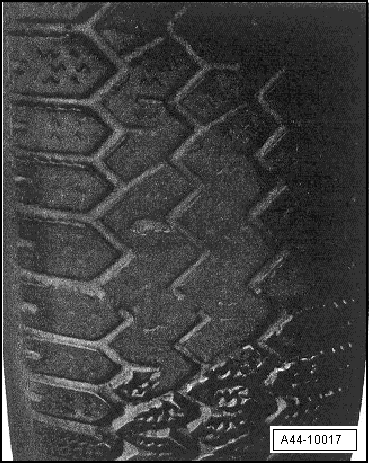
Flat spots in tread

A44-10017

Tyres with such damage must no longer be used and must be renewed.

Parts & tools for this job For 2005 Volkswagen Golf

As an Amazon Associate we earn from qualifying purchases.