
Workshop Manuals Factory service & repair Volkswagen
01 4-cylinder common rail engine (2.0 l, EA189 Gen II)02 4-cylinder common rail engine (2.0 l, EA189)03 4-cylinder injection engine (1.4 and 1.6 l direct injection)04 4-cylinder injection engine (1.4 l direct injection engine, turbocharger)05 4-cylinder injection engine (1.4 l direct injection engine, turbocharger and supercharger)06 4-cylinder direct injection engine (1.2 l engine, 2V, EA 111 turbocharger)07 4-cylinder common rail engine (1.6 l, EA189)08 Fuel supply system - Petrol engines09 4-cylinder diesel engine (1.9 l engine)10 4-cylinder diesel engine (2.0 l engine, 2-valve, SDI)11 4-cylinder diesel engine (2.0 l engine, 2-valve, TDI)12 4-cylinder injection engine (1.6 l roller rocker finger)13 4-cylinder diesel engine (2.0 l engine, 4 valve)14 4-cylinder injection engine (2.0 l direct injection)15 4-cylinder injection engine (1.4 l engine)16 Fuel supply system - Diesel engines17 Fuel supply system - petrol engines18 4-cylinder injection engine (1.6 l engine, BiFuel) Volkswagen R GmbH19 7-speed dual clutch gearbox 0AM20 6-speed automatic gearbox 09G21 6-speed manual gearbox 02Q22 6-speed manual gearbox 02S23 6-speed dual clutch gearbox 02E24 6-speed manual gearbox 0AJ25 5-speed manual gearbox 0A426 6-speed manual gearbox 0AG27 5-speed manual gearbox 0AF28 5-speed manual gearbox 0AH29 Wheels and Tyres Guide - Standard30 Brake systems31 Running gear, axles, steering32 Wheels and Tyres Guide33 Heating, air conditioning34 Heating and air conditioning: Auxiliary heater35 Electrical: Communication36 Electrical system37 General body repairs, exterior38 General body repairs, interior
Volkswagen Golf Plus (2005-2014)29 · Wheels and Tyres Guide - Standard
29 · Steering & suspension

General

Make
Volkswagen
Model
Golf Plus
Year
2005–2014
Section
Tyres with run-flat properties › General
Wheels and Tyres Guide - StandardGeneral

General

Tyres with run-flat properties have reinforced side walls when comparing them with normal tyres. This reduces the slippage of the side walls and prevents the tyre flanks sticking when the tyres are run deflated. This ensures the vehicle remains controllable and the vehicle has almost normal driving characteristics. The alleviates the necessity to fit the spare wheel in dangerous conditions e.g hard shoulder of a motorway or in bad weather conditions.

A deflated tyre can be driven further to the next workshop (approx. 50 km (approx. 30 miles)) at a suitable speed (max. 80 km/h (max. 50 mph)) and in suitable driving style for the conditions, see Owner's wallet.

After checking the respective wheel, the responsibility lies with the driver to decide if it is safe to drive further with the deflated tyre.
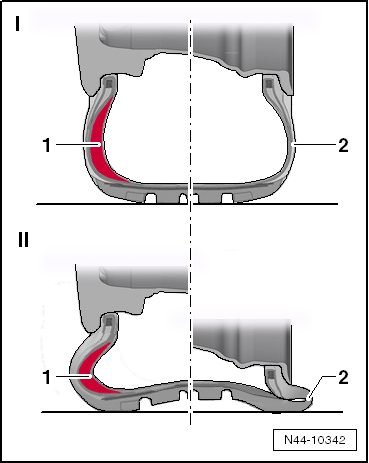
(I) Tyres with normal air pressure

N44-10342
1Tyres with run-flat properties (reinforced side walls (red))2Normal tyres

(II) Deflated tyre

When a normal tyre (2) deflates, the side walls are pressed against the wheel rims. The side walls heat up extremely or stick and are therefore destroyed when the tyre is deflated.

Tyres with run-flat properties (1) are supported on the reinforced side walls ((red)). A special tyre mixture and the reduced walkability of the reinforced side walls reduces the heat created when the tyre is run and the vehicle remains controllable.

Note

  • Please note the special requirements when using tyres with run-flat properties → Chapter.

Parts & tools for this job For 2005 Volkswagen Golf

As an Amazon Associate we earn from qualifying purchases.