
Workshop Manuals Factory service & repair Volkswagen
01 4-cylinder injection engine (1.8 and 2.0 l engine, chain drive)02 4-cylinder common rail engine (2.0 l, EA189)03 4-cylinder injection engine (2.0 l engine, turbocharger)04 4-cylinder injection engine (1.4 and 1.6 l direct injection)05 4-cylinder injection engine (2.0 l direct injection)06 4-cylinder injection engine (1.4 l direct injection engine, turbocharger)07 4-cylinder common rail engine (1.6 l, EA189)08 4-cylinder diesel engine (1.9 l engine)09 4-cylinder diesel engine (2.0 l engine, 4 valve)10 Fuel supply system - Diesel engines11 Fuel supply system - natural gas engines12 4-cylinder diesel engine (2.0 l engine, 2 valve)13 4-cylinder injection engine (1.6 l roller rocker finger)14 6-cylinder injection engine (direct injection)15 6-cylinder injection engine Volkswagen R GmbH16 4-cylinder direct-injection engine (1.4 l, natural gas, EA 111, turbocharger, supercharger)17 7-speed dual clutch gearbox 0AM18 Propshaft and rear final drive19 6-speed automatic gearbox 09M20 6-speed automatic gearbox 09G21 6-speed manual gearbox 02Q22 6-speed manual gearbox 02S23 6-speed dual clutch gearbox 02E24 6-speed manual gearbox 0AJ25 6-speed dual clutch gearbox 02E Volkswagen R GmbH26 5-speed manual gearbox 0A427 6-speed manual gearbox 02S, four-wheel drive28 6-speed manual gearbox 02Q four-wheel drive29 Propshaft and rear final drive Volkswagen R GmbH30 5-speed manual gearbox 0AH31 Wheels and Tyres Guide - Standard32 Brake systems33 Running gear, axles, steering34 Heating, air conditioning35 Heating and air conditioning: Supplementary heater36 Electrical: Communication37 Electrical system38 General body repairs, interior39 General body repairs, exterior
Volkswagen Passat B6 (2005-2010)32 · Brake systems
32 · Brakes

Checking vacuum generation

Make
Volkswagen
Model
Passat B6
Year
2005–2010
Section
Assembly overview - brake servo/brake master cylinder › Checking vacuum generation
Brake systemsChecking vacuum generation

Checking vacuum generation

Note

  • The average air pressure of the earth's atmosphere at sea level is 1013 mbar and decreases steeply as the altitude increases (approx. 100 mbar/1,000 m altitude). Local and time fluctuations also influence vacuum generation.
  • A cold engine, a switched-on air-conditioning system as well as engine idling have an adverse influence on generation of a vacuum.

Before starting work, check all vacuum hoses for damage (e.g. cracks or marten bite) and to check that they are correctly and firmly attached

Connect brake servo vacuum gauge VAS 6721Chapter.

Open cut-off valve (A).

Close cut-off valves (B+C).
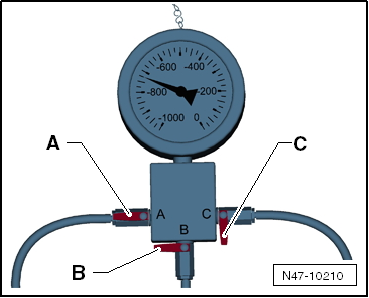
N47-10210

Start warm engine (>60° C), press accelerator briefly (engine speed greater than 2000/min).

Read indicated measured value.

Normally (see notes), the vacuum that is generated should be between 600 and 950 mbar (depending on engine size).

If the measured value is not reached even through the preconditions (see notes) have been met, the vacuum system must first be checked for leaks.

For comparison purposes, generate the vacuum with the manual vacuum pump VAS 6213Chapter.

Open cut-off valve (B) to facilitate removal of hose connections and adapter.

Parts & tools for this job For 2005 Volkswagen Passat

As an Amazon Associate we earn from qualifying purchases.