
Checking holding pressure
- Make
- Volkswagen
- Model
- Passat B6
- Year
- 2005–2010
- Section
- Fuel pump › Checking holding pressure
Checking holding pressure
Special tools and workshop equipment requiredPressure tester VAS 6550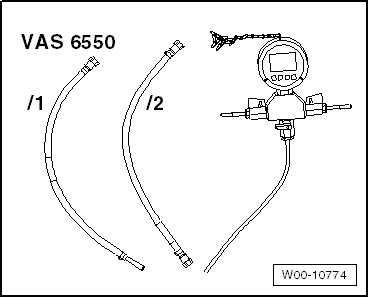
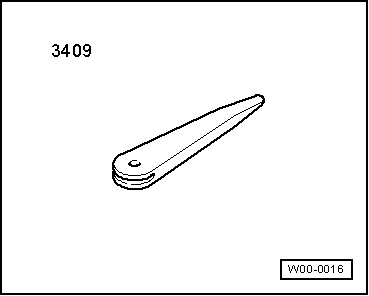
Observe safety precautions → Chapter.
Observe rules for cleanliness → Chapter.
Observe safety precautions when working on natural gas system → Chapter.
Connect hose VAS 6550/2 between fuel line from fuel tank to shut-off tap (A) of pressure tester VAS 6550.
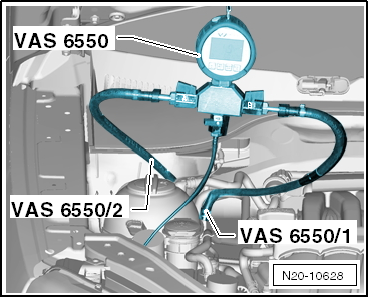
Connect hose VAS 6550/1 between fuel line leading to engine and shut-off tap (B) of pressure tester VAS 6550.
Actuate fuel pump with final control diagnosis to build up fuel pressure.
Note
- The fuel pump is now actuated to build up fuel pressure.
- If the final control diagnosis is to be carried out several times in succession, it may be necessary to start the engine briefly before repeating the final control diagnosis.
Read fuel pressure on pressure gauge and observe.
End self-diagnosis and switch off ignition.
Observe pressure drop on pressure gauge. After 10 minutes, the pressure must not drop by more than 1 bar.Check all fuel lines for leaks and damage.
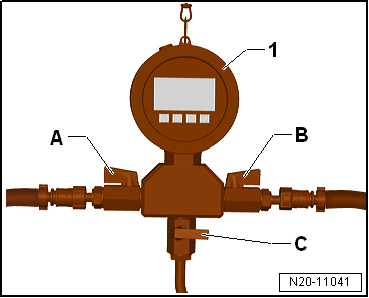
Ensure that drain tap (C) on pressure tester(1) is closed.
Shut-off valves (A) and (B) on pressure tester(1) are open.
Actuate fuel pump with final control diagnosis to build up fuel pressure.
After pressure has built up, close shut-off tap (B) of pressure tester immediately. Lever is then at right angle to direction of flow.
Check holding pressure on fuel filter Anchor.
Note
- Search for leak on engine side. Repeat holding pressure check. This time, close shut-off tap (A) to check whether leak actually is on engine side.
If there is a leak on engine side, carry out external check of fuel pipes and high-pressure pump for leaks.
If no fault can be determined, check the injectors for leaks:
Remove spark plugs. Open shut-off valves (A) and (B). Actuate fuel pump with final control diagnosis.
Check through spark plug holes whether fuel has collected on piston crown due to a leaking injector.
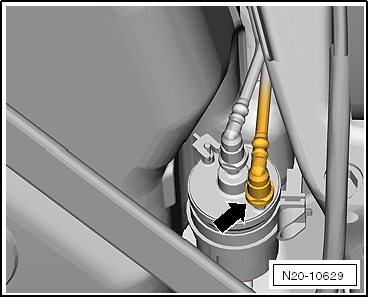
Pull fuel supply line (arrow) off fuel filter. Separate plug-in connectors → Chapter.
Warning The fuel line is under pressure.
Risk of injury to eyes and skin from fuel.
Wear eye protection and protective clothing to avoid eye injuries and skin contact. Before loosening hose connections, wrap a cloth around the connection. Then release pressure by carefully opening the connection point.
Connect pressure tester VAS 6550 between fuel filter and fuel supply line using hose VAS 6550/1 and hose VAS 6550/2.
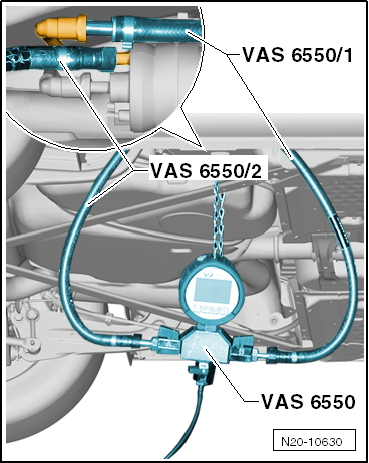
Connect hose VAS 6550/2 to connection (A) of pressure tester VAS 6550.
Connect hose VAS 6550/1 to connection (B) of pressure tester VAS 6550.
Ensure plug-in connectors are secured properly by pulling.
Ensure that drain tap (C) on pressure tester(1) is closed.
Shut-off valves (A) and (B) on pressure tester(1) are open.
Repeat holding pressure check Anchor.
After pressure has built up, close shut-off tap (A).
Observe pressure drop on pressure gauge. After 10 minutes, pressure must not drop below 3.0 bar.
Check fuel line leading to engine for leaks.
Check fuel filter for leaks.
If no fault is found:
Pressure limiting valve in fuel filter is defective. Renew fuel filter → Chapter.
Parts & tools for this job For 2005 Volkswagen Passat
- PARTFuel filterSearch: Volkswagen Passat 2005 fuel filter
- TOOLFuel pressure test kitSearch: fuel pressure test kit
- TOOLFuel line disconnect toolSearch: fuel line disconnect tool
As an Amazon Associate we earn from qualifying purchases.