
Workshop Manuals Factory service & repair Volkswagen
01 4-cylinder injection engine (1.8 and 2.0 l engine, chain drive)02 4-cylinder common rail engine (2.0 l, EA189)03 4-cylinder injection engine (2.0 l engine, turbocharger)04 4-cylinder injection engine (1.4 and 1.6 l direct injection)05 4-cylinder injection engine (2.0 l direct injection)06 4-cylinder injection engine (1.4 l direct injection engine, turbocharger)07 4-cylinder common rail engine (1.6 l, EA189)08 4-cylinder diesel engine (1.9 l engine)09 4-cylinder diesel engine (2.0 l engine, 4 valve)10 Fuel supply system - Diesel engines11 Fuel supply system - natural gas engines12 4-cylinder diesel engine (2.0 l engine, 2 valve)13 4-cylinder injection engine (1.6 l roller rocker finger)14 6-cylinder injection engine (direct injection)15 6-cylinder injection engine Volkswagen R GmbH16 4-cylinder direct-injection engine (1.4 l, natural gas, EA 111, turbocharger, supercharger)17 7-speed dual clutch gearbox 0AM18 Propshaft and rear final drive19 6-speed automatic gearbox 09M20 6-speed automatic gearbox 09G21 6-speed manual gearbox 02Q22 6-speed manual gearbox 02S23 6-speed dual clutch gearbox 02E24 6-speed manual gearbox 0AJ25 6-speed dual clutch gearbox 02E Volkswagen R GmbH26 5-speed manual gearbox 0A427 6-speed manual gearbox 02S, four-wheel drive28 6-speed manual gearbox 02Q four-wheel drive29 Propshaft and rear final drive Volkswagen R GmbH30 5-speed manual gearbox 0AH31 Wheels and Tyres Guide - Standard32 Brake systems33 Running gear, axles, steering34 Heating, air conditioning35 Heating and air conditioning: Supplementary heater36 Electrical: Communication37 Electrical system38 General body repairs, interior39 General body repairs, exterior
Volkswagen Passat B6 (2005-2010)31 · Wheels and Tyres Guide - Standard
31 · Steering & suspension

Flat spots (from locking wheels)

Make
Volkswagen
Model
Passat B6
Year
2005–2010
Section
Tyre noise › Flat spots (from locking wheels)
Wheels and Tyres Guide - StandardFlat spots (from locking wheels)

Flat spots (from locking wheels)

Flat spots can result from an extreme brake application which causes the wheels to lock, so that the rubber is worn off at the contact patch between the tread and the road surface.

As the tyres slide over the road surface, friction generates heat, which also reduces the wear resistance of the tread material.

Not even a highly wear-resistant tread compound can prevent the flat spots caused by violent braking.

Even ABS-controlled brake systems cannot prevent brief locking of the wheels, and thus, minor flat spots.

The degree of such wear depends largely on the vehicle speed, the road surface and the load placed on the wheel. The following examples should make this clear.

If a vehicle is braked to a standstill on a dry surface with the wheels locked, the amount of rubber worn from the tyre will cover an area the size of a postcard and will have a thickness of:

  • up to 2.0 mm from a speed of 57 km/h (23.8 m braking distance)
  • up to 3.3 mm from a speed of 75 km/h (41.8 m braking distance)
  • up to 4.8 mm from a speed of 92 km/h (71.6 m braking distance)
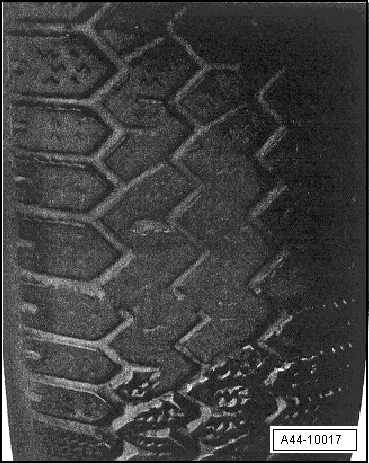
Flat spots in tread

A44-10017

Tyres with such damage must no longer be used and must be renewed.

Parts & tools for this job For 2005 Volkswagen Passat

As an Amazon Associate we earn from qualifying purchases.