
Safety precautions
- Make
- Volkswagen
- Model
- Passat B7
- Year
- 2010–2015
- Section
- Injection system › Safety precautions
Safety precautions
Warning Fuel system is under pressure! Wear eye protection and protective clothing to avoid possible injury and skin contact. Before loosening hose connections, wrap a cloth around the connection. Then release pressure by carefully pulling hose off connection.
To prevent injuries to persons and/or damage to the injection and ignition system, the following must be observed:
- For safety reasons, fuse No. 27 must be removed from fuse holder on left under dash panel before opening fuel system. Otherwise fuel pump will be activated by driver door contact switch.
- Do not touch or disconnect ignition cables when the engine is running or being turned at starter speed.
- Switch off ignition before connecting or disconnecting injection and ignition system wiring as well as test instrument cables.
Warning When doing any repair work, especially in the engine compartment, pay attention to the following due to the cramped conditions:
- Route all the various lines (e.g. for fuel, hydraulics, activated charcoal filter system, coolant and refrigerant, brake fluid and vacuum) and electrical wiring in their original positions.
- To avoid damage to lines, ensure sufficient clearance from all moving or hot components.
Note the following if testers and measuring instruments have to be used during a road test:
- Test and measuring instruments must always be secured to rear seat and operated by a second person from this location.
If test and measuring instruments are operated from front passenger seat and the vehicle is involved in an accident, there is a possibility that the person sitting in this seat may receive serious injuries when the airbag is triggered.
- If the engine is to be turned at starter speed without starting:
Pull all 4-pin connectors (arrows) off ignition coils.
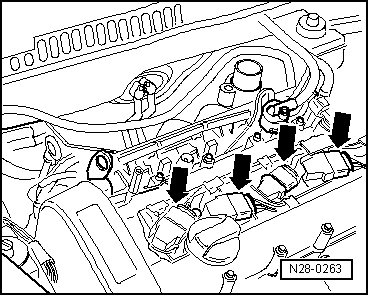
To do this, fit puller T10094 A on ignition coil with final output stage (arrow)Chapter.
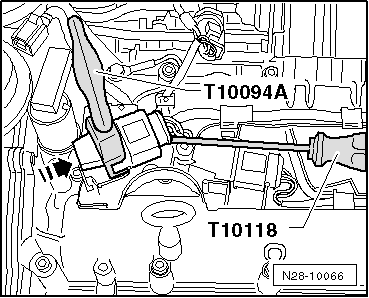
Pull ignition coil with final output stage out slightly.
Fit assembly tool T10118 as shown.
Carefully release connector locking mechanism and pull off connector.
When installing ignition coil for final output stage, slide connector on until it audibly engages.
Fit puller T10094 A as shown → Chapter.
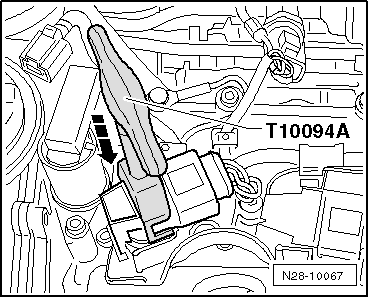
Press ignition coil with final output stage into cylinder head in direction of (arrow).
Parts & tools for this job For 2010 Volkswagen Passat
- PARTEngine gasket setSearch: Volkswagen Passat 2010 engine gasket set
- TOOLTorque wrenchSearch: 3/8 inch torque wrench
- TOOLFeeler gauge setSearch: feeler gauge set
As an Amazon Associate we earn from qualifying purchases.