
Removing and installing battery isolator
- Make
- Volkswagen
- Model
- Passat B7
- Year
- 2010–2015
- Section
- Battery › Removing and installing battery isolator
Removing and installing battery isolator
Warning
- Battery isolator improves crash safety on vehicles with battery installed in luggage compartment. In an accident, the airbag control unit triggers a charge disconnecting the voltage supply cable to the starter. Battery isolation is performed pyrotechnically, with a very small explosive charge. To ensure that you do not trigger the charge inadvertently when working on the battery or the battery isolator, you must first unscrew the negative terminal clamp → Chapter.
- Observe safety precautions when your are working on battery isolator Anchor.
- Comply with the instructions regarding the disposal of battery isolating units Anchor.
Installation of the pyrotechnical battery isolator is equipment-dependent in conjunction with a starter battery in the luggage compartment. The isolator is integrated into the main fuse box. The main fuse box is located on the left in the luggage compartment above the battery.
Warning
- Testing, removing, installing and repair work may only be performed by qualified personnel.
- When work is performed on the battery isolator, the battery earth cable must be disconnected.
- Before touching the battery isolator, the mechanic must electrostatically discharge himself. This can be done by touching a piece of earthed metal such as a water pipe, a heating pipe or metal girders.
- The battery isolation unit should be installed immediately after it is removed from its transportation packaging.
- If the work is interrupted, the battery isolation unit should again be placed in its transportation packaging.
- Battery isolation units must not be left lying unattended.
- Battery isolation units which have dropped onto a hard surface or show signs of damage must not be installed.
- The storage and transportation complies with the legislation for explosive substances.
Warning
- Non triggered battery isolation units must be disposed of in their original packaging and by an authorised authority according to national legislation. All enquires must be directed to your respective distribution centre or importer.
- Triggered battery isolation units can be disposed of through industrial waste system.
Warning
- Observe safety precautions when your are working on battery isolator Anchor.
- Comply with the instructions regarding the disposal of battery isolating units Anchor.
Switch off ignition and all electrical consumers.
Disengage ignition key out in position 0 (forward notch).
Disconnect battery in luggage compartment → Chapter.
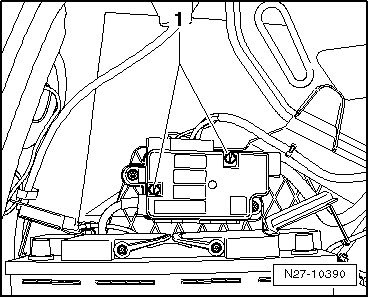
Open fasteners of main fuse box (1) by turning them 90° to left and open cover downwards.
Unbolt flanged nut (1) and detach battery positive cable (2) from connection thread.
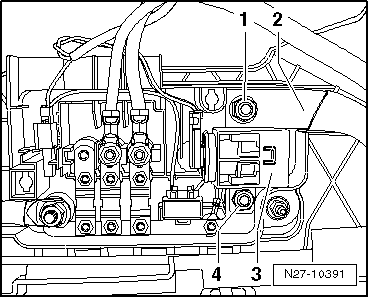
Unscrew self-locking nut (4) and remove pyrotechnical battery isolator (3) from connection threads. Take cable length into consideration while removing battery isolator.
Release connector (1) by pulling primary locking mechanism (3) in direction of arrow.
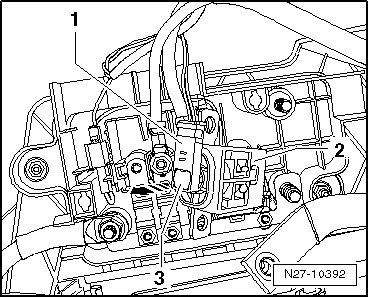
Pull connector (1) off in direction of arrow and remove pyrotechnical battery isolator (2) from vehicle.
Installation is carried out in the reverse order. When installing observe the following:
Note
- When attaching connector to pyrotechnical battery isolator, make sure that the connector engages audibly and that the primary locking mechanism is pressed in again.
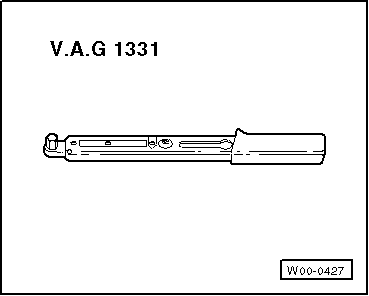
Tighten nut of B+ wire at main fuse box (1) to 15 Nm.
Tighten securing nut (self-locking) (4) of pyrotechnical battery isolator at main fuse box to 15 Nm.
Connect battery in luggage compartment → Chapter.
Parts & tools for this job For 2010 Volkswagen Passat
- TOOLBattery testerSearch: car battery tester
- TOOLDigital multimeterSearch: automotive digital multimeter
- TOOLBattery terminal cleanerSearch: battery terminal cleaner
As an Amazon Associate we earn from qualifying purchases.