
Removing and installing convenience system central control unit J393
- Make
- Volkswagen
- Model
- Passat B7
- Year
- 2010–2015
- Section
- Control units › Removing and installing convenience system central control unit J393
Removing and installing convenience system central control unit J393
Special tools and workshop equipment requiredTorque wrench V.A.G 1410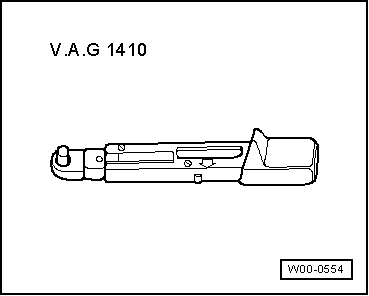
Depending on equipment, the following control units are integrated into the convenience system central control unit J393:
- Immobiliser control unit J362 or entry and start authorisation control unit J518
Additional information:
Self-study programmeNo.488The Passat 2011
Current flow diagrams, Electrical fault finding and Fitting locations
Operating manual
The convenience system central control unit J393 is, depending on equipment, responsible for the following in the vehicle:
- Control of the central locking system
- Activation of the rear door control unit
- Activation of the rear lid unlocking function
- Activation of the fuel filler flap unlocking function
- Activation of the sliding/tilting roof
- Activation of the anti-theft alarm (ATA), further information → Chapter
- Activation of the immobiliser, further information → Chapter
- Activation of the entry and start authorisation system, further information → Chapter
Note
- The procedure must always be carried out for reading the codes stored in the “convenience system central control unit” if the convenience system central control unit J393 is to be renewed Anchor.
- After renewing the convenience system central control unit J393, the convenience system central control unit's other functions, such as “immobiliser”, “anti-theft alarm”, “entry and start authorisation”, “tyre pressure monitor” and the central locking system keys must also be adapted depending on equipment.
- Start by adapting the immobiliser (Chapter) and continue, in any sequence, with the further functions of the convenience system central control unit J393.
After renewing the convenience system central control unit J393, the anti-theft alarm must be adapted → Chapter.
Vehicle diagnostic tester
Switch off ignition and all electrical consumers.
Disengage ignition key out in position 0 (forward notch).
Remove glove compartment General body repairs, interiorRep. gr.68Compartments/covers; Removing and installing glove compartment.
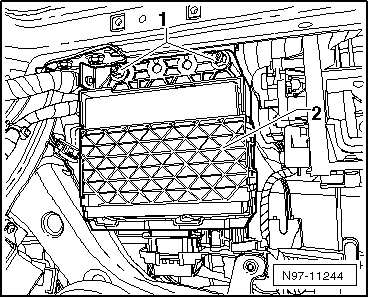
Unscrew both securing nuts (1) and remove convenience system central control unit J393 with bracket (2) from securing threads, taking connected wiring length into consideration.
Note
- The connectors can only be released and disconnected once the recesses of the connector and bracket are aligned with each other precisely.
Release locking lug (3) and push convenience system central control unit J393 into bracket in (direction of arrow) until recesses on connector (1) are exactly positioned over recesses (2) in bracket.
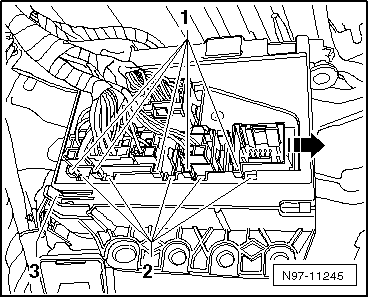
Pull all connectors off central control unit for convenience system J393.
Note
- The number of connectors depends on the vehicle equipment level.
- All connectors can only be fitted in one position and do not therefore have to be marked.
Open the four catches at the sides (arrows) and remove cover (1).
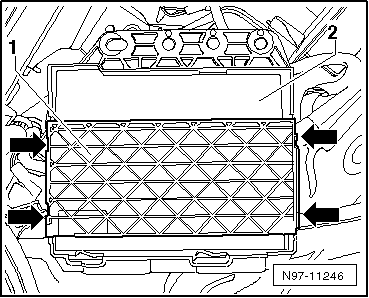
Remove convenience system central control unit J393(2) from bracket.
Installation is carried out in the reverse order. When installing observe the following:
Note
- The connectors can only be fitted and locked in place once the recesses of the connector (1) and the bracket (2) are positioned over one another precisely.
Tighten securing nuts (1) to specified torque of 4.5 Nm.
Vehicle diagnostic tester.
Note
- After renewing the convenience system central control unit J393, the convenience system central control unit's other functions, such as “immobiliser”, “anti-theft alarm”, “entry and start authorisation”, “tyre pressure monitor” and the central locking system keys must also be adapted depending on equipment.
- Start by adapting the immobiliser (Chapter) and continue, in any sequence, with the further functions of the convenience system central control unit J393.
Adapting convenience system central control unit
The following functions in the convenience system central control unit J393 can be adapted:
- Reading alarm sources of anti-theft alarm
- Reading alarm sources of alarm horn
- Adapting automatic unlocking on removing ignition key
- Adapting automatic locking at 15 km/h
- Adapting battery monitoring
- Adapting ATA delay on opening driver door
- Adapting unlocking of individual doors
- Adapting sensitivity of interior monitoring
- Adapting sensitivity of inclination sensor
- Deactivating factory mode
- Adapting convenience operation via remote control
- Adapting country setting for intelligent alarm horn
- Reading measured values of convenience system
- Adapting feedback indicating that anti-theft alarm system is armed
- Adapting feedback for unlocking and locking via remote control
- Adapting feedback for unlocking and locking via key
- Adapting feedback for unlocking and locking via access and start authorisation system
- Adapting remote control key
- Checking remote control key
- Adapting software of convenience system central control unit
- Updating convenience system central control unit
- Remote activation or deactivation of rear lid opening
Note
- It depends on the fitted optional equipment whether or not the above-mentioned adaptations can be carried out.
Vehicle diagnostic tester.
Parts & tools for this job For 2010 Volkswagen Passat
- TOOLDigital multimeterSearch: automotive digital multimeter
- PARTAssorted fuse kitSearch: car fuse assortment kit
- TOOLWire crimper and connector kitSearch: wire crimper connector kit
As an Amazon Associate we earn from qualifying purchases.