
Tyres with run-flat properties
- Make
- Volkswagen
- Model
- Passat B7
- Year
- 2010–2015
- Section
- Wheels, tyres › Tyres with run-flat properties
Running gear, axles, steeringTyres with run-flat properties
Tyres with run-flat properties
- As an option, the Passat can be equipped with self-sealing Continental tyres.
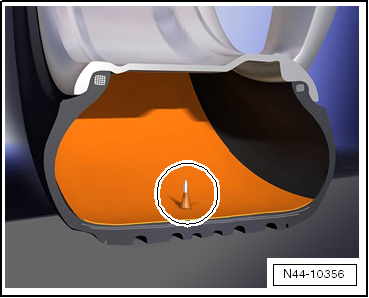
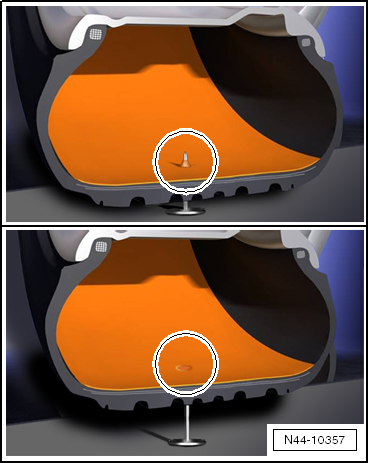
- This technology, referred to as ContiSeal, is a system that has been developed to allow the car to continue to be driven even if a nail or screw has penetrated the tyre: if screws or nails penetrate the tyre, a protective layer on the inside of the tyre running surface immediately seals the resulting holes.
- This means no air can escape. The sealing function is effective for almost all air leaks induced by objects up to 5 millimetres in diameter.
Note
- These may not be fitted in combination with other tyre types, e.g. run-flat tyres and “normal” tyres.
- ContiSeal is a preventative sealing compound installed by the manufacturer Continental as an integral component of the production process.
- ContiSeal is a self-adhesive, viscous sealing compound that is applied in an even coat from shoulder to shoulder on the inside of the running surface.
- The sealing compound represents an integral component of the mobility tyre.
- A mobility tyre can be identified by a special logo on the outside of the sidewall.
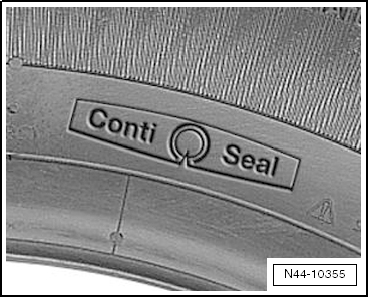
Warning The sealing compound is not intended as a permanent tyre repair following a puncture.
- If a foreign body with a diameter up to 5 mm punctures the running surface of a mobility tyre, the function of the sealing compound is to surround the object and to prevent any possible air loss by effecting an almost immediate seal.
- The sealing compound is designed to seal the majority of puncture types caused by foreign bodies up to 5 mm in diameter.
- ContiSeal significantly reduces the frequency of flat tyres, but it is not intended to allow the tyre to be operated with reduced pressure or when flat (without air).
- In all other respects, mobility tyres display the same properties as tyres without the ContiSeal sealing compound.
- When handling mobility tyres, take particular care to maintain cleanliness during work and also when storing tyres.
- The sealing compound on the inside of the running surface of the tyre is not protected and is therefore very susceptible to any type of contamination.
- We recommend storing each tyre individually in a sufficiently large plastic bag or similar.
- As with any other tyre, mobility tyres should be regularly checked for signs of cuts, penetrations and loss of inflation pressure.
- This inspection should be conducted at least once or twice a month, and always prior to each long trip.
- Penetrations or damage that is not attended to in good time can lead to a loss of inflation pressure and/or failure of the tyre.
- Mobility tyres with damage by cuts and/or penetrations must be inspected immediately.
- It is necessary to decide whether the tyre must be taken out of use and scrapped.
- Removing and installing the mobility tyre involves the same procedure as a normal tyre.
Parts & tools for this job For 2010 Volkswagen Passat
- TOOLTyre pressure gaugeSearch: digital tyre pressure gauge
- TOOLTorque wrenchSearch: 1/2 inch torque wrench
- TOOLBreaker barSearch: breaker bar
As an Amazon Associate we earn from qualifying purchases.