
Checking holding pressure
- Make
- Volkswagen
- Model
- Passat B8
- Year
- 2014–2023
- Section
- Fuel pump › Checking holding pressure
Checking holding pressure
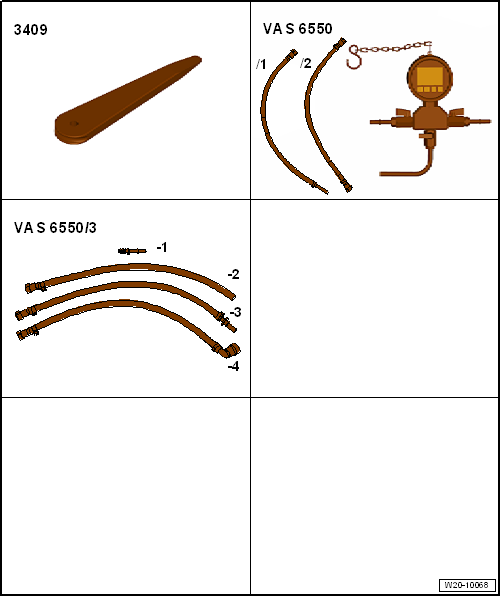
Connect fuel line from fuel tank to shut-off tap (B) of pressure tester VAS 6550 by means of hose VAS 6550/2.
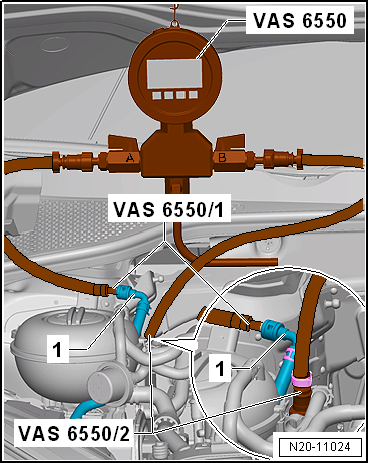
Connect fuel line leading to engine (1) to shut-off tap (A) of pressure tester VAS 6550 by means of hose VAS 6550/1.
Connect vehicle diagnostic tester.
Select final control diagnosis for fuel pump in vehicle self-diagnosis program.
Note
- The fuel pump is now actuated to build up fuel pressure.
- If the final control diagnosis was carried out several times in succession, it may be necessary to start the engine briefly before repeating the final control diagnosis.
Read off fuel pressure on pressure gauge.
Specification: ≥ 4.0 bar.End self-diagnosis, and switch off ignition.
Observe pressure drop on pressure gauge. After 10 minutes, pressure must not drop below 3.0 bar.
Check all fuel lines for leaks and damage.
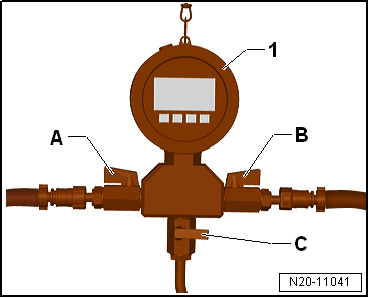
Ensure that drain tap (C) on pressure tester(1) is closed.
Shut-off valves (A) and (B) on pressure tester(1) are open.
Actuate fuel pump with final control diagnosis to build up fuel pressure.
After pressure has built up, close shut-off tap (A) of pressure tester immediately. Lever is then at right angle to direction of flow.
Proceed as follows to check residual pressure on fuel delivery unit Anchor.
Note
- Search for leak on engine side. Repeat holding pressure check. This time, close shut-off valve (B) to check whether leak actually is on engine side.
If there is a leak on engine side, carry out external check of fuel pipes and high-pressure pump for leaks.
If no fault can be determined, check the injectors for leaks:
Remove spark plugs.
Open shut-off valves (A) and (B). Actuate fuel pump with final control diagnosis.
Check through spark plug holes whether fuel has collected on piston crown due to a leaking injector.
Remove cover of assembly opening → Chapter.
Remove fuel pump control unit J538 with wiring harness still attached → Chapter.
Guide fuel pump control unit J538 out towards interior between fuel tank and floor panel.
Place fuel pump control unit J538 and wiring harness to one side.
Pull fuel line (1) off flange. Separate plug-in connectors → Chapter.
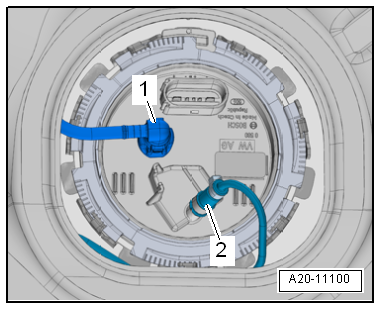
Connect pressure tester VAS 6550 to fuel delivery unit (1) by means of hose VAS 6550/3-4.
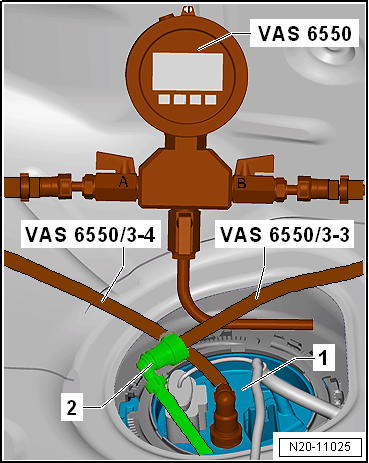
Connect pressure tester VAS 6550 to fuel line (2) by means of hose VAS 6550/3-3.
Ensure plug-in connectors are secured properly by pulling.
Ensure that drain tap (C) on pressure tester(1) is closed.
Shut-off valves (A) and (B) on pressure tester(1) are open.
Actuate fuel pump with final control diagnosis to build up fuel pressure.
After pressure has built up, close shut-off tap (B) of pressure tester immediately. Lever is then at right angle to direction of flow.
Repeat holding pressure check Anchor.
Check fuel line for leaks.
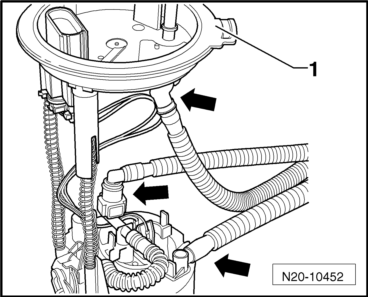
Open fuel delivery unit (1)Chapter.
Check that all hose connections (arrows) are connected.
Check fuel lines for leaks and damage.
Pressure retention valve in fuel delivery unit is defective; renew fuel delivery unit → Chapter.
Parts & tools for this job For 2014 Volkswagen Passat
- PARTFuel filterSearch: Volkswagen Passat 2014 fuel filter
- TOOLFuel pressure test kitSearch: fuel pressure test kit
- TOOLFuel line disconnect toolSearch: fuel line disconnect tool
As an Amazon Associate we earn from qualifying purchases.