
Checking for leaks
- Make
- Volkswagen
- Model
- Passat NMS, US and China
- Year
- 2011–2019
- Section
- Vacuum system › Checking for leaks
Checking for leaks
Note
- The average air pressure of the earth's atmosphere at sea level is 1013 mbar
- and decreases steeply as the altitude increases (approx. 100 mbar/1,000 m altitude).
- Local and time fluctuations also influence vacuum generation.
- A cold engine, a switched-on air-conditioning system as well as engine idling have an adverse influence on generation of a vacuum.
Check all vacuum hoses for damage (e.g. cracks or marten bite), and check that they are correctly and firmly attached.
Connect brake servo tester VAS 6721Chapter.
Open cut-off valve (A).
Close cut-off valves (B+C).
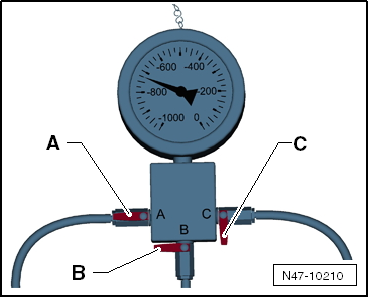
Start warm engine (>60°C), press accelerator briefly (engine speed above 2000 rpm).
Normally (see notes), the vacuum that is generated must be between 600 and 950 mbar (depending on engine type).
Open cut-off valve (C) to evacuate brake servo.
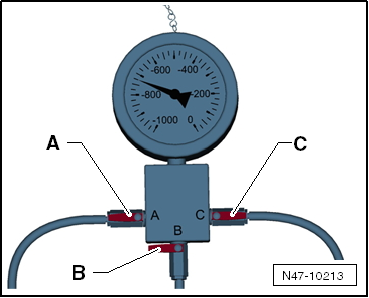
Switch off engine.
Read and make a note of measured value shown.
A vacuum decrease of 400 mbar in 12 hours is permissible.
If the vacuum decrease is greater, check for leaks in the vicinity of ...
Brake servoOrNon-return valve, vacuum hoses with connectors or vacuum pump/intake manifold..If there are large leaks, the vacuum decreases steeply within a few seconds.
After generation of vacuum, close cut-off valve (A) in order to check brake servo vacuum system.
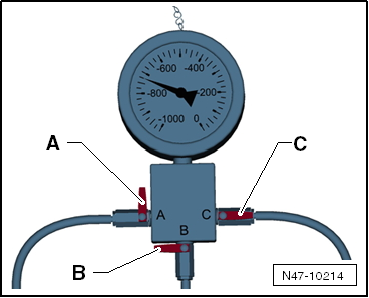
Once vacuum pressure has been generated, close shut-off valve (C) in order to check vacuum system from brake servo tester VAS 6721 up to intake manifold or vacuum pump.
Open cut-off valve (B) to facilitate removal of hose connections and adapter.
Parts & tools for this job For 2011 Volkswagen Passat
- PARTBrake padsSearch: Volkswagen Passat 2011 brake pads
- TOOLBrake bleeder kitSearch: one man brake bleeder kit
- FLUIDBrake fluidSearch: brake fluid
As an Amazon Associate we earn from qualifying purchases.