
Checking current draw
- Make
- Volkswagen
- Model
- Passat NMS, US and China
- Year
- 2011–2019
- Section
- Fuel pump › Checking current draw
Checking current draw
Special tools and workshop equipment requiredVehicle diagnostic testerHand-held multimeter V.A.G 1526D or pickup clamp V.A.G 1526B/2Test instrument adapter/DSO (5-pin) VAS 5565Vehicle diagnostic testerNote
- The battery voltage and the diesel fuel temperature have a great influence on the current draw of the fuel pump. For this reason, measures should be taken to ensure that battery voltage is at least 12.5 V during the check.
- The vehicle must be fuelled with the diesel fuel appropriate for the time of the year. The fuel sold in summer is guaranteed to be capable of filtration down to 0°C; that sold in the transition period (spring and autumn) down to -10°C. Diesel fuel sold in the winter is guaranteed to be capable of filtration down to -20°C. Summer diesel may coagulate (flock) in very low winter temperatures. If you are unsure, try and expose it to the low outside temperature for approximately 1 hour. If the fuel coagulates (flocks) at temperatures down to -20°C, it is unsuitable for low temperatures. This coagulation (flocking) can block the strainer in the fuel delivery unit as well as the fuel filter.
Remove rear bench seat General body repairs, interiorRep. gr.72Rear seat; Removing and installing bench seat / individual seats.
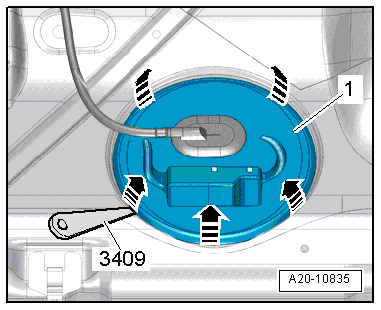
Unclip cover (1) for flange at retaining tabs (arrows), using removal wedge 3409.
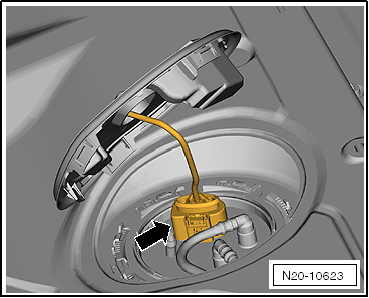
First check that plug connector (arrow) is fitted securely by pulling the plug connector without pressing the catch. The connector can cause a fault if it has not been fitted correctly.
Pull off connector (4).
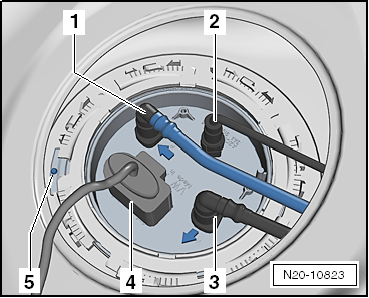
Connect test instrument adapter/DSO (5-pin) VAS 5565 to connector and fuel delivery unit.
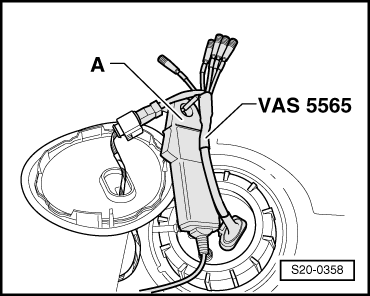
Connect pick-up clamp V.A.G 1526B/2(A) to red terminal with lettering “pick-up clamp” for test instrument adapter/DSO (5-pin) VAS 5565.
Note
- Pickup clamp of hand-held multimeter V.A.G 1715 can also be connected to red terminal with lettering “pickup clamp” of test instrument adapter/DSO (5-pin) VAS 5565.
Switch ignition on.
Connect vehicle diagnostic tester and carry out guided function Checking fuel pump.
Note
- The fuel pump is now activated for 30 seconds.
Read current draw on hand-held multimeter V.A.G 1526D.
Specification: max. 14.0 A.
If the measured value is not within specifications:
Remove fuel delivery unit → Chapter.
Check electrical wiring between flange and fuel pump for continuity.
Check filter in floor of fuel delivery unit for dirt or clogging.
If no open circuit or dirt is found:
Renew fuel delivery unit → Chapter.
Parts & tools for this job For 2011 Volkswagen Passat
- PARTFuel filterSearch: Volkswagen Passat 2011 fuel filter
- TOOLFuel pressure test kitSearch: fuel pressure test kit
- TOOLFuel line disconnect toolSearch: fuel line disconnect tool
As an Amazon Associate we earn from qualifying purchases.