
Checking holding pressure
- Make
- Volkswagen
- Model
- Passat NMS, US and China
- Year
- 2011–2019
- Section
- Fuel pump › Checking holding pressure
Checking holding pressure
Special tools and workshop equipment requiredPressure tester VAS 6550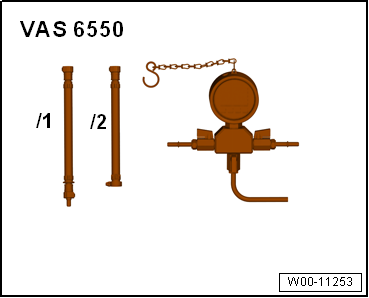
Observe safety precautions → Chapter.
Observe rules for cleanliness → Chapter.
Connect hose VAS 6550/2 between fuel line from fuel tank to shut-off tap (A) of pressure tester VAS 6550.
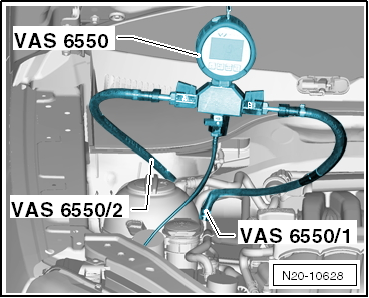
Connect hose VAS 6550/1 between fuel line leading to engine and shut-off tap (B) of pressure tester VAS 6550.
Actuate fuel pump with final control diagnosis to build up fuel pressure.
Note
- If the final control diagnosis is to be carried out several times in succession, it may be necessary to start the engine briefly before repeating the final control diagnosis.
Read fuel pressure on pressure gauge and observe.
| Engine code | Specified fuel pressure in bar |
|---|---|
| CDVB, CPKA, CPRA | ≥ 4.0 |
| CBTA, CBUA, CCCA | ≥ 3.5 |
End self-diagnosis and switch off ignition.
Observe pressure drop on pressure gauge. After 10 minutes, the pressure must not drop by more than 1 bar.Check all fuel lines for leaks and damage.
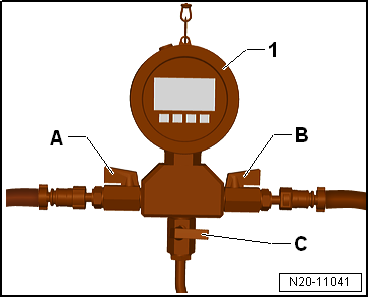
Ensure that drain tap (C) on pressure tester(1) is closed.
Shut-off valves (A) and (B) on pressure tester(1) are open.
Actuate fuel pump with final control diagnosis to build up fuel pressure.
After pressure has built up, close shut-off tap (B) of pressure tester immediately. Lever is then at right angle to direction of flow.
Proceed as follows to check residual pressure on fuel delivery unit Anchor.
Note
- Search for leak on engine side. Repeat holding pressure check. This time, close shut-off tap (A) to check whether leak actually is on engine side.
If there is a leak on engine side, check outside of all components for leaks.
If no fault can be determined, check the injectors for leaks:
Engine codes CBTA, CBUA, CCCA Rep. gr.24Injectors; Checking injectors.Engine codes CDVB, CPKA, CPRA:Remove spark plugs. Open shut-off valves (A) and (B). Actuate fuel pump with final control diagnosis.
Check through spark plug holes whether fuel has collected on piston crown due to a leaking injector.
Leak must be sought on fuel tank side; proceed as follows:
Remove bench seat General body repairs, interiorRep. gr.72Rear seat; Removing and installing bench seat / individual seats.
Guide carpet out and fold upwards, if fitted.
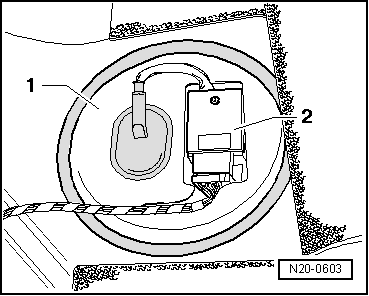
If fitted, remove fuel pump control unit J538(2) from cover on right.
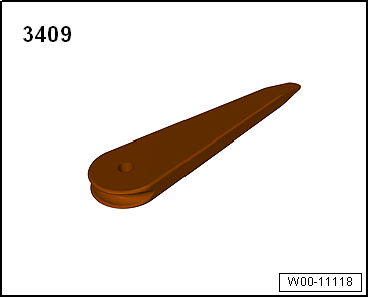
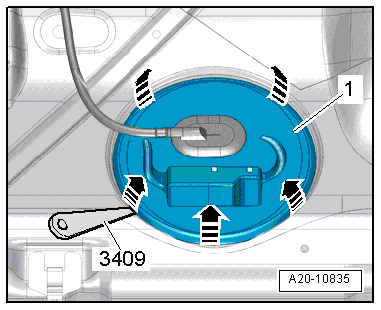
Unclip right cover (1) at retaining tabs (arrows), using removal wedge 3409.
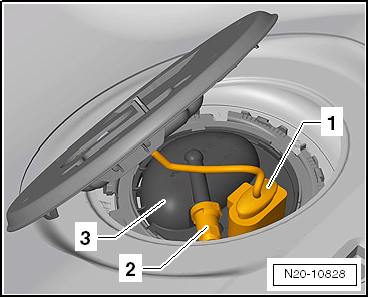
Disconnect fuel supply line (2). Separate plug-in connectors → Chapter.
Connect pressure tester VAS 6550 to fuel delivery unit (1) using hose VAS 6550/2.
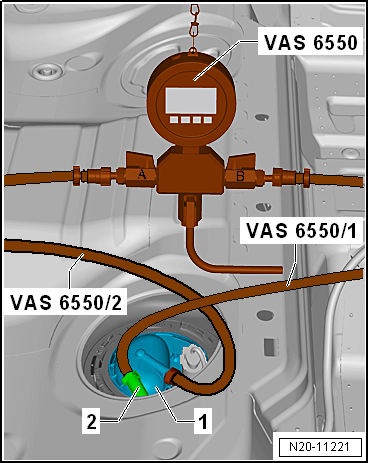
Connect hose VAS 6550/1 between pressure tester VAS 6550 and fuel supply line (2).
Ensure plug-in connectors are secure properly by pulling.
Make sure that drain tap (C) is closed and shut-off taps (A) and (B) on pressure tester VAS 6550(1) are open.
Actuate fuel pump with final control diagnosis to build up fuel pressure.
After pressure has built up, close shut-off tap (B) of pressure tester immediately. Lever is then at right angle to direction of flow.
Repeat holding pressure check Anchor.
Check fuel line between engine and fuel tank for leaks.
Open locking ring using wrench T10202.
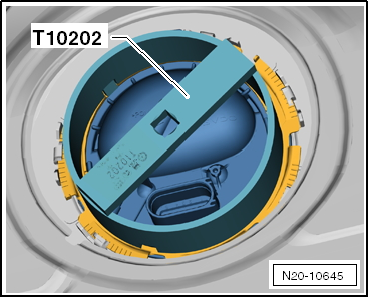
Do not cant key T10202 and press against locking ring firmly. If the key slips off, the fuel delivery unit can be damaged.
Check that all hose connections of fuel delivery unit are connected.
If no fault is found:
Pressure limiting valve in fuel delivery unit flange or pressure retention valve in fuel pump is leaking.
First renew flange with fuel filter and repeat pressure retention test Anchor.
If the pressure drops again:
Renew fuel delivery unit → Chapter.
Parts & tools for this job For 2011 Volkswagen Passat
- PARTFuel filterSearch: Volkswagen Passat 2011 fuel filter
- TOOLFuel pressure test kitSearch: fuel pressure test kit
- TOOLFuel line disconnect toolSearch: fuel line disconnect tool
As an Amazon Associate we earn from qualifying purchases.