volkswagen Workshop Repair Guides

Volkswagen Workshop Service and Repair Manuals

Removing and installing fuel delivery unit > < Rules for cleanliness
4-Cyl. injection engine (4 valve), Mechanics
Removing and installing parts of fuel supply system
Checking fuel pump

Special tools, testers and auxiliary items

  • ◆ Remote control V.A.G 1348/3A with adapter cable V.A.G 1348/3-2
  • ◆ Adapter set V.A.G 1594
  • ◆ Multimeter V.A.G 1715
  • ◆ Diode test lamp V.A.G 1527
  • ◆ Current flow diagram
  • ◆ Ring nut spanner 3217
  • ◆ Pressure tester V.A.G 1318
  • ◆ Adapter 1318/1
  • ◆ Adapter 1318/7
  • ◆ Adapter 1318/10
  • ◆ Adapter 1318/13
  • ◆ Measuring container
  • ◆ Torque wrench V.A.G 1332 (40...200 Nm)

Test conditions

  • ● The battery voltage must be OK.
  • ● Fuse 18 must be OK.

Checking function and voltage supply

Note:

Check whether a coded radio is installed as during the forthcoming work sequences the battery earth strap must be disconnected. Obtain radio code first if necessary.

  • ‒ Briefly operate starter. Fuel pump must be heard to run           briefly -approx. 1 second-.

If the fuel pump does not run:

 
N24-0153
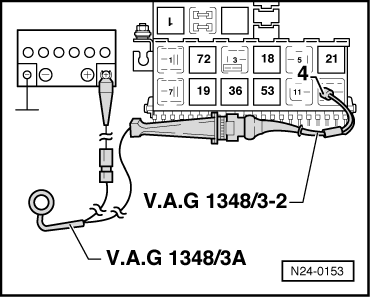
  • ‒ → Pull the fuel pump relay (J17) out of relay plate with fuse box (relay position 12).

Note:

If the relay cannot be removed from the relay plate without tools then first disconnect battery earth strap.

  • ‒ Connect remote control V.A.G 1348/3A with adapter cable V.A.G 1348/3-2 to contact 4 and battery positive (+).
  • ‒ Operate remote control.

Fuel pumps run:

  • ‒ Check activation of fuel pump relay:

=> 1AV Injection and ignition system (4 valve); Repair group 01; Self-diagnosis; Final control diagnosis

Fuel pump does not run:

  • ‒ Fold rear seat forwards.
  • ‒ Remove cover in luggage boot floor.
 
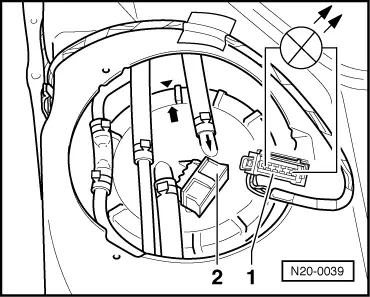
N20-0039
  • ‒ → Pull 4-pin connector -1- off fuel tank flange -2-.
  • ‒ Connect diode test lamp V.A.G 1527 using aux. cables from V.A.G 1594 to the outer contacts of the connector.
  • ‒ Operate remote control.
         LED must light up

LED does not light up:

  • ‒ Locate and eliminate open circuit using current flow diagram

LED lights up (voltage supply OK.):

  • ‒ Remove union nut from flange with 3217.
  • ‒ Check that the electrical wires between flange and fuel pump are connected.

If not open circuit can be found:

  • ‒ Renew fuel delivery unit.

Checking delivery rate

Test conditions

  • ● The voltage supply for the fuel pump OK.
  • ● Remote control V.A.G 1348/3A is still connected.

Test sequence

  • ‒ Remove filler cap from fuel tank filler neck.
Warning!
Fuel supply pipes are under pressure! Before disconnecting hose wrap a cloth around the connection. Then release pressure by carefully pulling hose off connection.

 
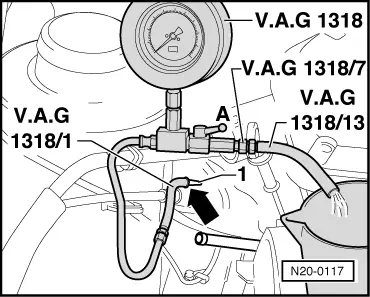
N20-0117
  • ‒ → Pull fuel supply hose (white marking) off fuel supply pipe -1-.
  • ‒ Connect pressure gauge V.A.G 1318 with adapter /1 to fuel supply pipe.
  • ‒ Screw adapter hose /13 with adapter /7 to pressure gauge and hold hose in measuring container.
  • ‒ Open pressure gauge cut-off tap. Lever points in throughflow direction -A-.
  • ‒ Operate remote control V.A.G 1348/3A. Whilst doing this slowly close the cut-off tap, until gauge shows a pressure of
         3 bar.
    From now on do not alter the position of the cut-off tap.
  • ‒ Empty measuring container.
  • ‒ The fuel pump delivery range is dependent upon battery voltage. Therefore connect the multimeter with adapter cables from V.A.G 1594 to the vehicle battery.
  • ‒ Operate remote control for
         30 seconds
    and measure battery voltage
 
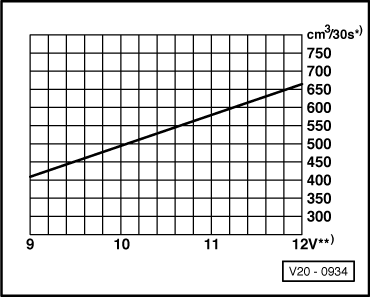
V20-0934
  • ‒ → Compare the quantity of fuel delivered with specification.

     *)     Minimum delivery cm3/30 seconds

     **)     Voltage at fuel pump with engine stationary and pump running (approx. 2 volts less than battery voltage).

If the minimum delivery rate is not attained:

  • ‒ Check the fuel pipes for possible restrictions (kinks) or blockages.
 
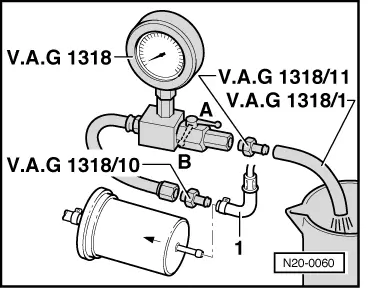
N20-0060
  • ‒ → Pull the supply hose -1- off fuel filter inlet.
  • ‒ Connect the pressure gauge V.A.G 1318 to hose with adapter /10.
  • ‒ Repeat delivery rate check.

If the minimum delivery rate is now attained:

  • ‒ Replace the fuel filter.

If the minimum delivery rate is again not attained:

  • ‒ Remove the fuel delivery unit and check the strainer filter for soiling.

Only when up to now no fault has been detected:

  • ‒ Replace the fuel delivery unit.

If the delivery rate has been attained but nevertheless you suspect a fuel supply system fault (e.g. intermittent failure of fuel supply system):

  • ‒ Check the current draw of the fuel pump as follows:
  • ‒ Reconnect all disconnected fuel pipes.
 
N20-0061
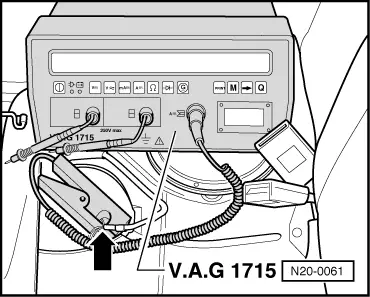
  • ‒ → Connect the multimeter V.A.G 1715 using the current clamp to the red/yellow wire from wiring harness.
  • ‒ Start the engine and run at idling speed.
  • ‒ Measure the current draw of the fuel pump.
         Specification: max. 8 amps.

Note:

If the fuel system malfunction is intermittent, you can perform the check during a test drive, to do this a 2nd person is necessary.

If the current draw is exceeded:

  • ‒ Replace the fuel delivery unit.

Checking fuel pump non-return valve

Test conditions

  • ● Remote control V.A.G 1348/3A is still connected.
  • ● Pressure gauge V.A.G 1318 is still connected.

Test sequence

Note:

With this check the fuel supply pipe connections from the fuel delivery unit to the point at which the pressure gauge V.A.G 1318 is connected will be checked for leaks at the same time.

  • ‒ Close pressure gauge cut-off tap (lever at right angles to direction of flow).
  • ‒ Operate remote control at short intervals, until a pressure of
         3 bar
    has built up.
Warning!
Danger of spray when opening the cut-offtap, hold container over the pressure gauge free connection.
  • ‒ If pressure builds up too high, lower excess pressure by carefully opening the cut-off tap.
  • ‒ Watch pressure drop. After 10 minutes the pressure must not drop below
         2 bar.

If the pressure drops further:

  • ‒ Check pipe connections for leaks.

If no wiring fault is detected:

  • ‒ Replace the fuel delivery unit.

Removing and installing fuel delivery unit > < Rules for cleanliness