
Saw-tooth wear
- Make
- Volkswagen
- Model
- Polo Mk4
- Section
- Tyre noise › Saw-tooth wear
Saw-tooth wear
Saw-tooth wear is a stepped wear pattern on the individual tread blocks → Fig. that can cause increased tyre noise. The saw tooth is caused by uneven deformation of the tread blocks in the tyre's contact patch. Saw-tooth wear is more pronounced on non-driven wheels than on driven wheels.
New tyres are more susceptible to saw-tooth wear because of the greater elasticity of the high tread blocks. As the tread depth decreases, the tread blocks become more rigid and the tendency to wear in a saw-tooth pattern decreases.
Appearance of saw tooth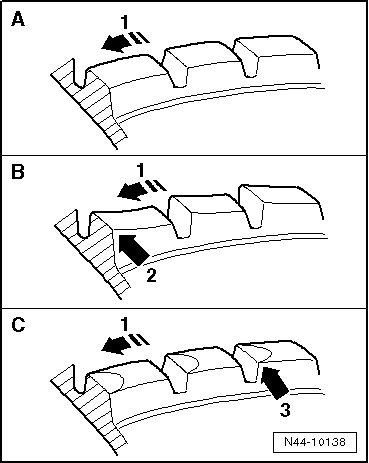
Pronounced saw-tooth wear can lead to customers complaining about tyre noise.
Pronounced saw-tooth wear occurs under the following conditions:
- toe values are too high
- tyre pressures are incorrect
- tread is coarse and open
- tyres are fitted on the non-driven axle
- very fast cornering.
In the event of saw-tooth wear, the direction of rotation of the tyre must be reversed. If saw-tooth wear is especially pronounced and tyre noise has increased, interchange the tyres diagonally. This will reduce the saw-tooth effect.
On front-wheel-drive vehicles, this effect is intensified by the greater wear on the front axle.
Tyre noise will be somewhat louder immediately after the tyres have been interchanged but will return to a normal level after about 500…1,000 km have been driven.
In the event of increased saw-tooth wear on the rear tyres – in particular on front-wheel drive vehicles – interchange the front and rear tyres. In the event of increased saw-tooth wear on the outer edges of the tyres on one axle, turn both tyres around on their rims. The left-hand wheel must then be fitted on the right side of the vehicle and the right-hand wheel on the left side.
Parts & tools for this job For Volkswagen Polo
- TOOLTyre pressure gaugeSearch: digital tyre pressure gauge
- TOOLTorque wrenchSearch: 1/2 inch torque wrench
- TOOLBreaker barSearch: breaker bar
As an Amazon Associate we earn from qualifying purchases.