
Checking fuel delivery rate
- Make
- Volkswagen
- Model
- Polo Sedan and Vento, India and Malaysia
- Year
- 2010–2020
- Section
- Fuel pump › Checking fuel delivery rate
Checking fuel delivery rate
Note
- When driving characteristic problems occur when the fuel tank is a approx. 1/4 filled, then check fuel delivery rates with approx. 1/4 filled tank or less.
Observe safety precautions → Chapter.
Observe rules for cleanliness → Chapter.
Connect battery charger Electrical systemRep. gr.27Battery; Charging battery.
Note
- On vehicles with engine code CPTA, the fuel delivery rate must first be checked in the engine compartment with the help of the function “Checking fuel delivery rate, quick test”. If the minimum fuel delivery rate is not attained, additional measurements must be performed.
Connect vehicle diagnosis tester.
Press following buttons on display one after the other:
- Guided Functions
- Engine
- Checking fuel delivery rate, quick test
Follow instructions on vehicle diagnosis tester.
If the specification is not attained, additional measurements must be performed on the fuel filter and on the fuel delivery unit Anchor.
Remove bench seat General body repairs, interiorRep. gr.72Rear seat; Removing and installing bench seat / individual seats.
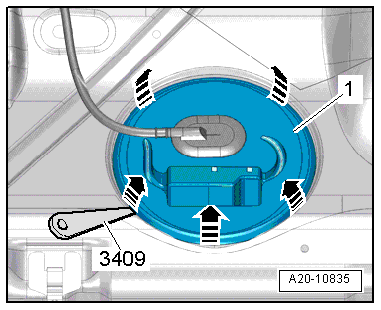
If fitted, unclip fuel pump control unit J538(2) from cover (1).
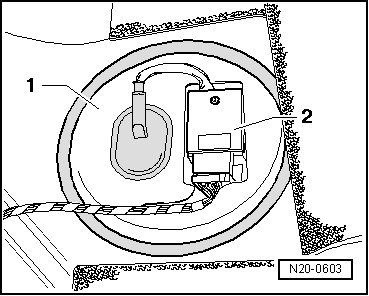
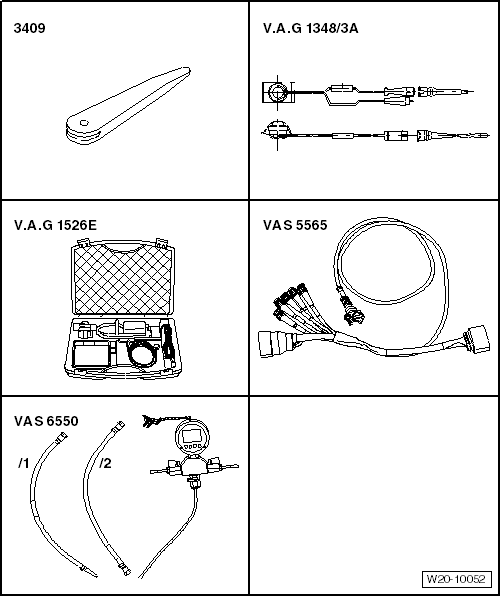
Unclip cover (1) at retaining tabs (arrows) using removing wedge 3409.
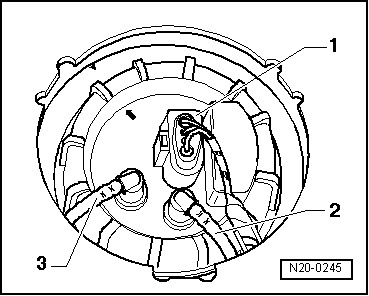
Release and pull off connector (1).
Connect test instrument/DSO adapter (5-pin) VAS 5565 to connector and fuel delivery unit.
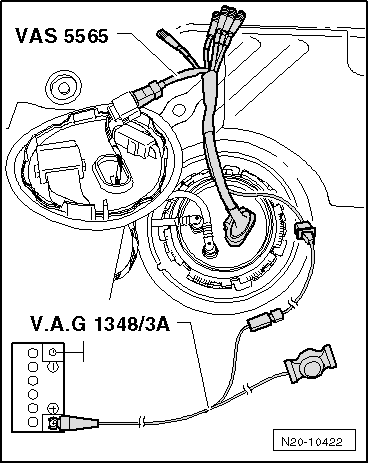
Connect remote control V.A.G 1348/3A to adapter VAS 5565 and to battery positive terminal in engine compartment.
Note
- This step serves only to have the fuel pump running when the engine is stopped.
The quantity of fuel delivered by the fuel pump is dependant on the battery voltage. The multimeter must therefore be connected to contacts (1) and (5) of 5-pin test instrument/DSO adapter VAS 5565 as well.
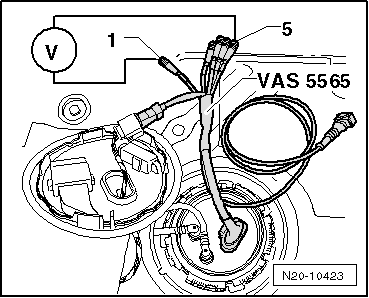
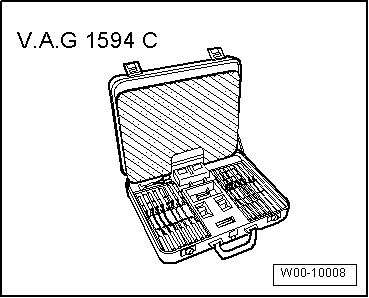
Connect multimeter with auxiliary measuring set V.A.G 1594C.
Release supply line (1) and pull it off. Separate plug-in connectors → Chapter.
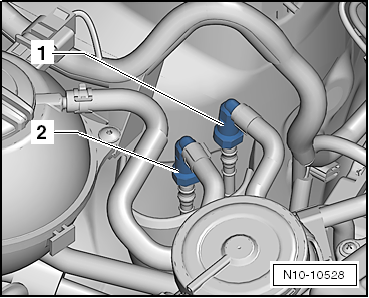
Warning The fuel line is under pressure.
Risk of injury to eyes and skin from fuel.
Wear eye protection and protective clothing to avoid eye injuries and skin contact. Before loosening hose connections, wrap a cloth around the connection. Then release pressure by carefully opening the connection point.
Collect escaping fuel with a cleaning cloth.
Using hose VAS 6550/2, connect pressure tester VAS 6550 to fuel supply line coming from fuel tank.
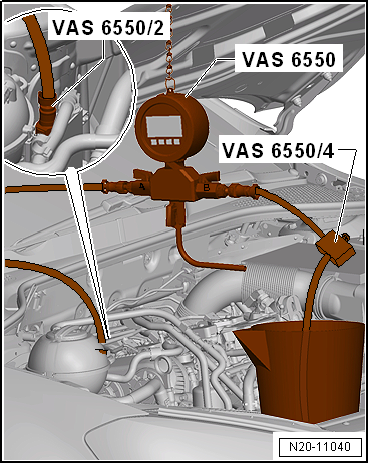
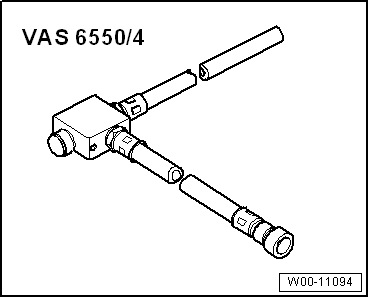
Connect pressure regulating valve VAS 6550/4 to connection (B) of pressure tester VAS 6550.
Hold end of hose of pressure regulating valve VAS 6550/4 in measuring container.
Ensure that drain tap (C) on pressure tester VAS 6550(1) is closed.
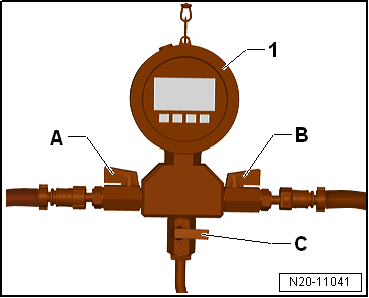
Shut-off taps (A) and (B) on pressure tester VAS 6550(1) must be open.
Warning Danger of spraying! Wear eye protection and protective clothing to avoid eye injuries and skin contact. Hold container in front of the free connection on the pressure tester VAS 6550.
Press remote control V.A.G 1348/3A.
Note
- The fuel system pressurisation pump G6 will be actuated.
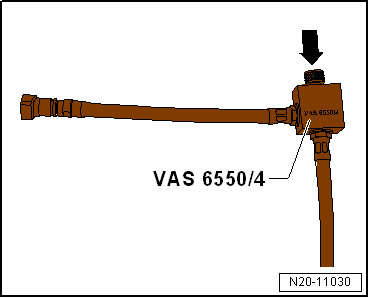
Adjust pressure on pressure regulating valve VAS 6550/4 to 3.0 bar.
Adjust pressure on pressure regulating valve VAS 6550/4 to 4.5 bar.
Set pressure on pressure regulating valve VAS 6550/4 using adjuster wheel (arrow).
From this point on do not change position of adjuster wheel anymore.
Drain measuring container.
Press remote control for 60 seconds whilst measuring voltage at fuel pump.
Compare delivered quantity of fuel with specification indicated in chart.
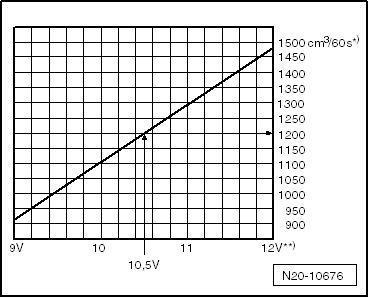
| Name of axis | Unit |
|---|---|
| Minimum delivery rate | cm3 |
| Voltage at fuel pump with engine not running and pump running. | Volt |
Example:
During the test a voltage of 10.5 volts is measured. This equates to a minimum delivery rate of approx. 1200 cm3 in 60 seconds.
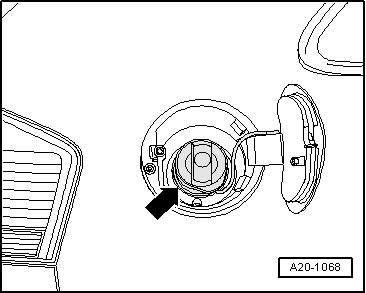
Open tank flap unit.
Clean area around fuel filler neck.
Unscrew cap from fuel filler neck (arrow).
Repeat check Anchor.
Check fuel tank breather → Chapter.
Check fuel lines for possible restrictions (kinks) or blockages.
Check fuel lines for leaks and damage.
Check fuel delivery rate on fuel filter as follows:
Pull fuel supply line (arrow) off fuel filter. Separate plug-in connectors → Chapter.
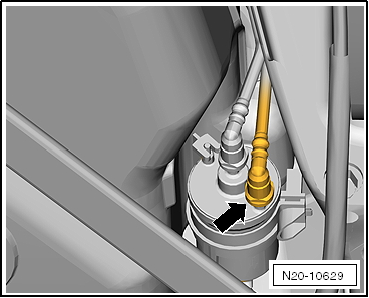
Warning The fuel line is under pressure.
Risk of injury to eyes and skin from fuel.
Wear eye protection and protective clothing to avoid eye injuries and skin contact. Before loosening hose connections, wrap a cloth around the connection. Then release pressure by carefully opening the connection point.
Connect pressure tester VAS 6550 to fuel supply line (2) by means of hose VAS 6550/1.
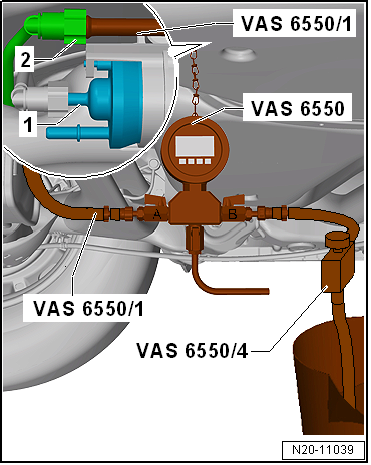
Connect pressure regulating valve VAS 6550/4 to connection (A) of pressure tester VAS 6550.
Hold end of hose of pressure regulating valve VAS 6550/4 in measuring container.
Ensure that drain tap (C) on pressure tester VAS 6550(1) is closed.
Shut-off taps (A) and (B) on pressure tester VAS 6550(1) must be open.
Repeat fuel delivery rate check Anchor.
Check fuel lines for possible restrictions (kinks) or blockages.
Check fuel lines for leaks and damage.
Check fuel filter, renew if necessary → Chapter.
Proceed as follows to check fuel delivery rate at fuel delivery unit:
Pull off fuel supply line (3) (black). Separate plug-in connectors → Chapter.
Warning The fuel line is under pressure.
Risk of injury to eyes and skin from fuel.
Wear eye protection and protective clothing to avoid eye injuries and skin contact. Before loosening hose connections, wrap a cloth around the connection. Then release pressure by carefully opening the connection point.
Connect pressure tester VAS 6550 with hose VAS 6550/2 to fuel delivery unit (1).
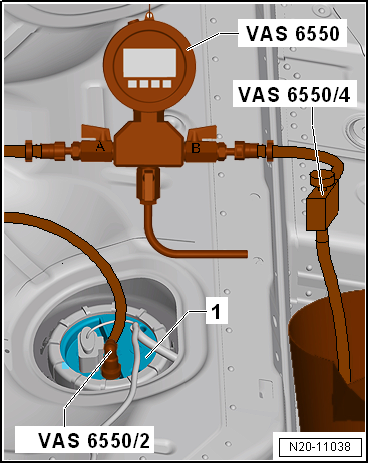
Connect hose VAS 6550/2 to shut-off tap (A).
Connect pressure regulating valve VAS 6550/4 to connection (B) of pressure tester VAS 6550
Hold end of hose of pressure regulating valve VAS 6550/4 in measuring container.
Ensure that drain tap (C) on pressure tester VAS 6550(1) is closed.
Shut-off taps (A) and (B) on pressure tester VAS 6550(1) must be open.
Repeat fuel delivery rate check Anchor.
Check fuel lines for possible restrictions (kinks) or blockages.
Check fuel lines for leaks and damage.
Remove fuel delivery unit → Chapter.
Check filter strainer for soiling.
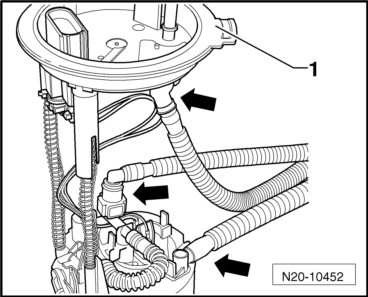
Check that all fuel delivery unit (1) hose connections (arrows) are connected.
Check fuel lines for possible restrictions (kinks) or blockages.
Check fuel lines for leaks and damage.
Renew fuel delivery unit → Chapter.
Parts & tools for this job For 2010 Volkswagen Polo
- PARTFuel filterSearch: Volkswagen Polo 2010 fuel filter
- TOOLFuel pressure test kitSearch: fuel pressure test kit
- TOOLFuel line disconnect toolSearch: fuel line disconnect tool
As an Amazon Associate we earn from qualifying purchases.