
Specifications:
- Make
- Volkswagen
- Model
- Polo Vivo, South Africa
- Year
- 2010–2017
- Section
- Checking pressures on vehicles › Specifications:
‹ Prev Checking systems with an expansion valve, receiver and air conditioner compressor regulating valve N280 (with externallyNext › With expansion valve, receiver and electrical air conditioner compressor
Heating; air-conditioningSpecifications:
Specifications:
Rising from starting pressure (when pressure gauge is connected) to 20 bar.
Falling from starting pressure (when pressure gauge is connected) to diagram value.
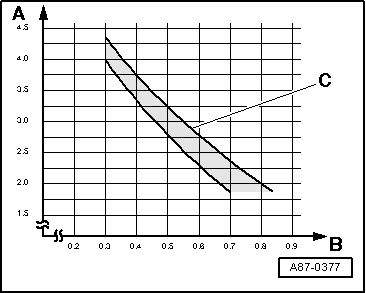
Note
- Under unfavourable conditions (very high ambient temperatures, high atmospheric humidity), the pressure on the high-pressure side can increase to a maximum of 29 bar.
- The control current (B) is indicated in the measured values block.
- The high-pressure value measured by the high-pressure sender G65 is indicated in the measured values block Rep. gr.87.
- The low pressure is adjusted to within tolerances within the output range for the air conditioner compressor depending on the control current for the air conditioner compressor regulating valve N280.
- Under unfavourable conditions (very high ambient temperatures, high atmospheric humidity), the output may be insufficient to achieve the specification in every case.
- The set working current for the regulating valve must be greater than 0.3 A to ensure that the regulating valve is reliably activated.
- At the setting “maximum cooling power”, the control current should be approx. 0.65 A to 0.8 A (vehicle-specific, indicated in the measured values block) Rep. gr.87.
- Absolute pressure means that 0 bar corresponds to an absolute vacuum. The normal ambient pressure corresponds to 1 bar absolute pressure. On most pressure gauges, a reading of 0 bar corresponds to an absolute pressure of one bar (which is confirmed by the existence of - 1 bar marking beneath the 0 scale marking).
| Possible deviation from specification | Possible cause of fault | Rectifying fault |
|---|---|---|
| High pressure remains constant or increases only slightly (above the pressure measured when the engine is stopped).Low pressure falls quickly to the diagram value or lower.The required cooling output is not delivered. | Actuation of air conditioner compressor regulating valve N280 is defective.Insufficient refrigerant in circuit. | Check actuation of air conditioner compressor regulating valve N280.Look for leaks using leak detector and rectify them.Recharge refrigerant circuit. |
| High pressure is normal.Low pressure matches the diagram value.The required cooling output is not delivered. | ||
| High pressure is normal.Low pressure too low (see diagram).The required cooling output is not delivered. | Insufficient refrigerant in circuit. | Extract some refrigerant from the refrigerant circuit.The quantity of refrigerant extracted is significantly less than the prescribed charge quantity.Look for leaks using leak detector and rectify them.Recharge refrigerant circuit.Repeat check.The quantity of refrigerant extracted is about equal to the prescribed charge quantity. |
| Expansion valve defective | Renew expansion valve.Recharge refrigerant circuit.Repeat check. |
Note
- If no fault can be found for this complaint, purge (clean) refrigerant circuit with refrigerant R134a . If this is not possible in your workshop, blow through refrigerant circuit with compressed air and dry with nitrogen .
- Check the measured values of the evaporator output temperature sender G263 or evaporator temperature sensor G308 and actuation of the air conditioner compressor regulating valve N280. If the measured value of the evaporator output temperature sender G263 or the evaporator temperature sender G308 is faulty, the evaporator may ice up or the cooling output will not be achieved.
- If a repeat test after the expansion valve has been renewed indicates that the air conditioning system is still not operating correctly, refit the expansion valve and purge the refrigerant circuit with compressed air and nitrogen. Then renew the air conditioner compressor and receiver.
- In this case, the evaporator may ice up although the correct quantity of refrigerant is present in the refrigerant circuit.
- If the expansion valve is defective (always closed or not opening wide enough) the air conditioner compressor regulating valve N280 will be set to maximum power and the low-pressure value will fall to the diagram value or less (the air conditioner compressor is drawing the refrigerant out of the low-pressure side). However, since no refrigerant can flow through the expansion valve, the required cooling power is not delivered, and it can be that the high-pressure value does not rise at all or not enough, since no energy exchange is occurring.
| Possible deviation from specification | Possible cause of fault | Rectifying fault |
|---|---|---|
| High pressure increases only slightly above the pressure measured when the engine is stopped.Low pressure falls only slightly.The required cooling output is not delivered. | Actuation of air conditioner compressor regulating valve N280 is defective. | Check actuation of air conditioner compressor regulating valve N280. |
| The air conditioner compressor is defective. | Extract refrigerant.Purge (clean) refrigerant circuit .Renew air conditioner compressor. Recharge refrigerant circuit. | |
| High pressure increases beyond the specification.Low pressure falls quickly to the diagram value or lower.The required cooling output is not delivered. | Actuation of air conditioner compressor regulating valve N280 is defective. | Check actuation of air conditioner compressor regulating valve N280. |
| Restriction or obstruction in the refrigerant circuit. | Feel the refrigerant circuit with the hand to sense the temperature gradient.At one component a temperature gradient will be detected:If a hose or pipe is kinked or crushed, renew it.In case of an obstruction, blow through refrigerant circuit with compressed air and nitrogen. Recharge refrigerant circuit.Repeat check.If no faults are found:Purge (clean) refrigerant circuit .Recharge refrigerant circuit.Repeat the check; if the system does not operate correctly | |
| Expansion valve defective. | Extract refrigerant.Renew the expansion valve and receiver.Recharge refrigerant circuit. |
Note
- In this case, the evaporator may ice up although the correct quantity of refrigerant is present in the refrigerant circuit.
- If the expansion valve is defective (always closed or not opening wide enough) the air conditioner compressor regulating valve N280 will be set to maximum power and the low-pressure value will fall to the diagram value or less (the air conditioner compressor is drawing the refrigerant out of the low-pressure side). However, since no refrigerant can flow through the expansion valve, the required cooling power is not delivered, and it can be that the high-pressure value does not rise at all or not enough, since no energy exchange is occurring.
| Possible deviation from specification | Possible cause of fault | Rectifying fault |
|---|---|---|
| High pressure and low pressure are normal at first, but after a time the high pressure increases beyond the specification.After a time, the low pressure falls to the diagram value or lower.The cooling power called for is not delivered. | Actuation of air conditioner compressor regulating valve N280 is defective. | Check actuation of air conditioner compressor regulating valve N280. |
| High pressure and low pressure are normal at first, but after a longer drive, the low pressure falls to below the specification (evaporator iced up). | Moisture in the refrigerant circuit. | Extract refrigerant.Blow through refrigerant circuit with compressed air and nitrogen.Renew receiver together with dryer.Evacuate refrigerant circuit for at least 3 hours.Recharge refrigerant circuit.Repeat the check; if the function is not OKPurge (clean) refrigerant circuit .Recharge refrigerant circuit.Repeat check. |
Note
- If this complaint occurs after a longer period of operation or only occasionally (the low pressure falls below the specification and the evaporator ices up) it is sufficient only to renew the dryer (fitted within the receiver). Check the quantity of refrigerant oil. Then evacuate the refrigerant circuit for at least 3 hours.
- In case of this complaint, it is not initially necessary to purge the refrigerant circuit with compressed air and nitrogen, since as a rule only a small quantity of moisture will have accumulated in the system, which can be removed by a longer evacuation period.
- In this case, the evaporator may ice up although the correct quantity of refrigerant is present in the refrigerant circuit.
| Possible deviation from specification | Possible cause of fault | Rectifying fault |
|---|---|---|
| High pressure normal, low pressure too low (see diagram), the required cooling power is delivered. | Actuation of air conditioner compressor regulating valve N280 is defective. | Check actuation of air conditioner compressor regulating valve N280. |
| Expansion valve defective. | Extract refrigerant.Purge (clean) refrigerant circuit .Renew the expansion valve and receiver.Recharge refrigerant circuit.Repeat the check; if the system does not operate correctlyRenew the air conditioner compressor. | |
| The air conditioner compressor is defective. | Extract refrigerant.Purge (clean) refrigerant circuit .Renew the air conditioner compressor.Recharge refrigerant circuit.Repeat check. |
Note
- If the fault is “high pressure normal, low pressure too low ” note the following: if faulty the evaporator could ice up or the required cooling output is not delivered.
- In this case, the evaporator may ice up although the correct quantity of refrigerant is present in the refrigerant circuit.
- Check the measured values of the evaporator output temperature sender G263 or evaporator temperature sensor G308 and actuation of the air conditioner compressor regulating valve N280. If the measured value at the high-pressure sender G65 is faulty, the evaporator can ice up or the required cooling power is not delivered.
- If the defect is in the air conditioner compressor regulating valve N280 (the regulating valve is not activated, but the air conditioner compressor still runs), it is not necessary to blow through the refrigerant circuit. If this fault occurs, it is sufficient to renew the air conditioner compressor (check the refrigerant oil quantity in the air conditioner compressor).
- If the expansion valve is defective (always closed or not opening wide enough) the air conditioner compressor regulating valve N280 will be set to maximum power and the low-pressure value will fall to the diagram value or less (the air conditioner compressor is drawing the refrigerant out of the low-pressure side). However, since no refrigerant can flow through the expansion valve, the required cooling power is not delivered, and it can be that the high-pressure value does not rise at all or not enough, since no energy exchange is occurring.
Rep. gr.87
| Possible deviation from specification | Possible cause of fault | Rectifying fault |
|---|---|---|
| High pressure normal or too high.Low pressure too low (see diagram).The air conditioner compressor is noisy (especially immediately after being switched on).The required cooling output is not delivered. | Actuation of air conditioner compressor regulating valve N280 is defective.Too much refrigerant in circuit. | Check actuation of air conditioner compressor regulating valve N280.Extract some refrigerant from the refrigerant circuit.The quantity of refrigerant extracted is about equal to the prescribed charge quantity:Renew the air conditioner compressor.The quantity of refrigerant extracted is significantly greater than the prescribed charge quantity:Recharge refrigerant circuit.Repeat check. |
| Too much refrigerant oil in circuit. | Drain refrigerant circuit.The quantity of refrigerant extracted is about equal to the prescribed charge quantity.Purge (clean) refrigerant circuit .Recharge refrigerant circuit.Repeat check. | |
| Expansion valve defective. | Drain refrigerant circuit.Renew the expansion valve and receiver.Recharge refrigerant circuit.Repeat the check; if the system does not operate correctlyRenew the air conditioner compressor. | |
| The air conditioner compressor is defective. | Drain refrigerant circuit.Purge (clean) refrigerant circuit .Renew the air conditioner compressor.The quantity of refrigerant extracted is significantly greater than the prescribed charge quantity.Recharge refrigerant circuit.Repeat check. |
Note
- If the defect is in the air conditioner compressor regulating valve N280 (the regulating valve is not activated, but the air conditioner compressor still runs), it is not necessary to blow through the refrigerant circuit. If this fault occurs, it is sufficient to renew the air conditioner compressor (check the refrigerant oil quantity in the air conditioner compressor).
- Overfilling with refrigerant oil can occur if the refrigerant oil level was not checked after the air conditioner compressor was renewed.
- If the air conditioner compressor is not to be replaced, drain refrigerant oil from air conditioner compressor via the block connections. From the total amount of refrigerant oil, fill 50 g direct into air conditioner compressor and fill remainder in refrigerant circuit according to vehicle-specific workshop manual.
- If the expansion valve is defective (always closed or not opening wide enough) the air conditioner compressor regulating valve N280 will be set to maximum power and the low-pressure value will fall to the diagram value or less (the air conditioner compressor is drawing the refrigerant out of the low-pressure side). However, since no refrigerant can flow through the expansion valve, the required cooling power is not delivered, and it can be that the high-pressure value does not rise at all or not enough, since no energy exchange is occurring.
| Possible deviation from specification | Possible cause of fault | Rectifying fault |
|---|---|---|
| High pressure and low pressure are normal.The required cooling output is not delivered. | Actuation of air conditioner compressor regulating valve N280 is defective.Too much refrigerant oil in circuit. | Check actuation of air conditioner compressor regulating valve N280.Purge (clean) refrigerant circuit . |
| High pressure and low pressure are normal.The air conditioner compressor is noisy (especially immediately after being switched on).The cooling power required is delivered. | Too much refrigerant oil in circuit. | Drain refrigerant circuit.Purge (clean) refrigerant circuit .Recharge refrigerant circuit.Repeat check. |
| Expansion valve defective. | Renew expansion valve. |
Note
- Overfilling with refrigerant oil can occur if the refrigerant oil level was not checked after the air conditioner compressor was renewed.
- If the air conditioner compressor is not to be replaced, drain refrigerant oil from air conditioner compressor via the block connections. From the total amount of refrigerant oil, fill 50 g direct into air conditioner compressor and fill remainder in refrigerant circuit according to vehicle-specific workshop manual.
- If the expansion valve is defective (always open) the evaporator temperature will no longer be regulated so that only gaseous refrigerant exits the evaporator. It is then possible that under certain operating conditions, drops of liquid will be drawn into the air conditioner compressor, which will hen cause noise (because liquid is incompressible).
‹ Prev Checking systems with an expansion valve, receiver and air conditioner compressor regulating valve N280 (with externallyNext › With expansion valve, receiver and electrical air conditioner compressor
Parts & tools for this job For 2010 Volkswagen Polo
As an Amazon Associate we earn from qualifying purchases.