
Flat spots (from locking wheels)
- Make
- Volkswagen
- Model
- Scirocco Mk3
- Year
- 2008–2017
- Section
- Tyre noise › Flat spots (from locking wheels)
Flat spots (from locking wheels)
Flat spots can result from an extreme brake application which causes the wheels to lock, so that the rubber is worn off at the contact patch between the tread and the road surface.
As the tyres slide over the road surface, friction generates heat, which also reduces the wear resistance of the tread material.
Not even a highly wear-resistant tread compound can prevent the flat spots caused by violent braking.
Even ABS-controlled brake systems cannot prevent brief locking of the wheels, and thus, minor flat spots.
The degree of such wear depends largely on the vehicle speed, the road surface and the load placed on the wheel. The following examples should make this clear.
If a vehicle is braked to a standstill on a dry surface with the wheels locked, the amount of rubber worn from the tyre will cover an area the size of a postcard and will have a thickness of:
- up to 2.0 mm from a speed of 57 km/h (23.8 m braking distance)
- up to 3.3 mm from a speed of 75 km/h (41.8 m braking distance)
- up to 4.8 mm from a speed of 92 km/h (71.6 m braking distance)
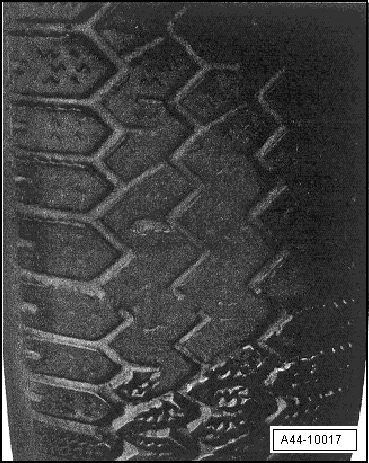
Tyres with such damage must no longer be used and must be renewed.
Parts & tools for this job For 2008 Volkswagen Scirocco
- TOOLTyre pressure gaugeSearch: digital tyre pressure gauge
- TOOLTorque wrenchSearch: 1/2 inch torque wrench
- TOOLBreaker barSearch: breaker bar
As an Amazon Associate we earn from qualifying purchases.