
Filling with coolant
- Make
- Volkswagen
- Model
- Touareg Mk2
- Year
- 2010–2018
- Section
- Coolant › Filling with coolant
Filling with coolant
Warning If large components (e.g. engine, radiator etc.) are to be removed/installed, it is absolutely necessary to drain the cooling system → Chapter. Otherwise, hidden air bubbles can result in incorrect filling. This results in temperature problems in the cooling system and heating circuit.
Warning Only distilled water may be used for mixing with coolant additives. The use of distilled water ensures optimum protection against corrosion.
Note
- The amount of water used in the coolant mixture has a great influence on its effectiveness. Because the water quality differs from country to country and even region to region, the quality of the water to be used has been defined. Distilled water fulfils all requirements. For this reason, we recommend using distilled water when mixing coolant for topping up or replacing coolant.
- Use only coolant additives in accordance with the Electronic Parts Catalogue (ETKA). Other coolant additives may reduce corrosion protection substantially. The resulting damage could lead to loss of coolant and subsequent severe damage to the engine.
- The correct coolant solution ratio helps prevent damage from freezing and corrosion as well as scaling. Moreover, the boiling temperature is raised. Therefore, the cooling system must be filled all year round with coolant additive.
- Because of its higher boiling point, the coolant improves engine reliability under heavy loads, particularly in countries with tropical climates.
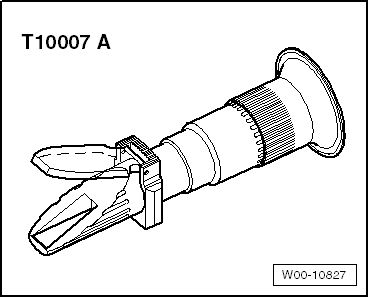
- ONLY refractometer T10007A may be used for determining current anti-freeze value.
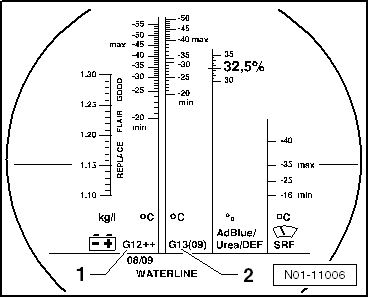
- The normal frost protection must be to at least -25°C, in countries with arctic conditions to -36°C. When climatic conditions require a stronger frost protection, only then may the frost protection be increased. But only to -48 °C. Otherwise, the cooling effect of the coolant will be impaired.
- The coolant concentration must not be reduced by adding water even in warmer seasons and in warmer countries. The frost protection must be at least -25 °C.
- Read off anti-freeze figures for respective replenished anti-freeze.
- The temperature read off the refractometer T10007A equates to the »ice flocculation point«. Flakes of ice can start forming in the coolant below this temperature.
- Do not reuse old coolant.
- Use only a water/anti-freeze mixture as a slip agent for coolant hoses.
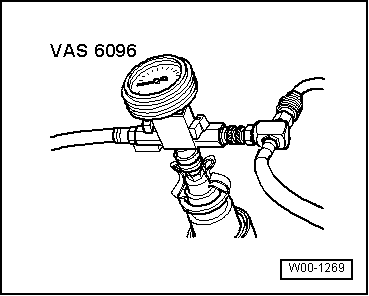
Fill coolant reservoir of VAS 6096 with at least 15 litres of pre-mixed coolant in correct mixture ratio:
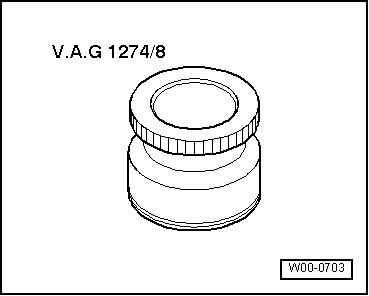
Coolant additive (40 %) and distilled water (60 %) for frost protection to -25 °CCoolant additive (50 %) and distilled water (50 %) for frost protection to -36 °CScrew adapter for cooling system tester V.A.G 1274/8 onto coolant expansion tank.
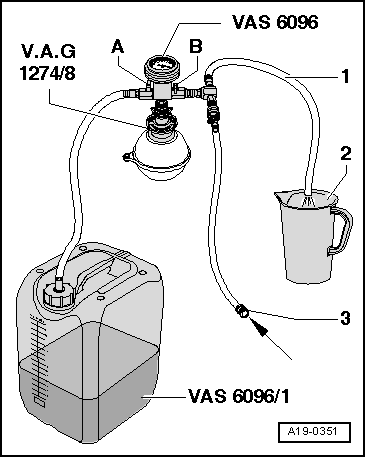
Attach cooling system charge unit VAS 6096 to adapter V.A.G 1274/8.
Close valves (A) and (B) (turn lever transverse to direction of flow to do this).
Feed vent hose (1) into a small container (2).
Note
- Exhaust air takes a slight quantity of coolant along with it; this should be collected.
Connect hose (3) to compressed air.
Pressure: 6 … 10 bar.Open valve (B); turn lever in direction of flow to do this.
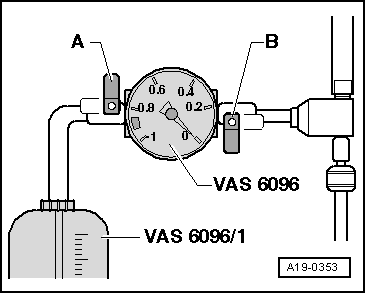
Also briefly open valve (A) (turn lever in direction of flow to do this) so that hose on VAS 6096 coolant reservoir fills with coolant.
Close valve (A) again.
Leave valve (B) open for a further 2 minutes.
The suction-jet pump still generates a vacuum in the cooling system.Close valve (B).
Pull off compressed air hose.
Observe pressure gauge. Vacuum must drop to min. 0.4 bar. If vacuum drops further, cooling system must be checked for leaks.
Note
- If vacuum drops, but stabilises at about 0.4 bar, the cooling system is leak tight.
- The subsequent filling must be performed »slowly«.
Open valve (A) slowly.
Remove cooling system charge unit VAS 6096 from adapter V.A.G 1274/8 at coolant expansion tank.
Check coolant level in expansion tank. If necessary, fill up or drain off.
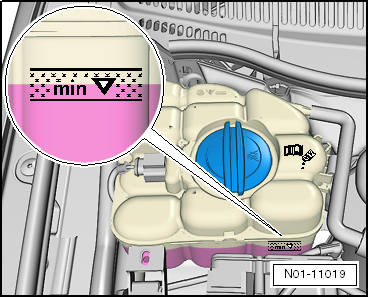
Check the filling quality → Chapter
Parts & tools for this job For 2010 Volkswagen Touareg
- FLUIDCoolantSearch: Volkswagen coolant antifreeze
- PARTThermostatSearch: Volkswagen Touareg 2010 thermostat
- TOOLCooling system pressure testerSearch: cooling system pressure tester
As an Amazon Associate we earn from qualifying purchases.