
Conicity
- Make
- Volkswagen
- Model
- Touareg Mk2
- Year
- 2010–2018
- Section
- Vehicle pulls to one side › Conicity
Conicity
Conicity is caused by a slight offset of the tread and/or the belt (amounting to a few tenths of a millimetre) relative to the geometric centre of the tyre. Taper is not visible and cannot be measured with equipment available in the workshop.
Parts of a tyre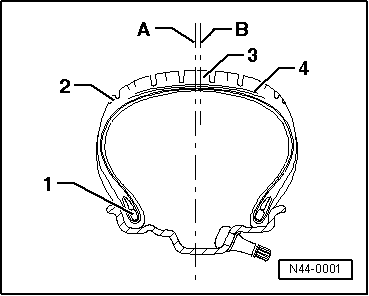
Exaggerated for clarity.
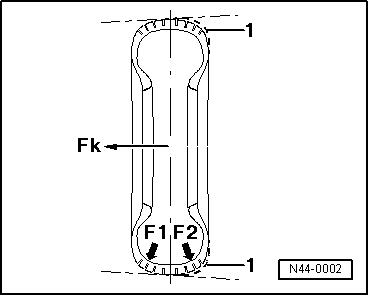
The offset produces differences in stiffness at the inner and outer shoulders of the tyre, resulting in differing vertical wheel forces. Consequently the belt or tread will not be pressed onto the road surface with the same force (F1, F2). A conical, or tapered, shape develops. The resulting force (conicity force Fk) can, depending on the speed, become so great that the vehicle then pulls to one side.
If the force Fk on one wheel of the axle is, for example, 50 Newton, and also 50 Newton on the other wheel, and both forces are exerted in the same direction, the forces are cumulated. Reversing a tyre on the rim can compensate for the lateral pull because the forces then act in opposite directions.
Because the direction in which the force of taper is exerted is not visible, only road tests and strategic rotation of wheels and tyres can establish which tyres cause the pulling.
The tyre consists of numerous components and materials which are vulcanised to form a single part at the end of a complicated manufacturing process. The result is differing production tolerances which make themselves noticeable through more or less strong lateral forces (conicity forces). These forces can also occur in new tyres.
Pulling to one side can be caused by the running gear. However, experience shows that in 90% of all complaints, the tyres cause pulling to one side.
On a straight, level road surface, the vehicle wants to pull to one side at a constant speed or with moderate acceleration. Force can be felt at the steering wheel.
Pulling to one side during fast acceleration is, in part, due to the basic design of vehicles with front wheel drive. Different friction levels at the left and right wheels or possible irregularities in the road surface (potholes) and consequently varying road adhesion have a substantial influence on the handling characteristics. This does not constitute a complaint which is covered by the warranty.
Parts & tools for this job For 2010 Volkswagen Touareg
- TOOLTyre pressure gaugeSearch: digital tyre pressure gauge
- TOOLTorque wrenchSearch: 1/2 inch torque wrench
- TOOLBreaker barSearch: breaker bar
As an Amazon Associate we earn from qualifying purchases.