
Description
- Make
- Alfa Romeo
- Model
- 145/146 Factory Service Manual
- Year
- 1994–1999
- Section
- Front suspension (1351/1596/1712 16V) › Description
Suspension and wheelsDescription
DESCRIPTION
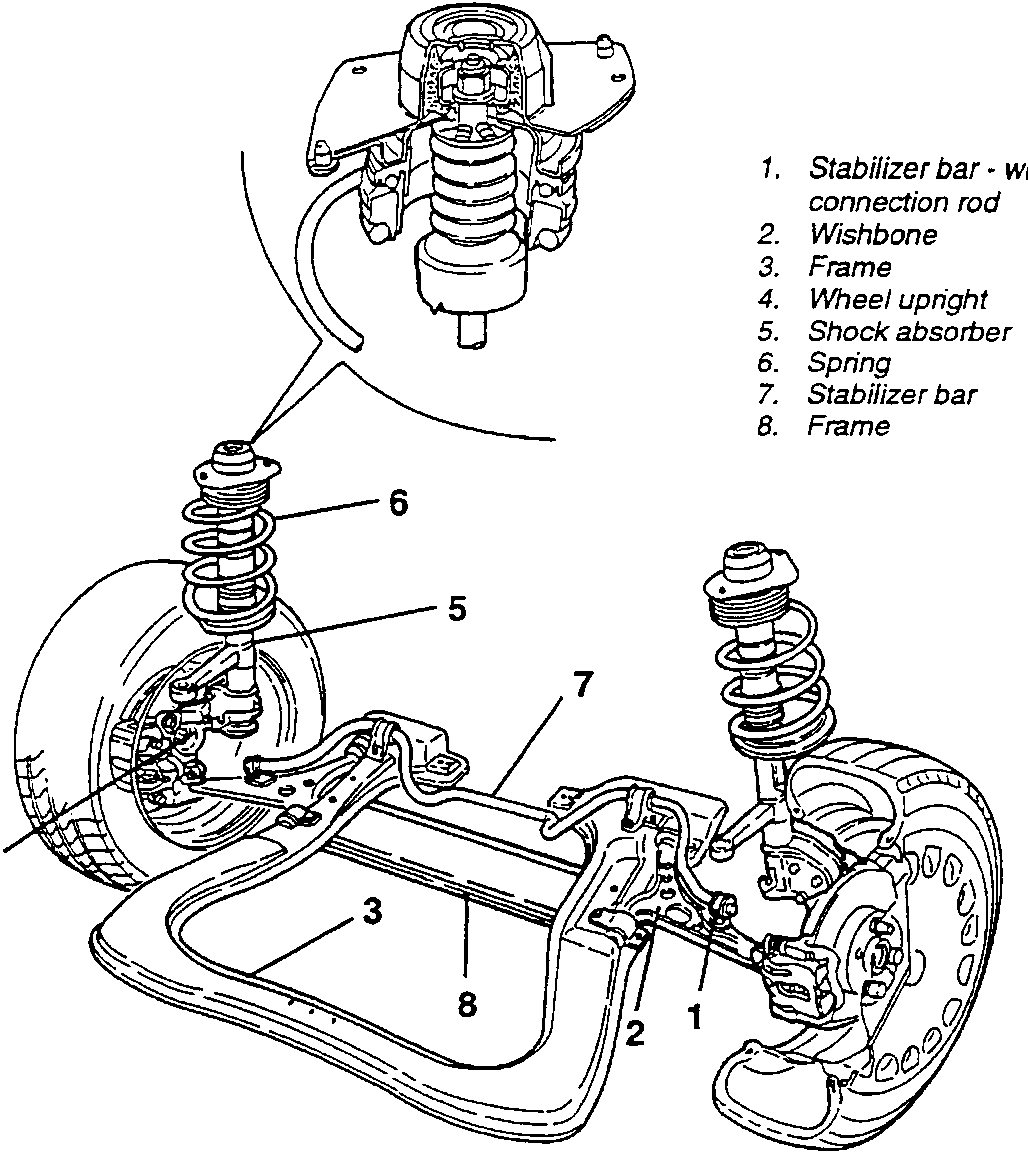
- Stabilizer bar - wishbone connection rod
- Wishbone
- Frame
- Wheel upright
- Shock absorber
- Spring
- Stabilizer bar
- Frame
The front suspension to independent wheels is of the McPherson type with telescopic struts and negative kingpin offset.
The front suspension assembly can be broken down into the following main components:
- The frame (3) supporting the power unit which is rigidly fastened to the body which besides integrating the bearing structure, also supports the cast iron suspension wishbones (2).
- The telescopic struts which comprise the helical springs (6) and the shock absorbers (5). The offset and tapered springs make it possible to reduce the thrust on the shock absorber stem and facilitate steering. This solution also eliminates shock absorber noise when the car is on the move, consequently improving comfort.
- The newly-designed shock-absorbers are pressurised with lamellar inlet valves with plates with particularly fine tolerances, thereby achieving outstanding results in terms of comfort and noiselessness over large obstacles while maintaining the necessary damping action.
- The cast iron wishbones (2), carry the ball joints connected with the wheel upright (4) and the silent-blocks with steel sheet reinforcement for fastening the wishbones themselves to the frame (3). The rotation of the wishbones on the silent-block confers high transversal rigidity and low longitudinal rigidity to the suspension. These operating conditions make it possible to:
- improve vehicle behaviour even under particularly critical roadholding conditions.
- improve driving comfort.
Increasing the rigidity of the suspension on one side of the vehicle and lowering it on the other, the stabilizer bar (7) serves to limit transversal inclination of the car body. This makes it possible to increase the speed limits when cornering as it counters the increase in the roll of the body caused by the centrifugal stresses which occur as the speed increases.
Parts & tools for this job For 1994 Alfa Romeo 145/146
- TOOLCoil spring compressorSearch: coil spring compressor
- TOOLBall joint separatorSearch: ball joint separator
- PARTFront shock absorbersSearch: Alfa Romeo 145/146 1994 front shock absorbers
Links open Amazon search results in a new tab. As an Amazon Associate I earn from qualifying purchases.