
Self-levelling suspension – specifications: (S.W.)
- Make
- Alfa Romeo
- Model
- 156 Factory Service Manual
- Year
- 1997–2002
- Section
- Self-levelling suspension › Self-levelling suspension – specifications: (S.W.)
Self-levelling suspension – specifications: (S.W.)
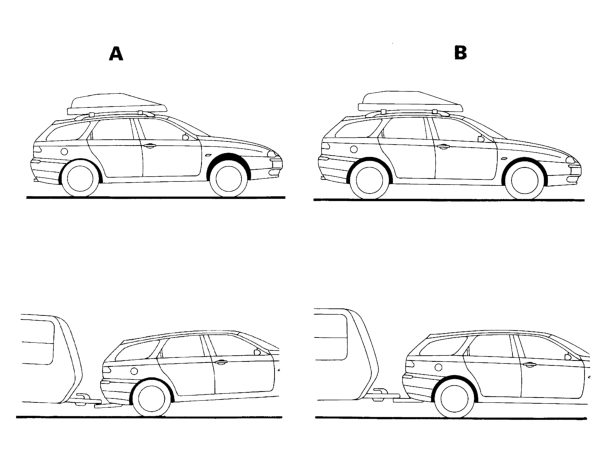
- A, Vehicles with conventional suspension
- B, Vehicles with self-levelling suspension
The springs and shock absorbers play a very important role in the vehicle's driving safety and comfort, ensuring tyre grip on the road surface at all times and at the same time absorbing impact on rough ground.
When a heavy load is transported or a trailer or caravan is towed, both these circumstances may cause the vehicle to suffer from the load on the rear axle.
A solution to this problem is the adoption of a self-levelling suspension system, which keeps a constant distance between the rear axle and the bodywork, irrespective of the load applied to the rear axle.
As may be observed in Fig. A, the position of the rear suspension is lowered, reducing the useful travel of the suspension and consequently confort when negotiating road surface roughness. In addition the frequency of the springs, the effective
damping of the shock absorbers and the suspension geometry vary significantly, deviating from optimum conditions.
For the Alfa 156 Sport Wagon, the BOGE Nivomat self-levelling suspension system has been adopted: it consists of two compact and independent units which are fitted instead of the conventional shock absorbers.
These units maintain the correct distance between the rear axle and the bodywork and their damping force is dependent on the load.
Nivomat suspension thus eliminates the well-known problem of conventional suspension which tends to be too hard when the vehicle is empty, and too "spongy" when travelling fully laden.
The Alfa 156 Sport Wagon fitted with Nivomat units travels comfortably even with a light load, but remains dynamically stable and safe when fully laden.
The BOGE Nivomat self-levelling suspension operates without requiring an external energy source.
The Nivomat suspension is a unit which has its own internal pumping action. The energy required for this purpose is obtained entirely from the vertical movements of the vehicle's bodywork.
As soon as the vehicle, by moving, makes the suspension work, the Nivomat units' internal pump starts to operate. It draws hydraulic fluid from an internal reservoir and sends it to a high-pressure chamber in which a compressed gas acts. In this way,
the Nivomat units bring the vehicle's bodywork to the predetermined height for optimum driving when the vehicle starts to move, compensating the downward movement of the bodywork caused by a heavy load or a trailer.
There is no separate device for controlling the height which requires adjustment: the height sensors are built into the shock absorber struts.
The initial procedure for adjusting the bodywork height is completed after the vehicle has travelled a distance of around 2000 metres, depending on the road surface.
When the load is removed or passengers leave the vehicle, the optimum height is restored while the vehicle is at a standstill.
The Nivomat units carry out the simultaneous functions of a load-dependent hydropneumatic spring and a hydropneumatic shock absorber and replace conventional shock absorbers, offering the advantages of hydropneumatic self-levelling suspension for
every type and class of vehicle, with load-dependent damping.
This system may be installed in the factory on new vehicles or relatively easily on vehicles already in circulation, without too much adaptation and at low cost.
Parts & tools for this job For 1997 Alfa Romeo 156
- TOOLCoil spring compressorSearch: coil spring compressor
- TOOLBall joint separatorSearch: ball joint separator
- PARTShock absorbersSearch: Alfa Romeo 156 1997 shock absorbers
Links open Amazon search results in a new tab. As an Amazon Associate I earn from qualifying purchases.