
Description
- Make
- Alfa Romeo
- Model
- GTV / Spider GTV and Spider (916) Factory Service Manual
- Year
- 1995–2000
- Section
- Air supply system › Description
DESCRIPTION
The air taken in through a dynamic inlet and filtered by a cartridge element (1), passes through the corrugated sleeve via the air-flow meter (2) with built in intake air temperature sensor.
From the corrugated sleeve the air reaches the turbocharger (3) which sends it under pressure, via a special pipe, to the intercooler (4) which lowers its temperature enabling better filling of the cylinders due to the greater density.
Supercharging is managed by the ignition control unit which, after reading a whole series of parameters (rpm, throttle position, etc.), electronically controls the adjustment pressure in the Waste Gate overpressure valve (5) through a special Pierburg solenoid valve (6); for further details on supercharging management, see the following paragraph.
The air is sent from the intercooler through a special pipe to the throttle body (7) which is controlled by the accelerator cable and adjusts the amount of air to be sent to the intake box (8). On one side of the throttle body there is a potentiometer (9) fastened to the throttle pivot pin. The potentiometer informs the control unit of the position of the throttle.
On the intake box, there is an additional air solenoid valve (10) which, via a special pipe, by-passes the throttle body making it possible to keep engine rpm constant under particular operating conditions of the engine. The supercharging system is fitted with an antistalling valve (11) which has the purpose of reducing and eliminating "ramming" which occurs when the accelerator pedal is released abruptly when the engine is supercharging; it is controlled by a vacuum signal picked up from the intake box. When the throttle valve closes, the vacuum transmitted by the connection pipe to the intake box, the antistalling valve opens allowing the pressure upstream of the throttle (closed) from discharging into the intake pipe. The fuel vapours flow and oil vapours to the air supply system (see specific paragraph). These are produced while the engine is running and are gathered in the special separator (12) through a pipe (13) leading from the right-hand cylinder head; as the separator is lower in temperature, the oil vapours are partially condensed. The condensed oil returns to the engine through a special pipe (14), while the remaining vapours are sent through a pipe (15) to the intake and then burnt in the engine.
BOOST-DRIVE MANAGEMENT
The Pierburg solenoid valve is supplied directly from a key-operated positive signal controlled permanently by the electronic control unit.
With the solenoid valve electrically de-energized cylinder D closes duct C, leaving ducts A and B in communication; the pressure of the supply arriving in duct B acts on the Waste-Gate valve, thereby adjusting the boost pressure.
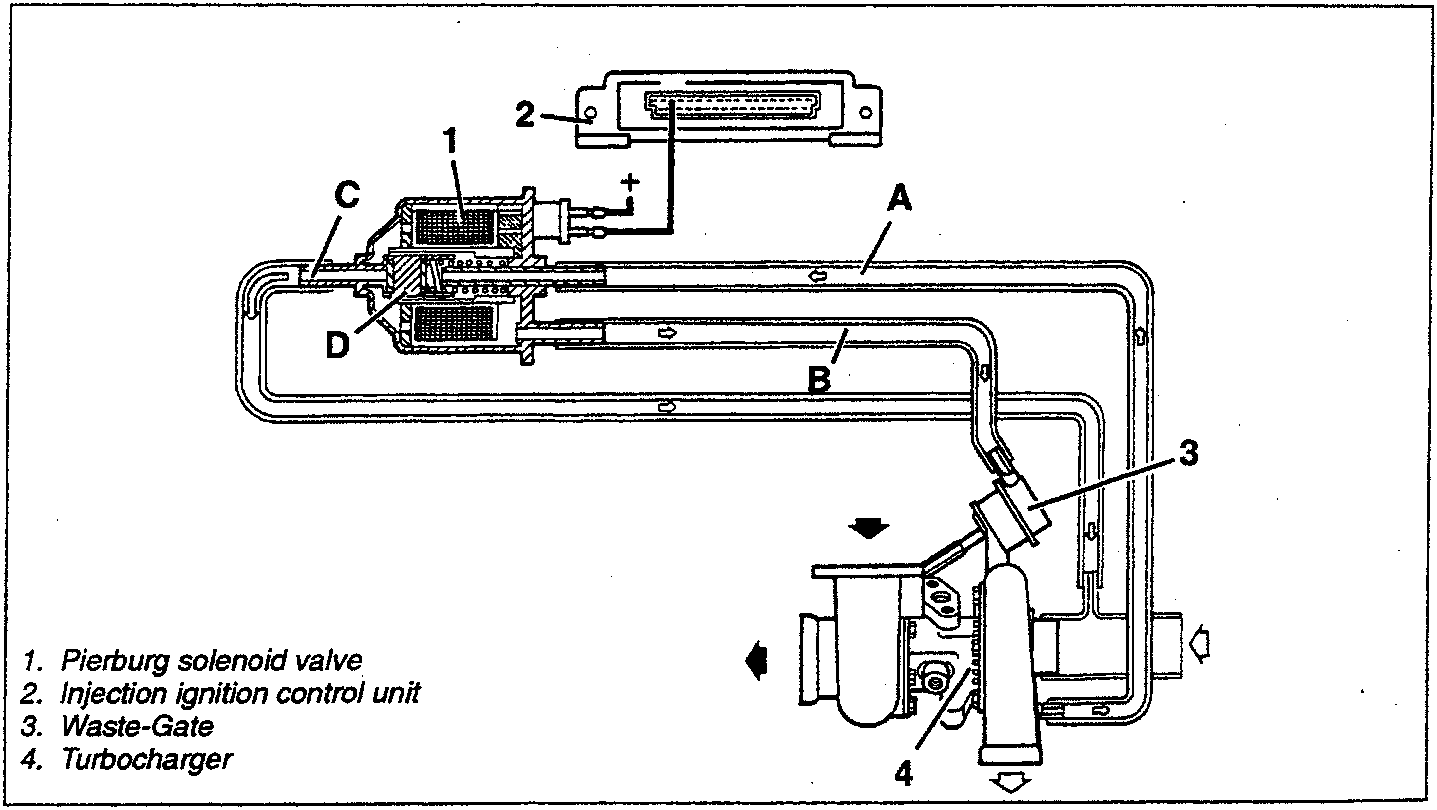
- Pierburg solenoid valve
- Injection ignition control unit
- Waste-Gate
- Turbocharger
Parts & tools for this job For 1995 Alfa Romeo GTV / Spider
- TOOLTorque wrenchSearch: 3/8 inch torque wrench
- TOOLSocket setSearch: socket set metric
- BOOKHaynes manualSearch: Haynes manual Alfa Romeo GTV / Spider
Links open Amazon search results in a new tab. As an Amazon Associate I earn from qualifying purchases.