
General notes
- Make
- Audi
- Model
- A6 C5
- Year
- 1997–2004
- Section
- Immobilizer self-diagnosis - “Immobilizer I” › General notes
Electrical system, self-diagnosisGeneral notes
General notes
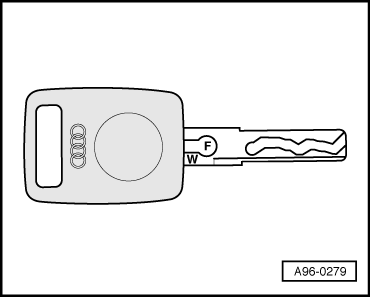
With “immobilizer I” the keys were originally not marked. Since the introduction of newer versions the keys have been marked with a (W) and an (F).
Components of the electronic immobilizer:
Immobilizer control unitImmobilizer warning lamp K117 in instrument clusterReader coil at ignition lockMatched ignition keys with electronics (transponder)- The immobilizer control unit is integrated into the instrument cluster, i.e. the instrument cluster must be renewed if the control unit is defective.
- The immobilizer acts on the engine management system by way of a matched engine control unit.
- Reader coil for immobilizer reads response code of transponder each time ignition is switched on.
- Immobilizer warning lamp K117 lights up briefly if an authorised vehicle key is used.
- If an unauthorised vehicle key is used or if there is a fault in the system, the immobilizer warning lamp K117 flashes continuously when the ignition is on.
Note
- Immobilizer self-diagnosis can now only be performed using the vehicle diagnostic, testing and information system VAS 5051.
- For security reasons, the PIN for the immobilizer is encoded. The encoded secret number (PIN = Personal Identification Number) is made up of 7 digits. It must be obtained by way of the appropriate regional sales centre/importer on the basis of the 14-digit immobilizer/engine control unit identification number → Chapter.
- The PIN can only be used in combination with the vehicle diagnostic, testing and information system VAS 5051.
Note
- Check the data of your vehicle diagnostic, testing and information system VAS 5051 with regard to the sales centre/importer and workshop code, as well as date and time.
- Immobilizer adaption function cannot be implemented with incorrect data.
- The engine will only start if use is made of an authorised vehicle key, i.e. a vehicle key matched to the immobilizer.
- The matching procedure → Chapter involves matching all vehicle keys, including spare and emergency keys, to the immobilizer.
- If new or additional vehicle keys are required, all vehicle keys must again be matched to the immobilizer.
- If for some reason matching cannot be performed for all vehicle keys, e.g. due to loss of keys on a journey, customers are to be informed that subsequent matching of all vehicle keys is required.
- It is particularly important to re-match all the remaining vehicle keys if any have been lost to ensure that the lost key is no longer authorized to start the vehicle.
Parts & tools for this job For 1997 Audi A6
- TOOLOBD2 scannerSearch: OBD2 scanner
- TOOLDigital multimeterSearch: automotive digital multimeter
- TOOLBack-probe test leadsSearch: back probe test leads
As an Amazon Associate we earn from qualifying purchases.