
Rear seat heating
- Make
- Audi
- Model
- Q7 Mk2
- Year
- 2015–2023
- Section
- General notes › Rear seat heating
Heating, air conditioningRear seat heating
Rear seat heating
The activation of the rear seat heating differs according to the vehicle version and equipment.
Note
- The air conditioning for the Audi Q7 is available in different versions, depending on the vehicle equipment. Check the correct version and compatibility of the different components → Chapter and Electronic parts catalogue.
Note
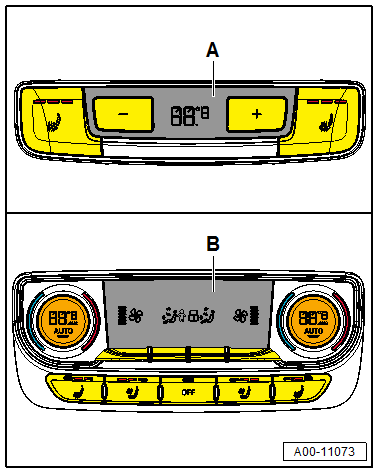
- On vehicles with a “Low” air conditioner (with no rear Climatronic operating and display unit E265 version (A) or (B)), the rear seat heating is set e.g. using the left seat heating button E653 and the right seat heating button E654 (different designations depending on the model and production period of the vehicle Current flow diagrams, Electrical fault finding and Fitting locations).
- The left seat heating button E653(A) and the right seat heating button E654(B) on a vehicle with a “Low” air conditioner (with no rear Climatronic operating and display unit E265, different designations depending on the model and production period of the vehicleCurrent flow diagrams, Electrical fault finding and Fitting locations) are installed in the panel on the rear centre console.
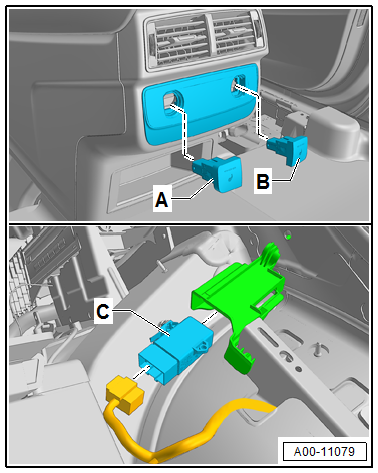
- The heated bench seat cushion for rear left seat Z10, the heated backrest for rear left seat Z11, the heated bench seat cushion for rear right seat Z12 and the heated backrest for rear right seat Z13 are activated by the heated rear seats control unit J786 or the seat heating control unit J882(C) (different designations depending on the model and production period of the vehicle Current flow diagrams, Electrical fault finding and Fitting locations).
- The control unit ( J786 or J882) (C) is currently installed underneath the trim on the left C-pillar Current flow diagrams, Electrical fault finding and Fitting locations.
- The control unit ( J786 or J882) (C)) currently has no self-diagnosis capabilityVehicle diagnostic tester in “Guided Fault Finding” mode and Current flow diagrams, Electrical fault finding and Fitting locations. The rear seat heating is only activated here if a corresponding release is issued by the onboard supply control unit J519.
Note
- The air conditioning for the Audi Q7 is available in different versions, depending on the vehicle equipment. Check the correct version and compatibility of the different components → Chapter and Electronic parts catalogue.
On vehicles with a E265 (version (A) for a “Mid” or “Mix” air conditioner or version (B) for a “High” air conditioner), the rear seat heating is set via the E265. E265 then activates the heating for the rear seats depending on the vehicle equipment and modelVehicle diagnostic tester in “Guided Fault Finding” mode and Current flow diagrams, Electrical fault finding and Fitting locations.
- A start/stop system is offered for this vehicle in combination with certain engines. On vehicles with a start/stop system, the seat heating might be deactivated while the stop function is active (to protect the battery A). However, the setting for the activation of the seat heating remains stored in the operating and display unit for rear air conditioning system E265. The seat heating is switched on again after the engine has been re-started via the start function Vehicle diagnostic tester in “Guided Fault Finding” mode.
Note
- The seat heating may be activated differently depending on the vehicle model Current flow diagrams, Electrical fault finding and Fitting locations.
- Depending on the model and vehicle equipment, the various pieces of information on the actuation of the seat heating (setting transmitted by E265, specified and actual seat temperature, etc.) are displayed differently in the various measured values in the different control units Vehicle diagnostic tester in “Guided Fault Finding” mode.
- Situations preventing activation of the rear seat heating (e.g. short circuit in connection to seat heating element, open circuit in power supply to corresponding control unit) are stored as faults in the E265, the onboard supply control unit J519, the front air conditioner operating and display unit E87, the data bus diagnostic interface J533, the control unit for rear left seat adjustment J876 or the control unit for rear left seat adjustment J877 (depending on the vehicle equipment and the version of the vehicle). On this vehicle, the information that the event memory in the corresponding control unit has to read out may not be transmitted via the data bus to E265Vehicle diagnostic tester in “Guided Fault Finding” mode. In the event of problems with seat heating, the first step should therefore always be to read out the event memories of the control units which activate the seat heating.
- Checking actuation of the heated seats is described in the Guided Fault Finding routine for the corresponding control unit (different versions of the E265, version (A) for a “Mid” or “Mix” air conditioner or version (B) for a “Mid” or “Mix” air conditioner), depending on the model and vehicle equipment) Vehicle diagnostic tester in “Guided Fault Finding” mode.
- If, for example, the voltage measured at terminal “30” of the onboard supply control unit J519 falls below a value stored in J519, the seat heating output is reduced or deactivated completely to relieve the load on the alternator CVehicle diagnostic tester (“Guided Fault Finding”).
- The “Read measured values” function of the Guided Fault Finding routine for the E265 indicates which seat heating setting has been selected. Actuation of the seat heating, the actual and specified temperature in the seat and the actual current flowing via the seat heating etc. are displayed in the “Reading measured values” function of the Guided Fault Finding routine for the corresponding control unit depending on the vehicle model and equipment Vehicle diagnostic tester in “Guided Fault Finding” mode.
- Depending on the version of the vehicle, the heating of the rear seats may be deactivated after a certain period if the system detects that a seat is not occupied Owner's Manual.
Parts & tools for this job For 2015 Audi Q7
- TOOLA/C manifold gauge setSearch: AC manifold gauge set
- TOOLUV leak detection kitSearch: AC UV leak detection kit
- PARTCabin filterSearch: Audi Q7 2015 cabin filter
As an Amazon Associate we earn from qualifying purchases.