
Notes on checking the cooling output
- Make
- Audi
- Model
- Q7 Mk2
- Year
- 2015–2023
- Section
- Repair notes › Notes on checking the cooling output
Heating, air conditioningNotes on checking the cooling output
Notes on checking the cooling output
Note
- This Workshop Manual only gives a general outline of the checking procedure. Perform the functional check of the heater as described in the "Guided Fault Finding" routine Vehicle diagnostic tester (“Guided Fault Finding”).
Note
- A start/stop system is available as optional extra for this vehicle with certain engines. Depending on the setting on the front air conditioner operating and display unit E87 (and if applicable also on the rear Climatronic operating and display unit E265), the stop function may be inhibited by these units. For example, the stop function is not available, or the stop function is interrupted and the engine is switched on as soon as the “defrost” mode is selected on the E87. This also applies if the difference between the set specified temperature and the measured actual temperature exceeds a certain value in heating and cooling mode Vehicle diagnostic tester (“Guided Fault Finding”).
- In this vehicle, the coolant circulation pump V50 (or coolant pump 2 for thermal management V618 on vehicles with high-voltage system) is activated not only when the “stop function” is active, but also when the engine is running, e.g. when a “warm” temperature is preselected on the E87 (“HI” on the display of the E87). In this vehicle, the V50 (or V618 on vehicles with high-voltage system) is also activated to support the engine coolant pump Vehicle diagnostic tester in “Guided Fault Finding” mode.
- Vehicles with an “auxiliary heater” as optional extra may not be fitted with a coolant circulation pump V50 (or a coolant shut-off valve N82). On vehicles with no V50 or N82, this function is assumed by the auxiliary heater components (heater coolant shut-off valve N279 and circulation pump V55) Auxiliary/supplementary heaterRep. gr.82Coolant circuit with auxiliary/supplementary heater; Connection diagram - coolant hoses.
- On vehicles with a “Low” air conditioner (without E265 and without air distribution housing or rear heater and air conditioning unit), the E87 regulates the temperature of the air that flows from the front heater and air conditioning unit to the rear vents so that the air from the vents in the rear settles at a medium temperature. For this purpose, the E87 uses the setting for the left and right side on E87 to calculate the specified temperature for the air from the vents in the rear. If however the setting on E87 is such that the temperature is no longer regulated (e.g. “HI” for maximum heating or “LO” for maximum cooling), the temperature of the air from the vents in the rear is no longer regulated. If for example, the settings on E87 are maximum heating “HI” for one side and maximum cooling “LO” for the other side, the air for the vents in the rear is heated to the maximum level.
- For vehicles with a “Mid” or “Mix” air conditioner (with a rear air distribution housing but without a rear heater and air conditioning unit), the air temperature and air volume calculated and regulated by the E87 are also influenced by the setting on the E265, version(A). However, only the temperature is adjustable on this E265Chapter“Removing and installing rear Climatronic operating and display unit E265, High air conditioner”.
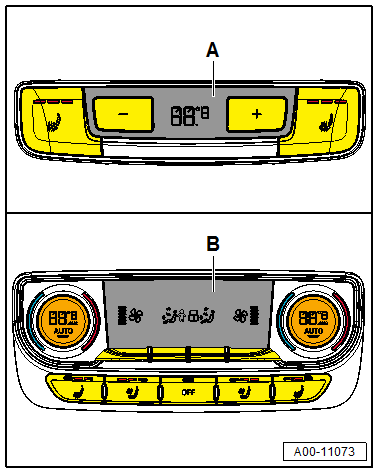
- For vehicles with a rear heater and air conditioning unit (with a “High” air conditioner), the air temperature and air volume calculated and regulated by the E87 are also influenced by the setting on the E265. The temperature for the left and right side is adjustable on this E265, version (B)Chapter“Removing and installing rear Climatronic operating and display unit E265, High air conditioner”.
- Certain air conditioner functions can be switched on and off via the MMI system (Multi Media Interface) using the “A/C” function on the “Car” / “Vehicle” menu. In addition, the operation of the air conditioner can also be influenced by the settings on the MMI (Multi Media Interface) in the “A/C” function of the “Car” / “Vehicle” menu. Therefore, if there are problems with these components, first check the settings on the MMI Infotainment/MMI Operating Manual.
Parts & tools for this job For 2015 Audi Q7
- TOOLA/C manifold gauge setSearch: AC manifold gauge set
- TOOLUV leak detection kitSearch: AC UV leak detection kit
- PARTCabin filterSearch: Audi Q7 2015 cabin filter
As an Amazon Associate we earn from qualifying purchases.