
Removing and installing brake pads
- Make
- Audi
- Model
- R8 Mk2
- Year
- 2015–2023
- Section
- Parking brake › Removing and installing brake pads
Removing and installing brake pads
Special tools and workshop equipment requiredVehicle diagnostic testerTorque wrench V.A.G 1332Lithium grease G 052 150 A2Moving parking brake motors back:
With ignition switched off, connect vehicle diagnostic tester to diagnostic connection in vehicle.
Switch on ignition.
Select Diagnosis and start the diagnosis.
Select Test plan tab.
Press Select own test and then select the following menu items:
- Running gear
- Brake system
- 01 - Self-diagnosis compatible systems
- 53 - Control unit for electromechanical parking brake J540
- 53 - Functions - electromechanical parking brake
- 53 - 46 Remove brake pads
Start the selected program and follow the instructions on the display of the vehicle diagnostic tester.
Remove rear wheel; observe precautions for vehicles with ceramic brakes Running gear, axles, steeringRep. gr.44Wheels, tyres.
Note
- Mark brake pads when removing them if they are to be reinstalled. Reinstall in their original position to prevent uneven braking.
- Take care not to damage paint on brake caliper when knocking out pad retaining pins.
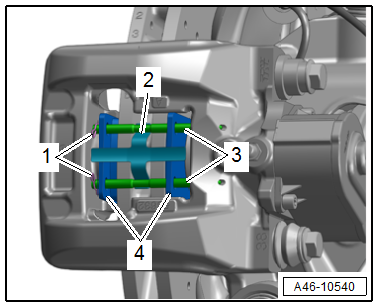
Warning Risk of injury.
- The brake pad retaining spring (2) is under tension. Hold down the pad retaining spring by hand while knocking out the retaining pins.
Pull out split pins (1).
Use a suitable punch to knock pad retaining pins (3) outwards out of brake caliper and detach pad retaining spring (2).
Detach brake pads (4).
Installation is performed in reverse sequence; note the following:
Check brake discs for wear and damage when renewing brake pads.
- Wear limit of brake discs MaintenanceBooklet421
For ceramic brake discs, also check the following:
- Cracks in the bolted joint area → Chapter
- Edge fractures → Chapter
- Chipping → Chapter
- Cracks extending into cooling channels → Chapter
- Assessing degree of wear → Chapter
Note
- Always renew brake pads on both sides of axle.
- Install all parts supplied in the repair kit when fitting new brake pads.
- Renew bolts for brake caliper.
- Use only methylated spirits for cleaning the brake caliper housing.
- Check protective caps on brake caliper pistons for damage; if necessary, install all parts supplied in repair kit → Chapter.
Warning Risk to health
- Do not blow out the brake system with compressed air.
Clean brake caliper.
Warning Risk of damage to protective cap for brake caliper pistons
- Take care not to damage protective cap when applying piston compressing tool.
Clean brake pad contact surfaces (arrows) on brake caliper and apply a small amount of lithium grease G 052 150 A2.
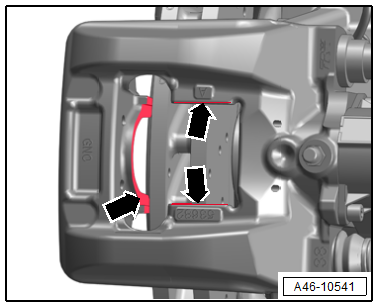
Check that guide pins can slide in and out. If guide pins do not move easily, install parts supplied in repair kit Electronic parts catalogue.
If used pads are being re-fitted, take care to install the marked pads in their original positions.
Note
- Take care not to damage paint on brake caliper when driving in pad retaining pins.
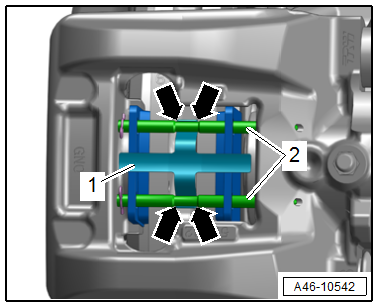
Installation position of pad retaining spring:
Pad retaining spring (1) is held in place at recesses (arrows) on pad retaining pins (2).Fit brake pads (4) in brake caliper and protect from falling out until first pad retaining pin has been inserted.
Insert pad retaining pins (3) with pad retaining spring (2) in brake caliper one after the other and knock them into brake caliper as far as stop (hold down pad retaining spring while doing so).
Secure pad retaining pins with split pins (1).
Fit rear wheel; observe precautions for vehicles with ceramic brakes Running gear, axles, steeringRep. gr.44Wheels, tyres.
- Chapter“Overview of fitting locations - parking brake”
Parts & tools for this job For 2015 Audi R8
- PARTBrake padsSearch: Audi R8 2015 brake pads
- TOOLCaliper piston rewind toolSearch: brake caliper piston rewind tool
- FLUIDBrake fluidSearch: brake fluid
As an Amazon Associate we earn from qualifying purchases.