
Removing - refitting: CNG cylindrical tank
- Make
- Citroën
- Model
- C3 Factory Workshop Manual
- Year
- 2002–2009
- Section
- Air and fuel supply › Removing - refitting: CNG cylindrical tank
Removing - refitting: CNG cylindrical tank
ESSENTIAL: Observe the safety requirements that apply to repairs on CNG circuits (see the relevant operation).
ESSENTIAL: All work on a gas powered vehicle should be performed in a ventilated area.
1. Recommended tools
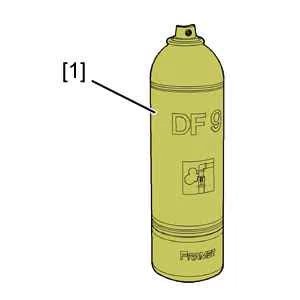
[1] Gas leak detector FRAMET DF9.
2. Removing
ESSENTIAL: When removing the natural gas components, close all the breather holes with plugs to prevent any foreign bodies entering the circuit.
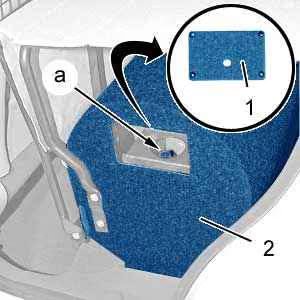
Remove the access flap (1).
Close the manual valve at "a" (clockwise).
Start the vehicle.
Change to CNG mode.
Accelerate to an engine speed of 3000 rpm.
Wait for the engine to change into petrol mode (the warning lamp flashes).
Remove the CNG tank protection cover (2).
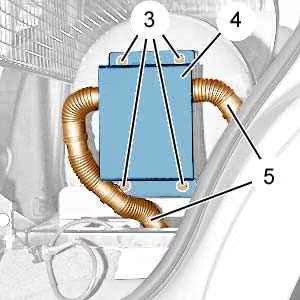
Remove:
- The 4 bolts (3)
- The protector (4)
Move aside the ventilation sleeves (5).
ESSENTIAL: As CNG coming into contact with the skin can cause serious cold burns, it is essential to wear protective gloves and spectacles in order to avoid all risk of frostbite.
Eliminate all of the following risks in the proximity of the vehicle:
- Sparks (use of a grinder)
- Flames (use of a cutting torch)
- Slow combustion (lit cigarette)
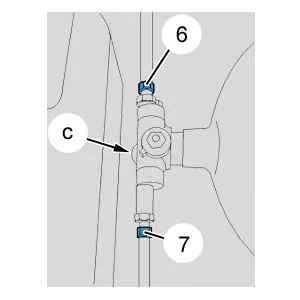
Disconnect the CNG tank electrovalve connector as "c".
Slowly undo the unions (6) and (7).
N.B.: A little gas may escape into the atmosphere if the piping is still pressurised.
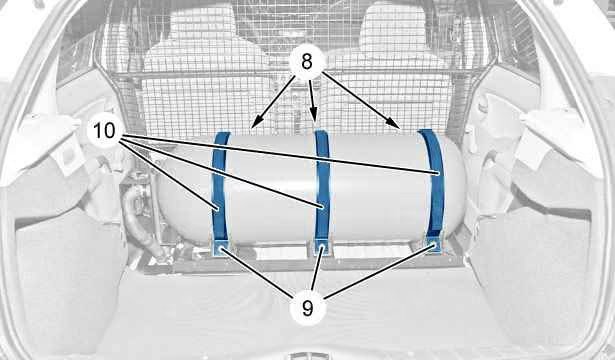
Remove:
- The 3 bolts (8)
- The 3 bolts (9)
- The straps (10)
- The CNG tank
N.B.: 2 persons are necessary for moving the CNG tank.
Blank the apertures of the CNG manual safety valve, using plugs (kit 1605).
3. Refitting
N.B.: 2 persons are required in order to reposition the CNG tank correctly.
Refit in the reverse order to removal.
Tighten:
- The bolts (8) to 2,2 ± 0,2 daN.m
- The bolts (9) to 4 ± 0,2 daN.m
Recouple unions (6) and (7).
Tighten unions (6) and (7).
Connect the CNG tank electrovalve at "c".
4. Checking the sealing of the gas pipes
Checking the sealing of the CNG piping and refitted unions.
If the CNG tank is empty, following draining and venting:
- Open the CNG tank manual valve
- Fill the CNG tank at the nearest CNG station
Open the CNG tank manual valve as "a".
Spray the leak detector product [1] on the unions (6) and (7).
Check the sealing of unions (6) and (7) Using the leak detector [1].
Should a leak occur:
- De-pressurise the system (see the relevant operation)
- Retighten the union
5. Additional operations
Reposition the ventilation sleeves (5).
Refit the protector (4).
Tighten the bolts (3).
Refit the CNG tank protection cover (2).
Parts & tools for this job For 2002 Citroën C3
- PARTEngine gasket setSearch: Citroën C3 2002 engine gasket set
- TOOLTorque wrenchSearch: 3/8 inch torque wrench
- TOOLFeeler gauge setSearch: feeler gauge set
As an Amazon Associate we earn from qualifying purchases.