
Switching off: Hybrid vehicle
- Make
- Citroën
- Model
- DS5 Factory Workshop Manual
- Year
- 2011–2015
- Section
- Engine assembly › Switching off: Hybrid vehicle
Switching off: Hybrid vehicle
ESSENTIAL: Observe the safety and cleanliness recommendations.
ESSENTIAL: Only those personnel who have received special training on electric vehicles are qualified to operate on the vehicle (please observe the regulations that are in force in the country concerned).
1. Tooling
| Tools | Reference | Designation |
|---|---|---|

| [VAT1] | Voltage absence verifier |
1.1. Equipment
An insulating pad.
2 Insulating bags.
Warning notices (Vehicle and work location).
Locking discs.
Adhesive tape (Orange).
1.2. Protective equipment
Insulating gloves (natural latex).
Hard hat with visor.
2. Preparation

Cut an insulating pad [1] of dimensions 15 X 15 cm.
N.B.: This operation only needs to be done once: The insulating pad can be used for other vehicles (depending on what condition it is in).
3. Switching off
3.1. Step 1: Vehicle identification - Sidelighting
CAUTION: Make sure that the vehicle indeed corresponds to the work order.
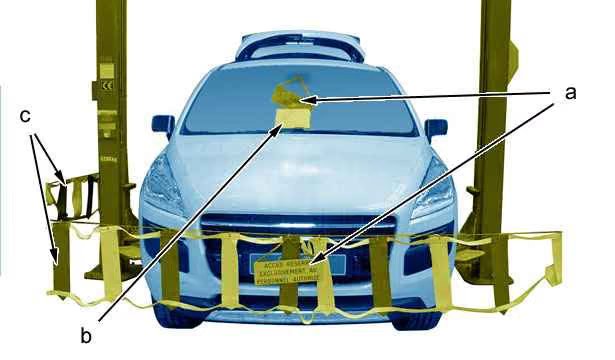
Place the vehicle in a work area dedicated to electric or hybrid vehicles.
N.B.: The work area must be separated off by chains or barriers (at "c").
Place the vehicle on a 2-post lift.
Carefully raise the vehicle: Wheels hanging.
N.B.: In the absence of a 2-post lift: Place the vehicle on a 4-post lift. Immobilise the vehicle using workshop chocks (one on a front wheel and another on a rear wheel).
N.B.: If there is no lift to raise the vehicle: immobilise the vehicle using workshop chocks (one on a front wheel and another on a rear wheel).
Fill out the work sheet and rest it on the vehicle’s windscreen (at "b").
Place the warning signs on the vehicle and on the work area (at "a").
Open:
- The door window (driver’s side)
- The boot lid
- The bonnet
Put the gear lever in position "N" (neutral).
Apply the handbrake.
CAUTION: Switch off the ignition and wait 30 seconds.
CAUTION: Check that no permanent power consumers (lighting, cooling fans, etc.) are on.
3.2. Step 2: Electrical separation and locking (Service battery)
CAUTION: After switching off the ignition, wait 6 minutes before disconnecting the ancillaries battery (Allowing the ECUs to go to sleep).
ESSENTIAL: Put on insulating gloves and a hard hat with visor (visor lowered).
CAUTION: Check the voltage absence verifier (VAT) (Following the manufacturer’s instructions).
Check the voltage (< 17V) between the positive terminal of the ancillaries battery and a body earth.
Disconnect the positive terminal of the ancillaries battery.
Fold back the protection cover on the positive terminal in order to prevent any accidental reconnections.
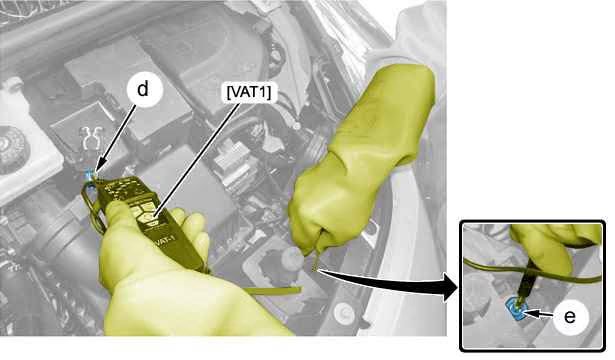
CAUTION: Check the voltage absence verifier (VAT) (Following the manufacturer’s instructions).
Do a check that there is no voltage between the positive cable that is disconnected (at "d") and a body earth (en "e"); Using tool [VAT1].
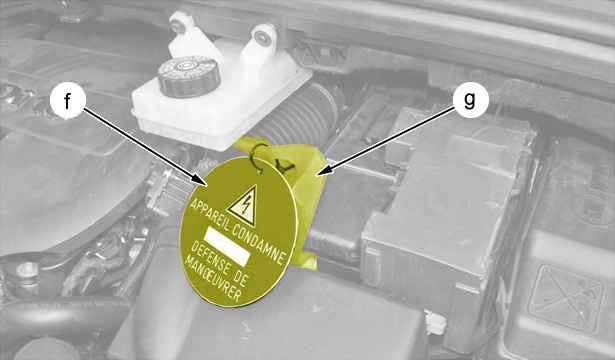
Place the terminal of the positive cable in an insulating bag (at "g").
Fit a locking disc (at "f").
ESSENTIAL: Wait one minute before continuing the depowering operations (Natural discharging of the capacitors).
3.3. Step 3: Electrical separation and locking (Traction battery)
N.B.: The circuit breaker is located under the boot floor.
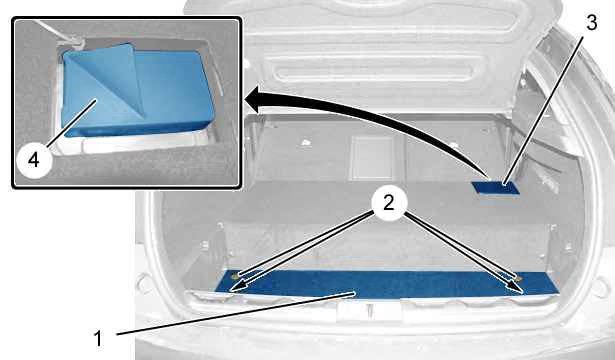
Tilt the rear benchseat backrests.
Remove:
- The 4 mountings (2)
- The boot floor (1)
- The flap (3)
Remove: The protector (4) of the circuit breaker.
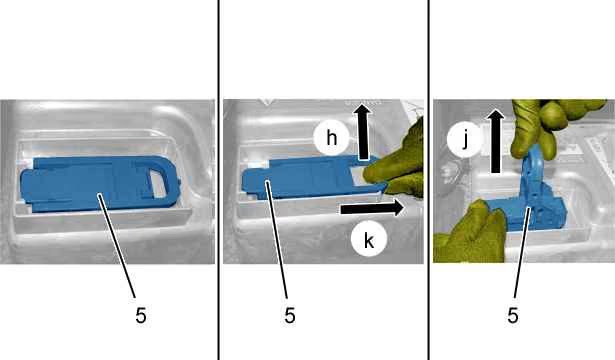
N.B.: Wearing of insulating gloves and helmet is not necessary for removing the circuit breaker (5).
Remove: The circuit breaker (5):
- Unlock: The circuit breaker (5) (in direction "k")
- Raise the locking lever of the circuit breaker (7) (in direction "h")
- Remove the circuit breaker (5) pulling it upwards (in direction "j")
Attach a label to the circuit breaker (5) indicating the date and the name of the operator.
Place the circuit breaker (5) in a locked area.

Refit: The protector (4) of the circuit breaker.
Fit a locking disc (at "l"); Fix using orange adhesive tape.
ESSENTIAL: Wait one minute before continuing the depowering operations (Natural discharging of the capacitors).
3.4. Step 4: Checking of the absence of voltage
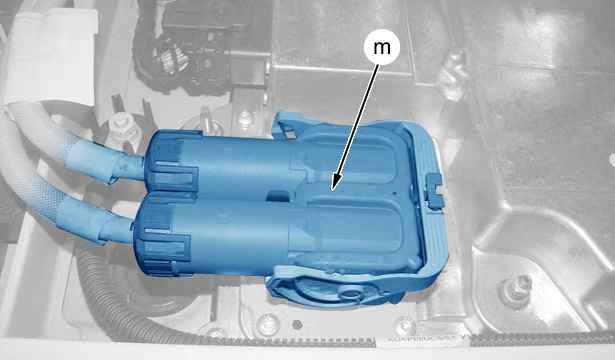
CAUTION: Observe the procedure for disconnection of the connector.
Disconnect the connector of the hybrid control ECU (at "m").
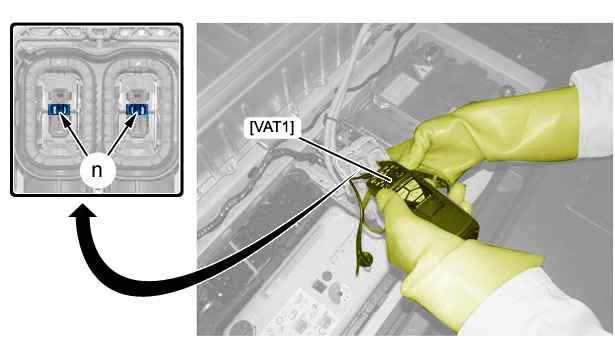
ESSENTIAL: Put on insulating gloves and a hard hat with visor (visor lowered).
CAUTION: Check the voltage absence verifier (VAT) (Following the manufacturer’s instructions).
ESSENTIAL: The equipment probes have to be contacting with the terminals at the centre of the socket (at "n").
Do a check that there is no voltage at the terminals of the connector (at "n"); Using tool [VAT1].
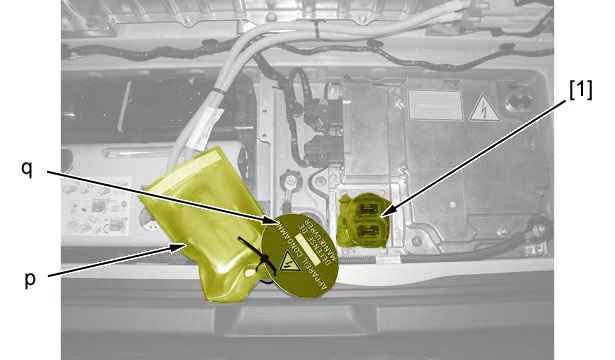
Protect the connectors:
- Close to the casing of the hybrid control ECU: Fit an insulating bag [1]; Fix using orange adhesive tape
- Close to the high voltage cable: Place the connector in an insulating bag (at "p")
Fit a locking disc (at "q").
CAUTION: Fill out the work sheet.
Parts & tools for this job For 2011 Citroën DS5
- PARTEngine gasket setSearch: Citroën DS5 2011 engine gasket set
- TOOLTorque wrenchSearch: 3/8 inch torque wrench
- TOOLFeeler gauge setSearch: feeler gauge set
As an Amazon Associate we earn from qualifying purchases.