
Fog/Driving Lamp: Adjustments
- Make
- Dodge
- Model
- Challenger
- Engine
- V8-5.7L
- Year
- 2010
- Section
- Fog/Driving Lamp › Adjustments
Fog/Driving Lamp: Adjustments
FRONT LAMP AIMING
VEHICLE PREPARATION FOR LAMP ALIGNMENT
1. Check for and replace any burnt out bulbs.
2. Repair or replace any faulty, worn or damaged body or suspension components that could hinder proper lamp alignment.
3. Verify proper tire inflation pressures.
4. Remove any accumulations of mud, snow or ice from the vehicle underbody and clean the front lamp lenses.
5. Verify there is no load in the vehicle (cargo or passengers), except for the driver.
6. The fuel tank should be full. Add 2.94 kilograms (6.5 pounds) of weight over the fuel tank for each estimated gallon of missing fuel.
7. Verify correct vehicle suspension height.
LAMP ALIGNMENT SCREEN PREPARATION
The following procedure prepares a suitable front lamp alignment screen.
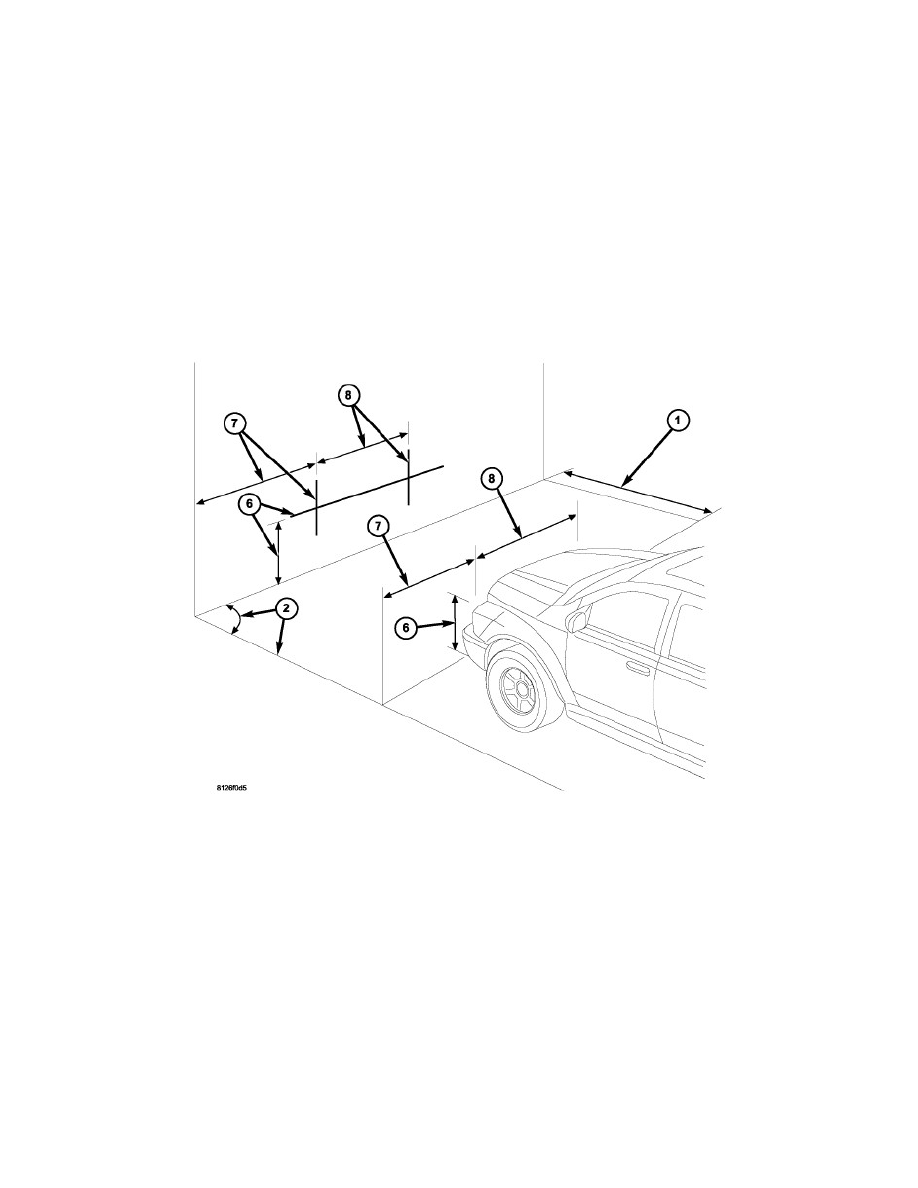
1. Tape a line on a level floor 7.62 meters (25 feet) away from and parallel to the flat wall that will be used as the lamp alignment screen. The level
floor will be used as the horizontal zero reference.
2. An adjacent wall or floor member that is perpendicular to the alignment screen can be used as the vertical zero reference. If there is no adjacent
wall or floor member that is perpendicular to the screen, tape a second line on the floor perpendicular to both the alignment screen and the first
line, and outboard of either side of where the vehicle will be positioned. This will be used as the vertical zero reference.
3. Position the vehicle so the side of the vehicle is parallel to the vertical zero reference, and the front of the lamp lenses are in the vertical plane of
the parallel line taped on the floor 7.62 meters (25 feet) away from the screen.
4. Rock the vehicle side-to-side three times to allow the suspension to stabilize.
5. Jounce the front suspension three times by pushing downward on the front bumper and releasing.
6. Measure the distance between the optical center of one of the lamps being aimed (head or fog) and the floor (horizontal zero reference). Transfer
this measurement to the alignment screen with a piece of tape placed horizontally to the floor. This line will be used as the lamp horizontal
reference.
7. Measure the distance between the vertical zero reference and the optical center of the nearest lamp being aimed (head or fog). Transfer this
measurement to the alignment screen with a piece of tape placed vertically across the appropriate (head or fog) lamp horizontal reference. This is
the centerline reference for the first lamp.
8. Measure the distance on center between the first and the second lamp being aimed. Transfer this measurement to the alignment screen with a
Pinch or Ctrl + scroll to zoom. Double-tap to reset.
Parts & tools for this job For 2010 Dodge Challenger 5.7L
- PARTReplacement bulbsSearch: Dodge Challenger 2010 5.7L bulbs
- TOOLDigital multimeterSearch: automotive digital multimeter
Links open Amazon search results in a new tab. As an Amazon Associate I earn from qualifying purchases.