
Identification data (page 2 of 2)
- Make
- Fiat
- Model
- Bravo /Brava (182) Factory Service Manual
- Year
- 1995–2001
- Section
- Technical data (98 range)
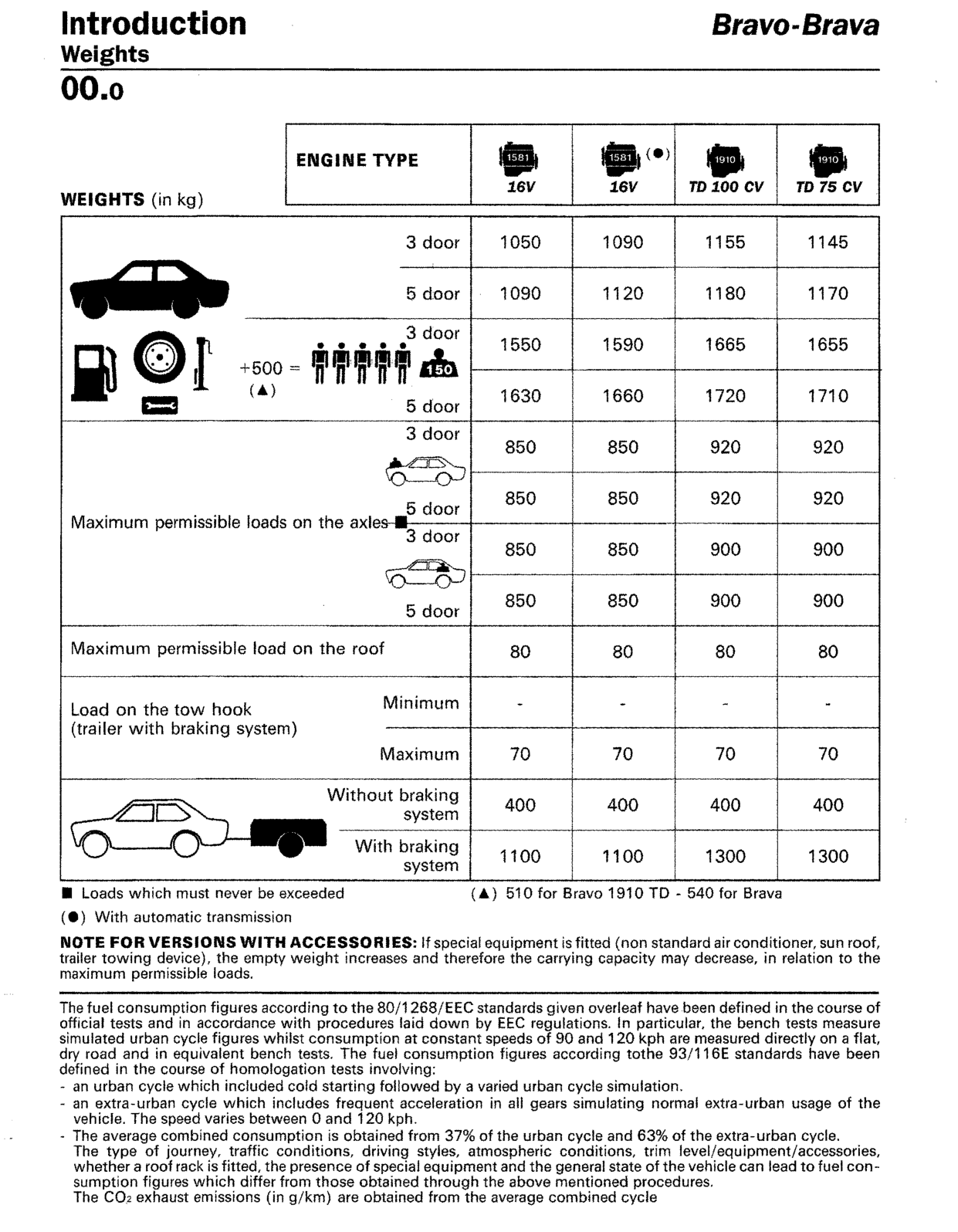
NOTE FOR VERSIONS WITH ACCESSORIES: If special equipment is fitted (non standard air conditioner, sun roof, trailer towing device), the empty weight increases and therefore the carrying capacity may decrease, in relation to the maximum permissible loads.
| WEIGHTS (in kg) | ENGINE TYPE | 1581 16V |
1581 (●) 16V |
1910 TD 100 CV |
1910 TD 75 CV |
|---|---|---|---|---|---|
| 3 door | 1050 | 1090 | 1155 | 1145 | |
| 5 door | 1090 | 1120 | 1180 | 1170 | |
| 3 door | 1550 | 1590 | 1665 | 1655 | |
| 5 door | 1630 | 1660 | 1720 | 1710 | |
| Maximum permissible loads on the axles ■ | 3 door | 850 | 850 | 920 | 920 |
| 5 door | 850 | 850 | 920 | 920 | |
| 3 door | 850 | 850 | 900 | 900 | |
| 5 door | 850 | 850 | 900 | 900 | |
| Maximum permissible load on the roof | 80 | 80 | 80 | 80 | |
| Load on the tow hook (trailer with braking system) |
Minimum | - | - | - | - |
| Maximum | 70 | 70 | 70 | 70 | |
| Without braking system | 400 | 400 | 400 | 400 | |
| With braking system | 1100 | 1100 | 1300 | 1300 | |
■ Loads which must never be exceeded &...... (▲) 510 for Bravo 1910 TD - 540 for Brava
(●) With automatic transmission
The fuel consumption figures according to the 80/1268/EEC standards given overleaf have been defined in the course of official tests and in accordance with procedures laid down by EEC regulations. In particular, the bench tests measure simulated urban cycle figures whilst consumption at constant speeds of 90 and 120 kph are measured directly on a flat, dry road and in equivalent bench tests. The fuel consumption figures according tothe 93/116E standards have been defined in the course of homologation tests involving:
- an urban cycle which included cold starting followed by a varied urban cycle simulation.
- an extra-urban cycle which includes frequent acceleration in all gears simulating normal extra-urban usage of the vehicle. The speed varies between 0 and 120 kph.
- The average combined consumption is obtained from 37% of the urban cycle and 63% of the extra-urban cycle.
The type of journey, traffic conditions, driving styles, atmospheric conditions, trim level/equipment/accessories, whether a roof rack is fitted, the presence of special equipment and the general state of the vehicle can lead to fuel consumption figures which differ from those obtained through the above mentioned procedures.
The CO2 exhaust emissions (in g/km) are obtained from the average combined cycle
Original page
Parts & tools for this job For 1995 Fiat Bravo
Links open Amazon search results in a new tab. As an Amazon Associate I earn from qualifying purchases.