
Lock-up clutch
- Make
- Fiat
- Model
- Bravo /Brava (182) Factory Service Manual
- Year
- 1995–2001
- Section
- Components and operation (Automatic) › Lock-up clutch
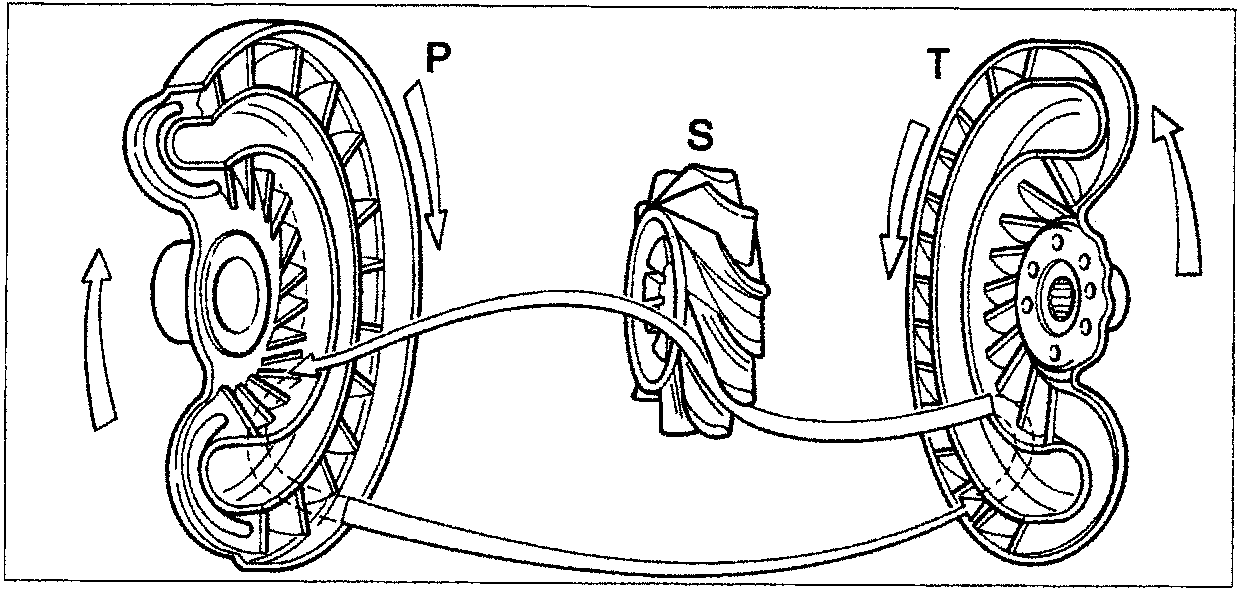
NOTE The torque converter does not sustain any kind of wear as there is no mechanical connection between the driven part and the driving part.
The impeller P is connected to the crankshaft and, rotating in a clockwise direction, acts as a pump, transmitting its energy to the oil.
The centrifugal force pushes the oil towards the periphery of the impeller, where it flows at high speed towards the turbine T. Here the oil's kinetic energy impresses a clockwise rotary movement to the turbine. The oil then passes through the stator S, where it is diverted in accordance with an angle which permits it return to the pump with high efficiency. The stator is connected to the gearbox casing by means of a free wheel engagement system, which prevents its rotation in an anti-clockwise direction and provides a reaction torque, proportional to the oil flow diversion, which is added to that of the turbine.
The ratio between the torque acting on the turbine and that provided by the pump is known as the torque multiplication ratio and is proportional to the difference in speed of rotation between the pump and turbine.
With the wheels stopped, the torque is around double that delivered by the engine.
As the turbine speed increases, the torque multiplication decreases continuously and tends to reach the ratio of 1:1, corresponding to a turbine speed of 85-90% of the pump speed. When the turbine and pump speeds are almost the same, the stator is enveloped by an oil flow directed at an angle which makes it change its direction of rotation and, as it is not blocked by the free wheel, it rotates in a clockwise direction without impediment and the torque converter behaves like a simple hydraulic joint.
LOCK-UP CLUTCH
In first, second and reverse gears, the driving torque is transmitted by the torque converter.
In third and fourth gears, the torque is transmitted first hydraulically by the converter, and secondly mechanically via the lock-up clutch. The lock-up clutch, by connecting the pump to the converter's turbine when the speed increases, eliminates the internal slipping of the converter and provides a mechanical coupling between the engine and the gearbox main shaft.
The locking of the torque converter allows the performance of the transmission to be improved at high speeds, leading to a reduction in fuel consumption on long motorway journeys.
The lock-up clutch is switched on by the control module via the lock-up solenoid SL, at the higher gears (3rd and 4th gears), when it is no longer necessary to multiply the driving torque supplied by the torque converter.
The solenoid SL opens, discharging the oil pressure from the chamber A, while the pressure in the converter continues to act on the face B: the clutch, fitted on the turbine hub, is then pushed against the casing connected to the converter's pump, thus locking the converter.
Parts & tools for this job For 1995 Fiat Bravo
- PARTClutch kitSearch: Fiat Bravo 1995 clutch kit
- TOOLClutch alignment toolSearch: clutch alignment tool
- FLUIDGear oilSearch: Fiat Bravo manual gearbox oil
Links open Amazon search results in a new tab. As an Amazon Associate I earn from qualifying purchases.