
Alignment: Specifications (page 2 of 4)
- Make
- Jeep
- Model
- Commander 2WD
- Engine
- V6-3.7L VIN K
- Year
- 2006
- Section
- Alignment
Alignment: Description and Operation
WHEEL ALIGNMENT
DESCRIPTION
CAUTION: STEERING COLUMN MODULE IS CENTERED TO THE VEHICLES STEERING SYSTEM. FAILURE TO KEEP THE SYSTEM
AND STEERING COLUMN MODULE CENTERED AND LOCKED/INHIBITED FROM ROTATING CAN RESULT IN STEERING COLUMN
MODULE DAMAGE.
NOTE: Suspension components with rubber/urethane bushings should be tightened with the vehicle at normal ride height. It is important to have the
springs supporting the weight of the vehicle when the fasteners are torqued. If springs are not at their normal ride position, vehicle ride comfort could
be affected and premature bushing wear may occur.
Wheel alignment involves the correct positioning of the wheels in relation to the vehicle. The positioning is accomplished through suspension and
steering linkage adjustments. An alignment is considered essential for efficient steering, good directional stability and to minimize tire wear. The most
important measurements of an alignment are caster, camber and toe.
CAUTION: Never attempt to modify suspension or steering components by heating or bending.
OPERATION
-
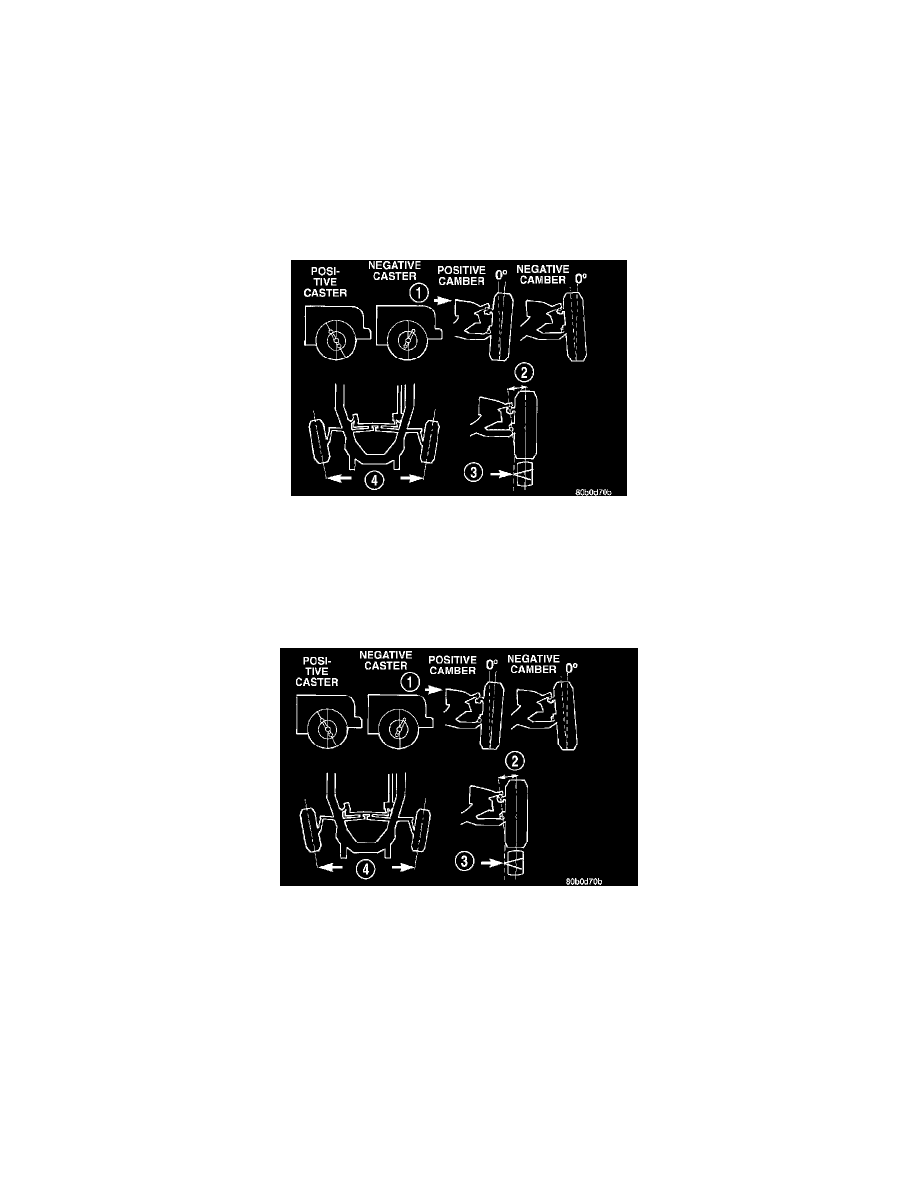
CASTER (1) is the forward or rearward tilt of the steering knuckle from vertical. Tilting the top of the knuckle forward provides less positive
caster. Tilting the top of the knuckle rearward provides more positive caster. Positive caster promotes directional stability. This angle enables the
front wheels to return to a straight ahead position after turns.
-
CAMBER (2) is the inward or outward tilt of the wheel relative to the center of the vehicle. Tilting the top of the wheel inward provides negative
camber. Tilting the top of the wheel outward provides positive camber. Incorrect camber will cause wear on the inside or outside edge of the tire.
-
TOE (4) is the difference between the leading inside edges and trailing inside edges of the front tires. Wheel toe position out of specification
cause's unstable steering, uneven tire wear and steering wheel off- center. The wheel toe position is the final front wheel alignment adjustment.
-
THRUST ANGLE (3) is the angle of the rear axle relative to the centerline of the vehicle. Incorrect thrust angle can cause off-center steering and
excessive tire wear. This angle is not adjustable, damaged component(s) must be replaced to correct the thrust angle.
Pinch or Ctrl + scroll to zoom. Double-tap to reset.
Parts & tools for this job For 2006 Jeep Commander 3.7L
- TOOLTie rod end toolSearch: tie rod end puller
- TOOLBall joint separatorSearch: ball joint separator
- FLUIDPower steering fluidSearch: Jeep power steering fluid
Links open Amazon search results in a new tab. As an Amazon Associate I earn from qualifying purchases.