
EGR modulator valve (Emission control)
- Make
- Land Rover
- Model
- Freelander Workshop Manual
- Year
- 1998–2000
- Section
- Description and operation › EGR modulator valve
EGR modulator valve
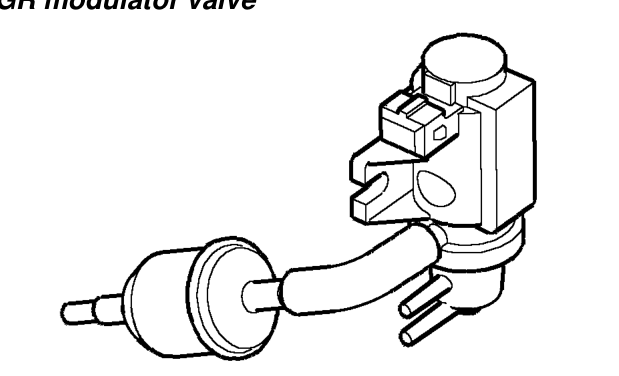
The EGR modulator valve is vacuum operated through a solenoid valve, mounted on the bulkhead. When the Engine Control Module (ECM) determines that exhaust gas recirculation should take place, the solenoid valve is modulated and vacuum, supplied by the brake servo vacuum pump, opens the EGR valve. Exhaust gases are then fed through the EGR cooler into the inlet manifold. When EGR is not required the ECM switches the control solenoid to close the EGR valve.
The EGR solenoid valve operates at a frequency of 300 Hz. The signal pressure to the EGR valve from the EGR modulator valve is controlled between the vacuum supplied from the vacuum pump and atmospheric pressure supplied via an air cleaner attached to the EGR modulator valve.
If the EGR modulator valve fails in the stuck open position, a decrease in engine performance, and an increase in visible smoke emissions will be noticed. The effects of a stuck closed modulator valve may not be noticed by the driver.
A MAF sensor is mounted in the air cleaner outlet pipe to sense the volume of air entering the engine. An increase in EGR will cause a corresponding decrease in clean intake air flow, the MAF sensor detects this difference so that the ECM can monitor and control the volume of exhaust gases being recirculated.
Catalytic Converter (CAT) ’L’ Series
Hydrocarbon and Carbon Monoxide emissions are reduced through the use of a catalytic converter in the exhaust system where pollutants are burned using the oxygen contained in the exhaust gas.
The CAT is mounted between the downpipe and the intermediate pipe. A flange is welded to each end with three captive bolts in each flange. The CAT is connected to the mating flanges of the downpipe and intermediate pipe and secured with three nuts on each flange. A metal gasket seals each flanged joint.
The CAT is fabricated from stainless steel and welded fully at all it’s joints. The catalyst element comprises a ceramic matrix formed into a honeycomb of small squares. The matrix is coated with a special surface treatment called ’washcoat’. The washcoat increases the surface area of the catalyst element by approximately 7000 times. A coating is applied to the washcoat which contains the precious metal Platinum.
The metallic coating of platinum oxidizes the carbon monoxide and hydrocarbons and converts them into water (H2O) and carbon dioxide (CO2).
Parts & tools for this job For 1998 Land Rover Freelander
- PARTExhaust gasketSearch: Land Rover Freelander 1998 exhaust gasket
- TOOLPenetrating oilSearch: penetrating oil
- TOOLOBD2 scannerSearch: OBD2 scanner
Links open Amazon search results in a new tab. As an Amazon Associate I earn from qualifying purchases.